Vanadium Redox Flow Batteries: Long-Duration Solar Energy Storage
Learn how vanadium redox flow batteries store 8 to 24 hours of solar power without degradation, fire hazards, or battery replacement cliffs.
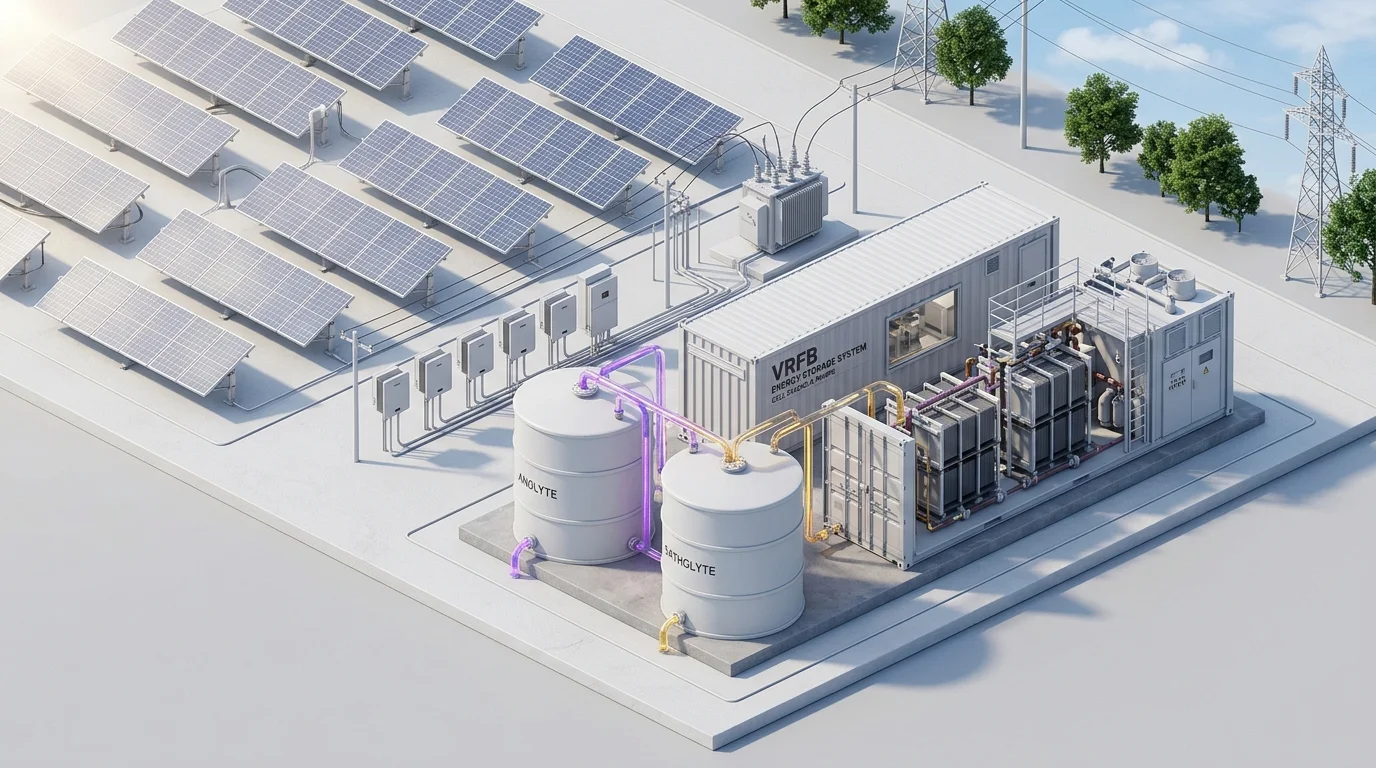
Solar panels make abundant electricity during the middle of the day. The true test of a modern power grid is saving that clean energy so factories, schools, and hospitals can run through the night and during cloudy weather.
Most people think of lithium-ion batteries when they picture solar storage. Lithium-ion batteries work well for phones, electric cars, and short backup needs of two to four hours. However, when solar farms and commercial buildings need eight, twelve, or twenty-four hours of continuous power, lithium batteries run into serious barriers. They degrade over time, lose storage capacity with every cycle, and carry fire risks that require complex cooling equipment.
Enter the vanadium redox flow battery (VRFB). Unlike standard solid batteries, flow batteries store energy in liquid tanks. They do not degrade after thousands of cycles, cannot catch fire, and can easily run for twenty-five to thirty years on the original hardware. For long-duration solar energy storage, vanadium flow batteries are changing how businesses and utilities power their operations.
How a Vanadium Redox Flow Battery Works
Standard batteries pack their energy-storing chemicals inside solid metal electrodes. In contrast, a vanadium flow battery keeps its energy in liquid solutions known as electrolytes.
The system consists of three main parts:
- Two Large Storage Tanks: One tank holds the negative electrolyte (anolyte), and the other tank holds the positive electrolyte (catholyte).
- Circulation Pumps: Electric pumps continuously push the liquid solutions through pipes into a central power unit.
- The Cell Stack: The central reaction chamber where electricity is exchanged. Inside the stack, a thin proton exchange membrane separates the two liquids while allowing positive hydrogen protons to pass through.
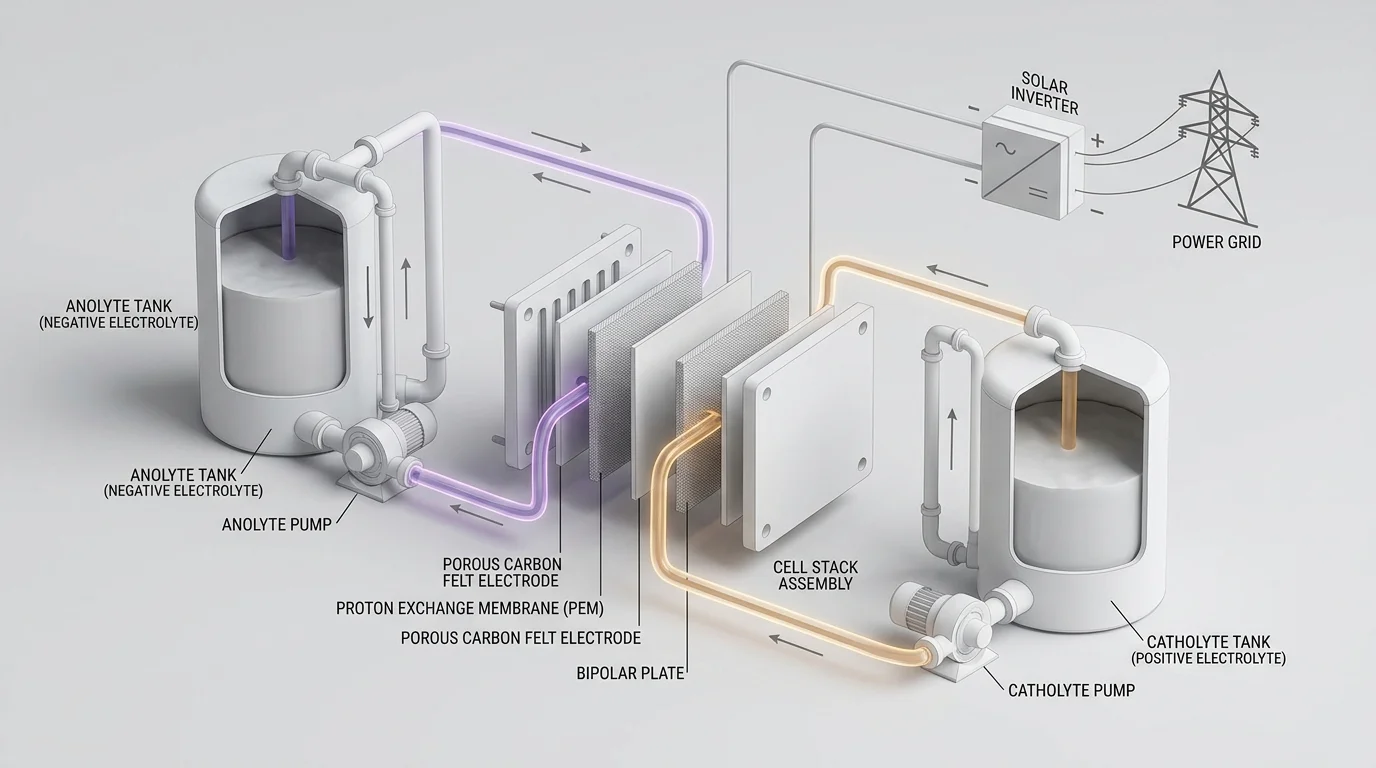
When solar panels produce extra power during sunny afternoons, that electricity flows into the cell stack. The electrical current charges the vanadium ions in the liquid. The charged liquid then pumps back into the storage tanks, ready to sit safely for hours, days, or even weeks.
When sunset arrives and power is needed, the pumps reverse the process. The liquids circulate through the stack again, releasing their stored electrons as clean electricity back to the electrical panel and power grid.
The Secret Magic of Vanadium Chemistry
Why do scientists and engineers use vanadium instead of other elements like iron, zinc, or lead?
In earlier flow battery designs from the twentieth century, batteries used two different chemical elements, such as iron in one tank and chromium in the other. Over time, chemical ions would slowly seep across the central membrane. This crossover contaminated both tanks, gradually ruining the battery until it stopped holding a charge.
Vanadium solves this challenge completely. Vanadium has a unique superpower: it can exist in four different stable electrical charge states (V²⁺, V³⁺, V⁴⁺, and V⁵⁺).
- The negative electrolyte tank cycles between V²⁺ and V³⁺.
- The positive electrolyte tank cycles between V⁴⁺ and V⁵⁺.
Because the exact same metal element is on both sides of the central membrane, ion crossover causes zero permanent damage. If a vanadium ion drifts across the membrane into the other side, simple maintenance or electrical balancing restores the battery to one hundred percent capacity. The electrolyte fluid never wears out, and it can be reused indefinitely.
The Power and Energy Advantage: Decoupled Sizing
One of the greatest engineering advantages of flow batteries is that power and energy are completely independent:
- Power (measured in kilowatts or megawatts): Determined by the surface area of the central cell stack. This dictates how much electricity the battery can deliver in a single instant.
- Energy Capacity (measured in kilowatt-hours or megawatt-hours): Determined purely by the size of the liquid storage tanks. This dictates how many hours the battery can keep running.
With a standard lithium-ion battery, if you want twice as many hours of backup storage, you must buy twice as many expensive battery packs. With a vanadium flow battery, doubling your storage duration simply means ordering larger plastic tanks and filling them with more water-based electrolyte solution. This makes vanadium systems increasingly cost-effective for multi-hour solar shifts.
Vanadium Flow vs. Lithium-Ion vs. Sodium-Ion
To see how vanadium flow systems compare with other leading solar storage chemistries, review this direct breakdown:
Vanadium Flow (VRFB)
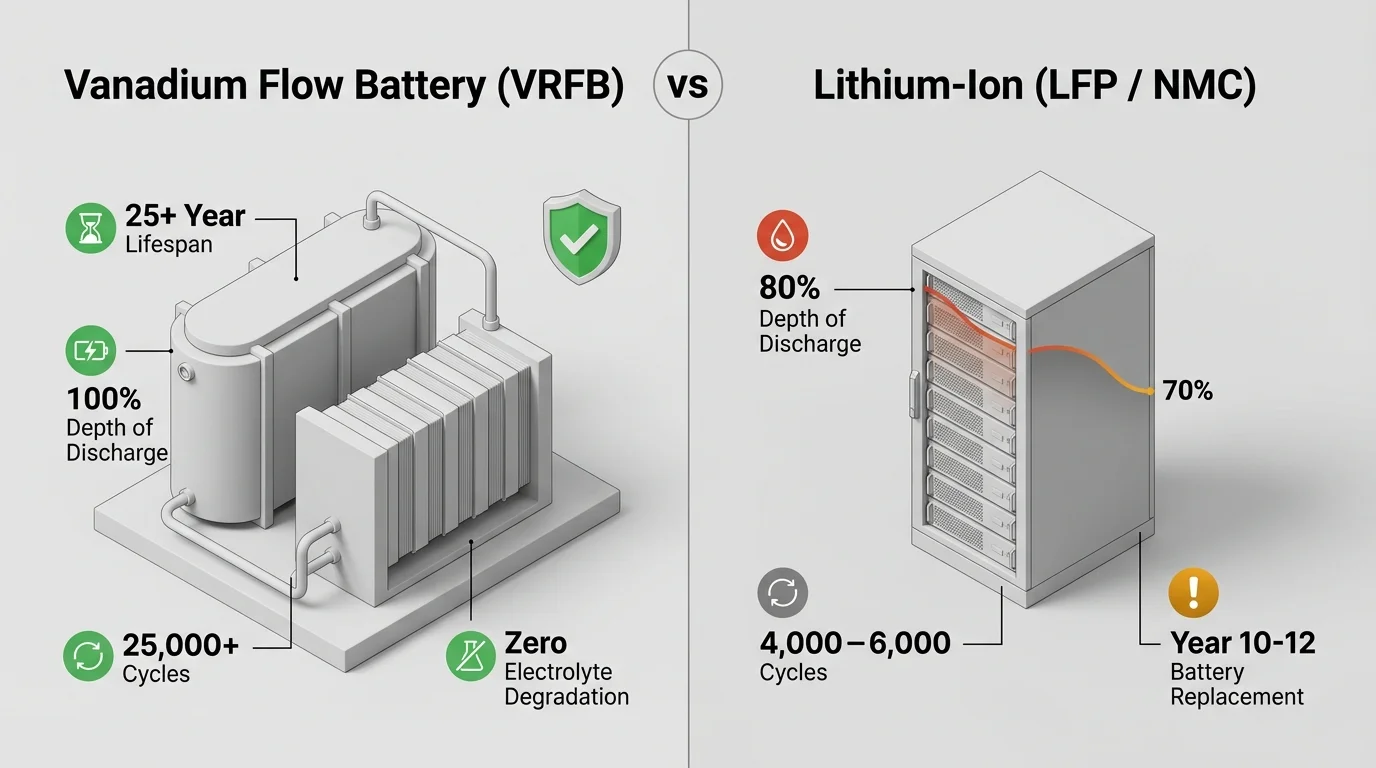
- Zero chemical degradation over 20,000+ full charging cycles
- Non-flammable water-based electrolyte eliminates thermal runaway risks
- 100% usable depth of discharge with no capacity fade penalties
- Electrolyte retains 30% to 50% residual salvage value after decades
Lithium-Ion (LFP)
- High energy density ideal for rooftop systems and electric vehicles
- Suffers 2% to 3% annual capacity loss requiring replacement at year 12
- Usually restricted to 80% to 90% depth of discharge to prolong life
- Requires active fire suppression and HVAC thermal management
Sodium-Ion
- Uses earth-abundant table salt components free of cobalt or nickel
- Better cold-weather discharge rates than standard lithium chemistries
- Degrades through solid-state crystal expansion over repeated cycles
- Best suited for 2 to 4 hour commercial backup rather than all-night shifting
The Four Stages of Daily Solar Flow Storage
A vanadium flow battery integrates into a commercial solar facility through four distinct daily operational phases:
Morning Solar Ramp
As morning sunlight strikes the solar array, the on-site facility runs directly on clean solar watts. Small excess generation begins charging the liquid tanks at low pump speeds.
Midday Peak Absorption
Solar panels reach peak generation around noon. The cell stacks accept high charging currents, converting solar kilowatt-hours into chemical energy stored safely in the fluid tanks.
Evening Peak Discharge
Electricity rates spike as people return home and commercial grid demand peaks. The flow battery discharges stored daytime solar power, avoiding costly utility demand charges.
Overnight Baseload Support
Through midnight and early dawn, the large electrolyte tanks continue supplying steady electricity to refrigeration, servers, and security systems until the morning sun rises again.
Total Cost of Ownership: Why the 25-Year Math Favors Vanadium
When evaluating battery storage options, looking only at the initial price tag can be misleading.
At commercial scale, lithium-ion battery systems carry an upfront equipment cost of approximately $900 per kilowatt-hour installed. In comparison, a vanadium flow system often costs around $1,100 per kilowatt-hour installed. That initial $200 per kilowatt-hour gap often leads buyers to pick lithium without examining long-term lifecycle numbers.
However, the economics flip decisively over time:
- One Hundred Percent Usable Capacity: Lithium batteries are generally kept between ten and ninety percent charge to prevent fast degradation, giving you about eighty percent usable energy. Vanadium flow batteries offer one hundred percent usable depth of discharge. Every drop of electrolyte provides working power without shortening battery life.
- The Year Twelve Replacement Cliff: Lithium battery cells degrade by about two to three percent each year. By year twelve, lithium capacity falls below eighty percent, requiring a major capital expenditure of $450 to $500 per kilowatt-hour for pack replacement. Vanadium systems experience virtually zero capacity loss and continue operating on their original equipment.
- End-of-Life Residual Value: When a lithium battery reaches the end of its useful life, recycling it is complex and often carries disposal fees. In a vanadium system, the vanadium metal inside the liquid does not wear out. At the end of thirty years, owners can sell the purified vanadium back to metal suppliers or rent it to another facility, recovering thirty to fifty percent of their original investment.
Over a twenty-five-year commercial solar lifecycle, a vanadium flow installation typically delivers a significantly lower levelized cost of storage (LCOS), saving facility owners hundreds of thousands of dollars compared to two generations of lithium packs.
Real-World Solar and Vanadium Installations
Utility companies and heavy industrial plants are already deploying vanadium flow batteries at massive scales:
- Dalian Rongke Power Station (China): The largest operational redox flow facility in the world. This installation delivers 100 megawatts of power and 400 megawatt-hours of energy storage, stabilizing the regional power grid and absorbing massive amounts of wind and solar energy across Liaoning Province.
- Oxford Energy Superhub (United Kingdom): An advanced hybrid storage facility pairing a five-megawatt vanadium flow battery from Invinity Energy Systems with a fifty-megawatt lithium battery. The vanadium battery handles heavy daily solar cycling, protecting the lithium battery from rapid wear.
- NTPC Renewable Energy Storage Project (India): A landmark 100 megawatt-hour utility contract awarded to Delectrik Systems to provide long-duration grid stabilization alongside large-scale solar arrays in Rajasthan and Gujarat.
- Microgrid Mines in Western Australia: Remote gold and iron ore mining operations rely on multi-megawatt vanadium flow batteries paired with desert solar arrays, replacing millions of liters of diesel fuel each year with zero fire risk in harsh desert temperatures.
Practical Considerations and Sizing Limits
While vanadium redox flow batteries excel in commercial and utility settings, they are not suitable for every application:
- Physical Footprint: Because flow batteries use liquid tanks and pumps, they have lower energy density by volume than lithium packs. They require dedicated outdoor pads, utility basements, or shipping container enclosures, making them impractical for compact residential garage walls.
- Round-Trip Efficiency: Lithium batteries achieve a round-trip electrical efficiency of ninety to ninety-two percent. Vanadium flow batteries generally operate between seventy-five and eighty-two percent efficiency due to small parasitic power losses from circulating pumps. However, the larger usable capacity and lack of degradation more than compensate for this difference in multi-hour storage roles.
- Temperature Stability: The aqueous sulfuric acid electrolyte operates safely between ten and forty degrees Celsius. In freezing climates, system enclosures include simple thermal insulation to keep the liquid flowing smoothly without external heating fuel.
Frequently Asked Questions
Solid batteries degrade because their metal electrodes physically expand, shrink, and crack as ions wedge into them during each charging cycle. In a vanadium flow battery, chemical reactions take place entirely inside a liquid solution. Because there are no solid crystal structures to crack, the liquid can be charged and discharged over twenty thousand times without losing capacity.
No. The electrolyte solution is water-based and naturally flame retardant. Unlike lithium batteries, vanadium systems cannot experience thermal runaway, cannot explode, and do not produce dangerous flammable gases during overcharging. This makes them exceptionally safe for hospitals, airports, and industrial complexes.
Yes. Vanadium flow batteries can be discharged down to zero percent state of charge without causing any damage to the central cell stack or electrolyte fluid. This gives system owners access to one hundred percent of their rated storage capacity on every single cycle.
Vanadium does not degrade or break down over time. At the end of a project, the liquid can simply be pumped into tanker trucks and filtered for reuse in a brand new battery system, or sold back to the metals market. This gives the system significant residual asset value compared to discarded solid battery packs.