Solar Rapid Shutdown Guide: NEC Safety Rules and How It Works
Learn how solar rapid shutdown works, NEC 690.12 electrical safety codes, array boundary voltage limits, and how MLPE protects first responders.
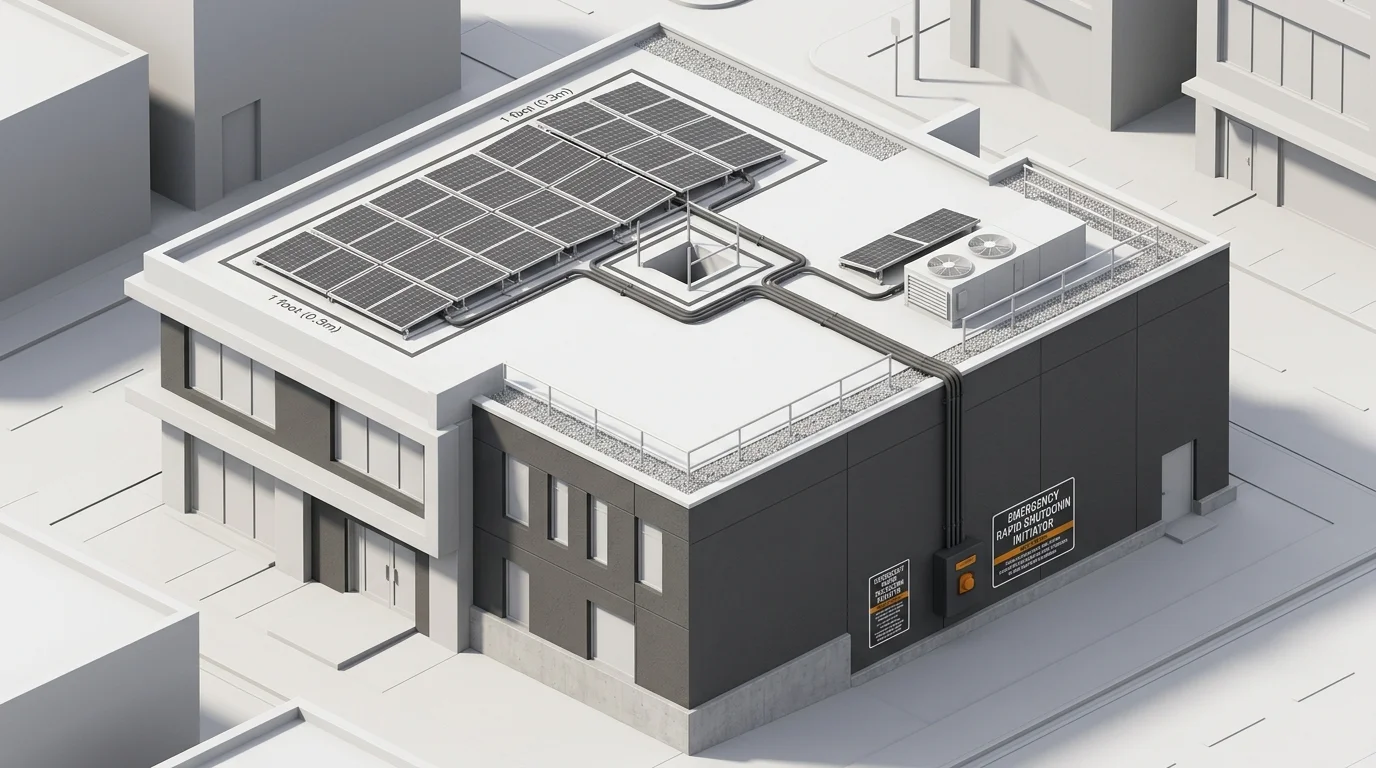
Solar panels make direct current (DC) electricity when sunlight hits them. Even when you turn off your main home breaker, rooftop panels and wires stay live with high voltage. During an emergency, this high voltage creates shock hazards for firefighters on the roof.
To solve this danger, building codes require a safety system called solar rapid shutdown. Regulated under rapid shutdown NEC 690.12 rules, this system drops roof voltage fast. Within seconds of flipping a safety switch, high roof voltage drops to safe levels. Firefighters can then cut roof holes or spray water safely.
Why Rapid Shutdown Exists: Firefighter Safety
When a house catches fire, firefighters often cut holes in the roof. This lets hot smoke and toxic gas escape. On standard string inverter systems without rapid shutdown, panels connect in long series loops. These wire strings carry 300 to 600 volts in homes. Commercial roofs can reach 1,000 to 1,500 volts.
If an axe or saw cuts into live solar pipes, sparks can start fires or shock the firefighter. Water from fire hoses can also carry current back to crews.
Solar rapid shutdown fixes this danger. It cuts the solar array into small, safe pieces. When the switch trips, power stops flowing right away. This keeps rescue workers safe.
The NEC 690.12 Array Boundary Rules
The National Electrical Code sets clear boundaries around rooftop solar arrays. These rules state how fast voltage must drop. They also set safe limits inside and outside the solar boundary zone.
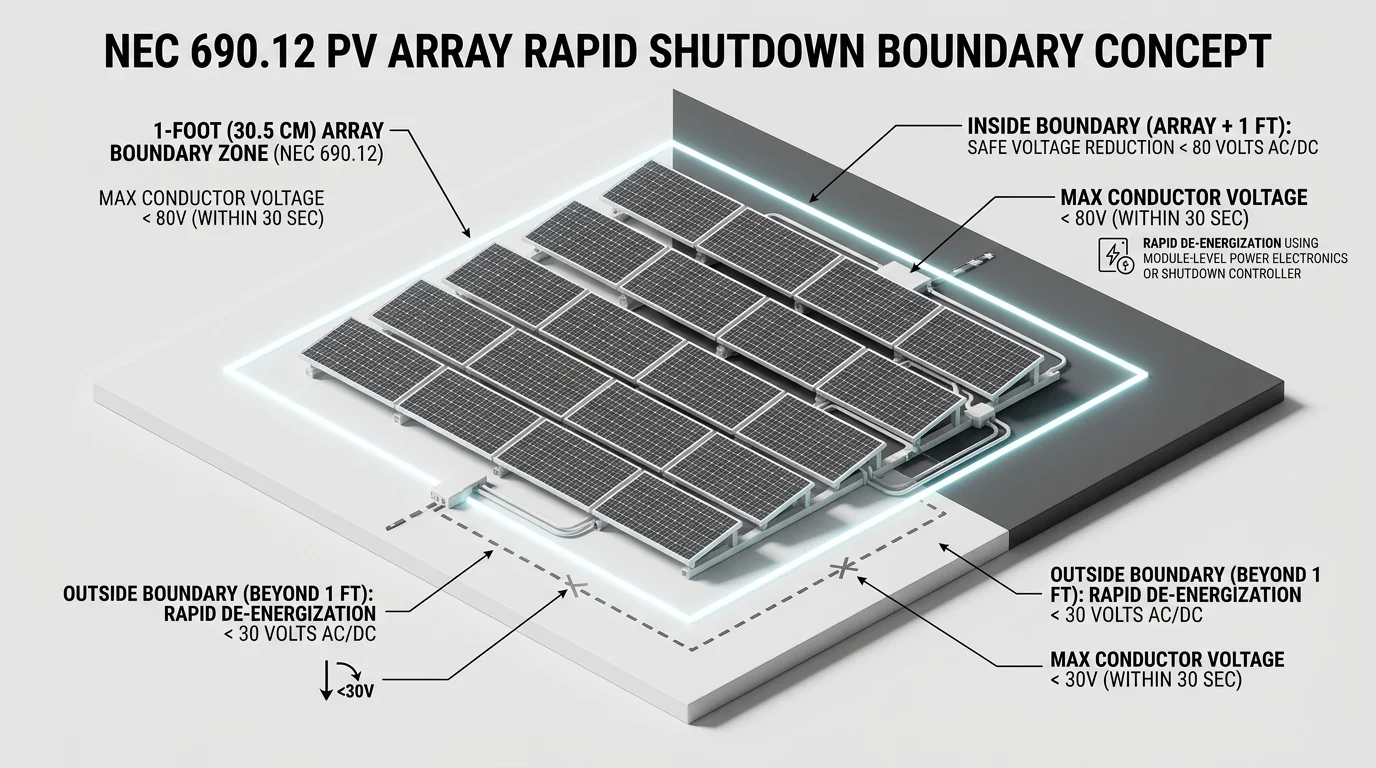
Electrical codes divide the roof into two main zones:
1. Inside the Array Boundary
The array boundary is the area within 1 foot (305 mm) around the solar panels. It also extends 1 foot above the panels. Within 30 seconds of switch trigger, voltage inside this zone must drop to 80 volts or less. Cutting voltage at each panel keeps rooftop wires safe to touch.
2. Outside the Array Boundary
Any solar wire leaving the 1-foot border must drop to 30 volts or less within 30 seconds. This rule covers conduits on the roof, down walls, or in the attic. Systems must also limit total power to under 240 volt-amperes to stop shock and sparks.
Initiation Trigger
A firefighter flips the rapid shutdown initiator (RSI) switch at ground level, or the main power grid fails.
Signal Cutoff
The transmitter stops sending its continuous keep-alive signal through the power lines or wireless link.
Module Disconnect
Small switches at each solar panel open fast to cut module power.
Safe De-Energization
Within 30 seconds, roof wires drop below 80 volts inside the zone and below 30 volts outside, removing shock risks.
How Solar Rapid Shutdown Works
A complete rapid shutdown system uses three main parts: a switch, a signal link, and module-level shutdown hardware.
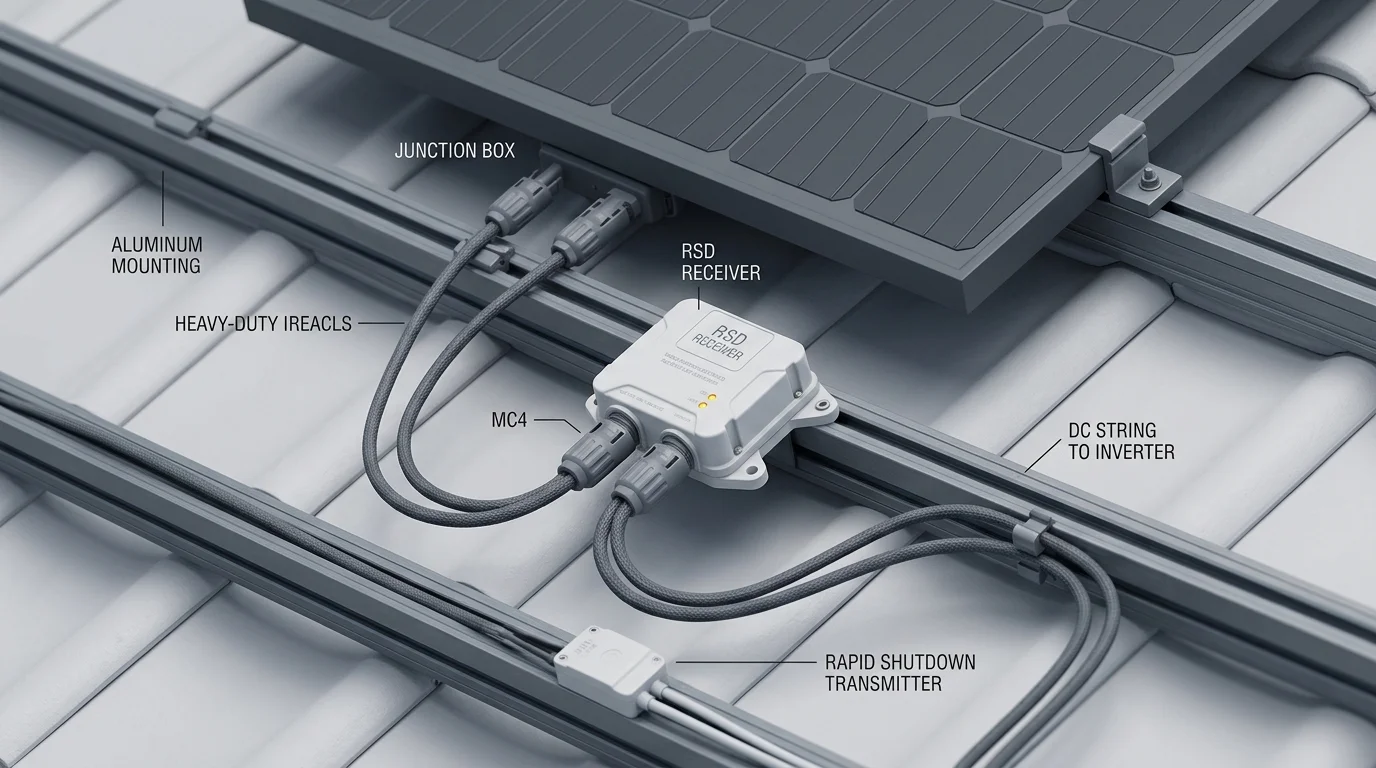
1. The Rapid Shutdown Initiator (RSI)
The initiator is the switch that triggers the safety system. Electrical codes require clear labels on this switch. Crews must be able to reach it easily outside near the main meter panel. The initiator can be:
- The main service disconnect switch for the building.
- A bright red or yellow emergency stop button.
- An integrated solar AC disconnect switch.
When someone flips the switch off, it cuts power to the shutdown transmitter.
2. The Keep-Alive Signal
Most systems use a fail-safe signal called a keep-alive pulse. The main transmitter sends a steady digital pulse through the DC wires using SunSpec power line rules.
Receivers on the roof listen for this pulse. As long as they hear it, they let power flow. If power cuts out, the signal stops instantly. Without the signal, roof units switch off right away. This design guarantees that if wires melt or break, the system shuts down on its own.
3. Module-Level Power Electronics (MLPE)
On the back of each panel, small devices control voltage. Installers use three main hardware choices to meet code:
Comparing Rapid Shutdown Technologies
Solar equipment handles rapid shutdown in different ways. Here is how common options compare:
Microinverters
Microinverters change DC power to AC power right at each panel. Because no high-voltage DC runs across the roof, microinverters meet safety rules easily. When grid power stops, microinverters shut down at once.
DC Power Optimizers
Optimizers attach to each panel and feed a central inverter. When rapid shutdown trips, each optimizer drops to 1 volt. A string of 20 panels drops from 800 volts to a harmless 20 volts.
Dedicated RSD Boxes
Small rapid shutdown boxes clip to each panel frame. They work with standard string inverters. They add safety shutoff without changing inverter setup, making them great for older systems.
Commercial Systems: UL 3741 PV Hazard Control
On large flat commercial roofs, adding boxes to thousands of panels costs extra money and adds points of failure. Safety rules allow another option called a Photovoltaic Hazard Control System under standard UL 3741.
A UL 3741 system protects firefighters through smart building design rather than rooftop electronics. Installers use tested sets of:
- Certified commercial string inverters with rapid shutdown controls.
- Guarded, non-metal wire trays that protect cables.
- Special racking that insulates wires from the roof frame.
Engineers test UL 3741 setups to prove that shock current cannot pass through a person. This option cuts installation costs on large warehouses while keeping firefighters safe.
Required Placards and Warning Labels
Electrical inspectors check warning signs under NEC 690.56(C). A solar system will fail inspection if warning plaques are missing or wrong.
Installers must place a weather-proof label at the main service panel and near the shutoff switch. The plaque must show:
- Color Coding: A bright yellow tag with black letters, or a red tag with white letters for emergency stops.
- System Type: Clear words that state if wires drop inside and outside the array, or only outside.
- Array Diagram: A simple map that shows where panels, switches, and battery boxes sit on the property.
Equipment Costs and Budgeting
Adding rapid shutdown parts changes solar project costs:
- Microinverters: Systems with microinverters include rapid shutdown at no extra cost, because safety is built into the design.
- DC Optimizers: Optimizers cost between $70 and $120 per panel. This price covers both power tracking and safety shutdown.
- Standalone RSD Receivers: For basic string inverters, clip-on boxes cost $25 to $45 per panel, plus $100 to $300 for the signal transmitter box.
- Commercial UL 3741 Solutions: Removes module boxes, saving $15 to $35 per panel in parts and labor on large commercial jobs.
For a typical 8-kilowatt home roof system (about 20 panels), rapid shutdown adds $600 to $1,200 in equipment. This keeps your home up to code and protects emergency crews.
Frequently Asked Questions
No. Rapid shutdown rules only apply to solar panels on buildings. Ground mounts and open carports do not need rapid shutdown unless wires enter a building or local rules require it.
Yes. Grid-tied systems start rapid shutdown as soon as grid power fails. If you have a battery backup with a transfer switch, the system isolates safely while running essential home lights and appliances.
An AC disconnect switch cuts power between your inverter and the breaker box. But it leaves high DC voltage on the roof. Rapid shutdown cuts power right at each panel to make roof wires safe.
Good rapid shutdown parts are sealed against rain and dust. They last 25 years just like solar panels. If a unit ever fails, it defaults to open mode, keeping the roof safe.