AC-Coupled vs. DC-Coupled Solar Battery Systems: Efficiency, Wiring, and Retrofit Guide
Compare AC-coupled and DC-coupled solar battery storage. Learn about inverter wiring, round-trip efficiency, clipping capture, and retrofit options.
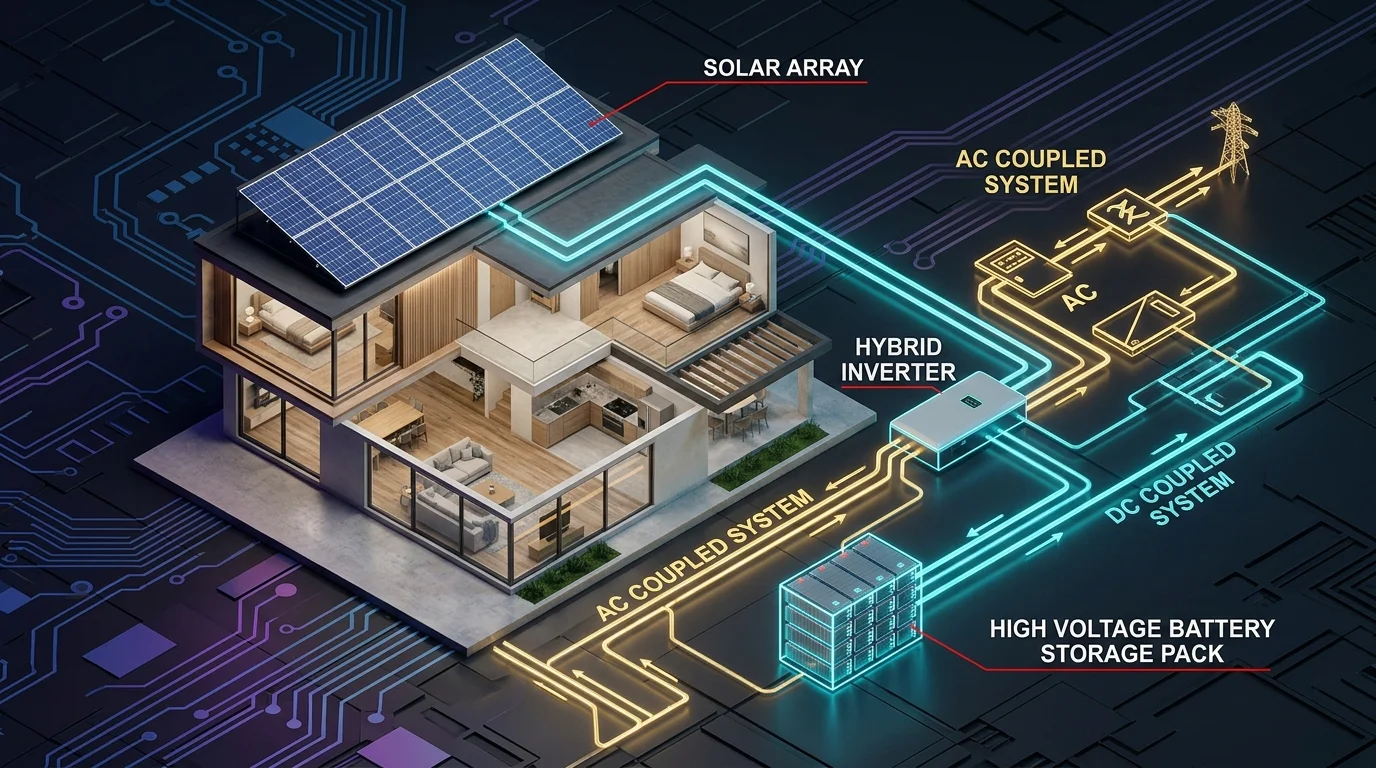
When adding a home battery storage system to your solar panels, one of the most critical engineering choices you will make is selecting between an ac coupled vs dc coupled solar architecture. Both setups store clean solar energy for use at night or during electrical grid blackouts, but they route and convert electrical currents in completely different ways.
Solar panels naturally generate direct current (DC) electricity, while home appliances run on alternating current (AC) power. Batteries can only store energy as DC power. The fundamental difference between AC coupling and DC coupling is where the battery connects in this electrical circuit and how many times the power must be converted before it enters your home.
In this guide, we break down how AC and DC coupling work, compare their round-trip efficiency and equipment costs, explain solar clipping recapture, and help you determine which system configuration fits your home.
Understanding DC-Coupled Solar Battery Systems
In a dc coupled solar battery setup, both the rooftop solar panel array and the battery storage bank connect to the same centralized hybrid inverter. The direct current produced by your solar panels flows directly into your battery without undergoing unnecessary power conversions.
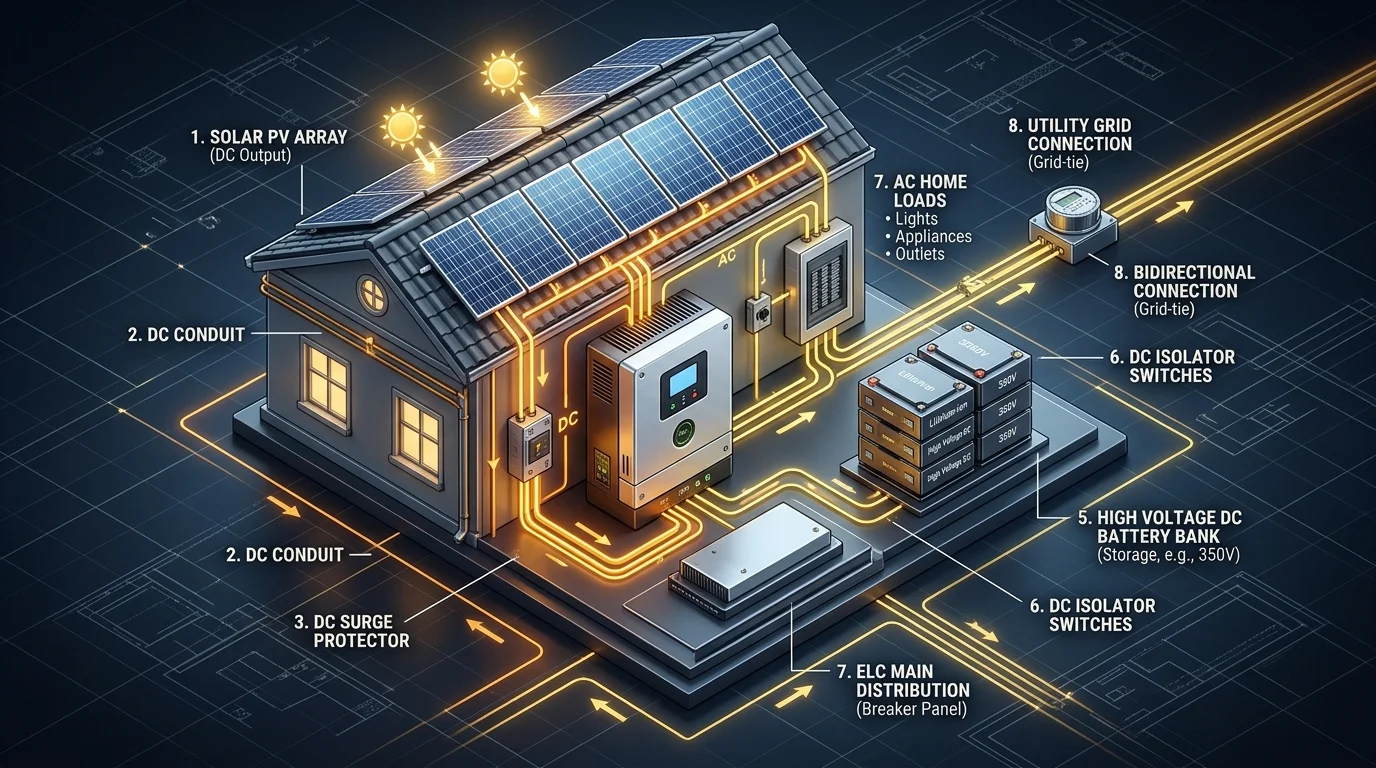
Because solar panels produce DC power and batteries store DC power, energy travels straight through a Maximum Power Point Tracking (MPPT) charge controller directly into the battery cells. Power is only converted once (from DC to AC) when you turn on home lights or appliances.
How DC Energy Flows Through the System
Rooftop DC Generation
Sunlight strikes the photovoltaic cells on your roof, producing high-voltage DC electricity that travels down through dedicated DC conduit to the hybrid inverter.
Direct DC Battery Charging
During sunny daylight hours, excess DC power charges your high-voltage lithium battery bank directly at peak efficiency without converting to AC first.
Single-Stage Inversion
When your home demands electricity, the hybrid inverter converts DC power from either the panels or the battery into standard 120V/240V AC power for household circuits.
Solar Clipping Capture
If your solar panels produce more instantaneous power than the inverter’s AC limit, the extra DC energy is diverted directly into the battery rather than being lost.
Understanding AC-Coupled Solar Battery Systems
In an AC-coupled configuration, your solar panels and your battery storage system operate through separate, dedicated inverters. The solar panels connect to a standard grid-tie string inverter or microinverters, while the battery contains its own integrated bi-directional inverter.
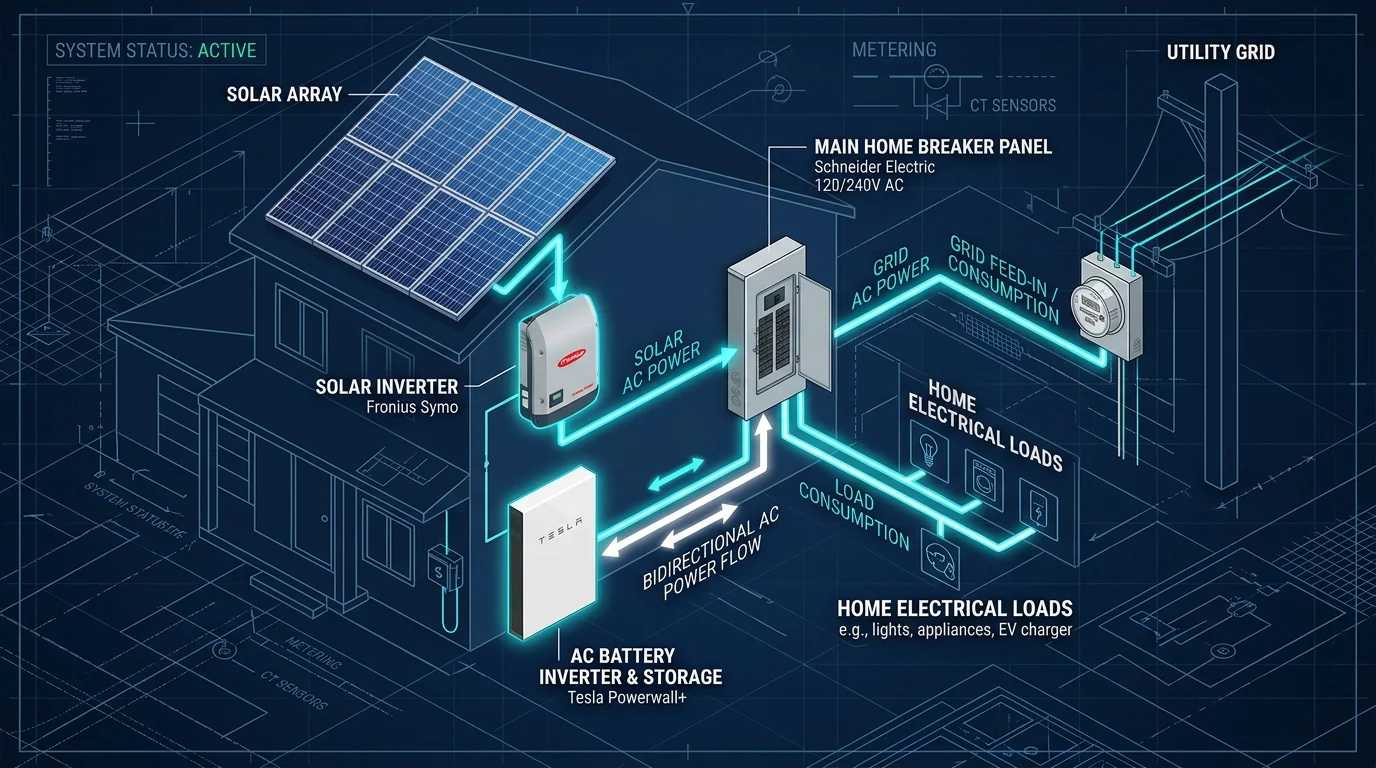
When solar panels produce DC power, the solar inverter immediately converts it into AC electricity for the main electrical panel. If your home does not consume all the power, the excess AC electricity travels into the battery inverter, where it is converted back into DC power for chemical storage. Later, when you discharge the battery, the electricity is converted a third time back into AC power.
This multi-stage conversion process introduces slight efficiency losses, but it offers unmatched flexibility for an ac coupled battery retrofit on homes that already have solar panels installed.
Head-to-Head Comparison: AC vs. DC Coupling
Choosing between AC and DC coupling involves weighing system efficiency against installation simplicity and equipment flexibility.
DC-Coupled Architecture
- Single hybrid inverter manages both solar panels and battery storage
- Higher round-trip efficiency by avoiding triple power conversions
- Recaptures clipped solar power during peak midday sun
- Lower total equipment hardware costs for brand new installations
- Ideal for new solar plus storage systems and off-grid properties
AC-Coupled Architecture
- Works seamlessly with existing string inverters and microinverters
- Zero rewiring of rooftop solar circuits required during installation
- Charges from any AC source, including the utility grid and backup generators
- Modular expansion allows adding multiple independent battery units
- Standard architecture for popular batteries like Enphase IQ and Tesla Powerwall 2
Power Conversion Losses and Round-Trip Efficiency
The primary technical advantage of DC coupling is higher solar battery round trip efficiency. Every time electricity passes through an inverter or rectifier, approximately 2% to 4% of the energy is lost as heat.
Here is a side-by-side breakdown of the conversion pathways for both architectures:
| System Feature | DC-Coupled System | AC-Coupled System |
|---|---|---|
| Solar to Battery Flow | DC → MPPT → DC Battery (1 step) | DC → AC Inverter → AC Bus → DC Rectifier → Battery (2 steps) |
| Battery to Home Flow | DC Battery → Hybrid Inverter → AC Home (1 step) | DC Battery → Battery Inverter → AC Home (1 step) |
| Total Conversions (Solar to Battery to Home) | 1 Inversion Stage | 3 Conversion Stages |
| Average Round-Trip Efficiency | 94% to 98% | 88% to 92% |
| Solar Clipping Recapture | Supported natively | Not supported (power is clipped at solar inverter) |
| Retrofit Compatibility | Requires replacing existing solar inverter | Universal plug-and-play with any existing inverter |
| System Redundancy | Single point of failure (hybrid inverter) | Dual inverters provide backup fault isolation |
Solar Inverter Clipping and Oversizing
Modern solar arrays are often oversized relative to their inverter rating (for example, installing 8 kW of panels on a 6 kW inverter). This design choice ensures that the system reaches maximum power output earlier in the morning and sustains it later in the afternoon.
During peak midday hours, solar production can exceed the inverter’s maximum AC output rating. In an AC-coupled system, this excess power is clipped and discarded because the solar inverter cannot convert more wattage than its rated AC capacity.
In a DC-coupled system with a hybrid solar inverter vs battery inverter, excess DC electricity is routed directly into the battery bank before reaching the inverter stage. This enables homeowners to harvest 100% of their rooftop solar generation without leaving usable energy on the table.
Black Start and Off-Grid Grid Islanding
During severe weather events and extended utility power outages, your energy storage system must disconnect from the public grid to protect utility workers. This process is called grid islanding.
If a battery becomes completely drained during an extended multi-day blackout, DC-coupled systems have a built-in advantage known as cold black start capability:
- DC-Coupled Black Start: When the sun rises the next morning, the solar panels generate DC power and immediately trickle charge the battery through the DC charge controller, waking the system up automatically.
- AC-Coupled Black Start: Because standard grid-tie solar inverters require a stable AC frequency signal to turn on, an AC-coupled system with a dead battery may require manual restart or a small backup generator to jumpstart the inverter circuit.
Which Coupling Architecture Should You Choose?
Choose a DC-Coupled System If:
- You are building a brand-new solar installation: Installing a hybrid inverter and high-voltage DC battery simultaneously minimizes hardware costs and maximizes daily efficiency.
- You want the highest possible efficiency: Maximizing every kilowatt-hour of self-generated electricity delivers a faster financial payback.
- You are planning an off-grid cabin or rural homestead: Native DC charging provides more reliable automatic startup during cloudy winter weather.
Choose an AC-Coupled System If:
- You already have working solar panels on your roof: An AC-coupled battery can be wired into your electrical subpanel in a single afternoon without touching your roof or replacing your solar inverter.
- Your system uses microinverters: If your roof uses Enphase or APsystems microinverters under each panel, AC-coupled battery storage is the natural pairing.
- You want to charge heavily from off-peak grid power: AC batteries excel at fast time-of-use grid charging during cheap overnight utility hours.
Frequently Asked Questions
Yes, but doing so requires replacing your current string inverter with a multi-mode hybrid inverter and rewiring the rooftop DC circuits down to the new inverter. For most homeowners with existing solar, adding an AC-coupled battery is significantly more cost-effective because it avoids labor and equipment replacement costs.
Both AC-coupled and DC-coupled systems adhere to strict UL 9540 and UL 1973 safety standards. Modern DC-coupled systems use high-voltage lithium iron phosphate (LiFePO4) chemistry with built-in rapid shutdown modules and arc-fault protection, providing equal thermal safety to AC-coupled alternatives.
Microinverters attach directly to the back of each individual solar panel on your roof, converting DC electricity into AC electricity immediately at the panel level. Because power leaves the roof as AC electricity, any battery added downstream must be AC-coupled to accept that power.
The round-trip efficiency loss in an AC-coupled system occurs during the conversion process (heat loss in internal electronics), not as permanent degradation of the battery cells. Both AC and DC systems experience normal electrochemical battery aging of roughly 1.5% to 2.5% capacity loss per year over their 10 to 15 year lifespan.