Time-of-Use Rates and Solar Batteries: How to Maximize Savings
Learn how time-of-use (TOU) rates work with solar panels. Discover how battery storage arbitrage and west-facing panels cut peak utility bills.
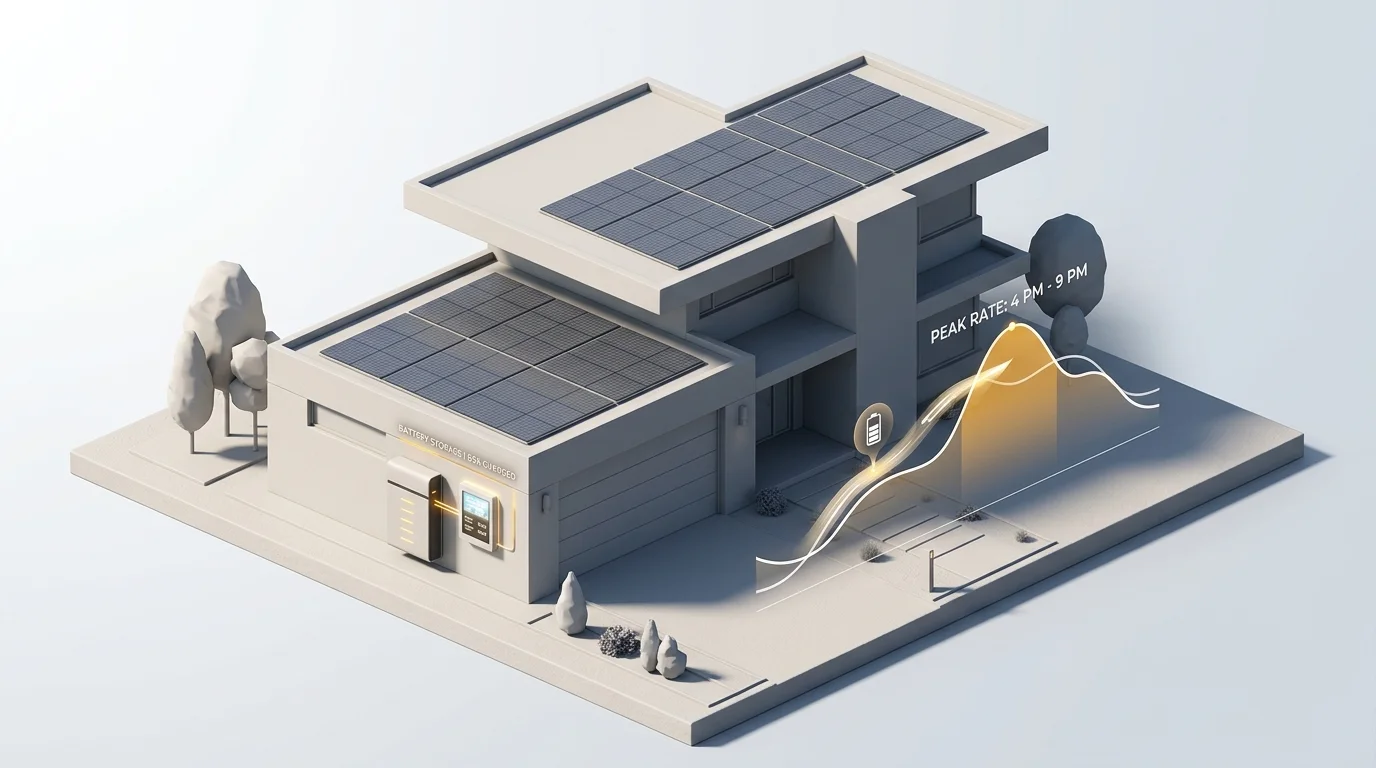
For years, home solar savings followed a simple rule: every kilowatt-hour of sunlight your panels produced canceled out a kilowatt-hour from your electric bill. You paid one flat rate for power, and your solar credits balanced your monthly bill.
Today, that old billing model is vanishing. Electric utilities across the country are moving homeowners to time-of-use electricity rates. Under these plans, the price of power changes throughout the day based on electric grid demand.
Understanding how time-of-use rates work with solar batteries is now the most important factor in lowering your electric bill. By pairing rooftop solar panels with smart battery storage, you can protect your wallet against high peak electricity prices.
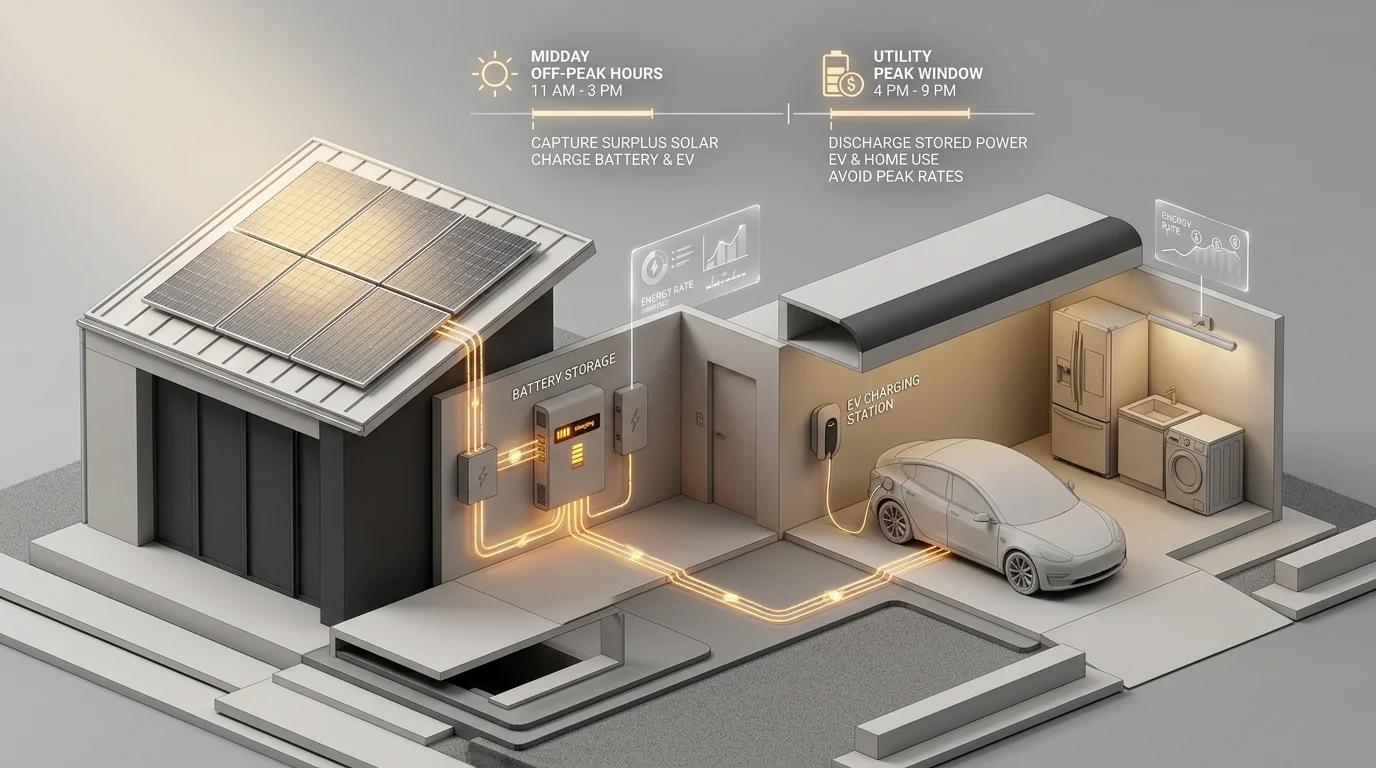
Daily Battery Arbitrage Energy Cycle
Smart home energy systems store surplus daytime solar electricity in home batteries, then discharge that power during expensive evening utility windows to avoid high peak charges.
What Are Time-of-Use (TOU) Rates?
Time-of-use rates charge different prices for electricity depending on the time of day, the day of the week, and the season. Instead of charging a single flat rate, utilities break the 24-hour day into pricing tiers:
- On-Peak Hours: The most expensive hours of the day, typically from 4:00 PM to 9:00 PM on weekdays. This is when families return home from school and work, turn on air conditioning, cook dinner, and plug in electronics.
- Partial-Peak Hours: Moderate prices during transition periods, such as early afternoon (2:00 PM to 4:00 PM) or late evening (9:00 PM to 11:00 PM).
- Off-Peak Hours: Lower rates during periods of low electrical demand, typically late at night (11:00 PM to 6:00 AM) and weekend mornings.
- Super Off-Peak Hours: The lowest rates of all, often offered from midnight to 6:00 AM for charging electric cars, or during sunny spring middays when excess solar energy floods the electric grid.
Why Peak Hours Shifted to the Evening
Years ago, utility peak demand happened around noon on hot summer days when business air conditioning ran hardest. As millions of homes and commercial buildings installed rooftop solar panels, daytime solar production surged. The grid was flooded with clean daytime electricity, turning midday into a time of cheap energy surplus.
However, once the sun sets in the late afternoon, solar output drops quickly just as household energy demand spikes. Utilities must fire up expensive fossil fuel peaker plants to keep lights on. This daily mismatch between solar production and evening energy use is known as the duck curve. Utilities responded by shifting peak price windows to the late afternoon and evening.
Why Solar Panels Alone Struggle on TOU Plans
If you install rooftop solar panels without a home battery under a time-of-use tariff, you face an economic mismatch:
- Midday Solar Export Penalty: Your solar panels generate the bulk of their electricity between 10:00 AM and 3:00 PM. Under modern net billing rules, utilities buy your excess solar power at wholesale or avoided-cost credits, often between $0.05 and $0.08 per kilowatt-hour.
- Evening Peak Purchase Penalty: When you return home at 6:00 PM, your panels produce little or no electricity. To run your refrigerator, television, lighting, and air conditioning, you must buy power from the electric grid during on-peak hours. In high-cost utility areas, evening peak electricity costs between $0.45 and $0.69 per kilowatt-hour.
Exporting clean electricity for five cents at noon and buying it back for fifty cents at dinner is a losing trade. Without energy storage, solar homeowners miss out on hundreds of dollars in potential utility savings every year.
How Battery Arbitrage Unlocks Maximum Savings
Battery time-of-use arbitrage solves this pricing mismatch. Energy arbitrage means storing low-cost electricity and using it when power costs the most.
Here is how a smart home solar battery manages energy throughout a typical day:
- Morning (6:00 AM to 10:00 AM): Solar production ramps up as the sun rises. Your panels cover your morning breakfast routine and basic household loads.
- Midday (10:00 AM to 3:00 PM): Solar panels produce far more electricity than your house consumes. Instead of exporting this valuable power to the grid for pennies, your system routes excess electricity into your home battery until it reaches 100 percent capacity.
- Late Afternoon and Evening (4:00 PM to 9:00 PM): On-peak utility rates kick in. Your solar inverter switches your home power source to the battery. Your home runs entirely on stored daytime solar energy, keeping your electric meter frozen during the most expensive hours of the day.
- Night (9:00 PM onward): When on-peak hours end and off-peak rates return, your home draws cheap power from the electric grid as your family sleeps.
Solar Only on TOU
Exports clean energy to the utility at low wholesale credit rates during midday, then buys back expensive grid power at dinner time for $0.45 to $0.60 per kWh.
Solar + Battery Arbitrage
Stores free midday sunshine on-site. Discharges during the 4 PM to 9 PM peak window to eliminate high utility prices and deliver reliable blackout protection.
Calculating Your Battery Arbitrage Value
The financial return of a solar battery depends on your utility rate spread: the difference between your peak electricity rate and your off-peak rate.
To estimate your annual arbitrage savings, multiply your usable battery storage capacity (usually 10 to 13.5 kilowatt-hours) by the price spread and 300 annual charge cycles:
- Small Price Spread (under $0.15 per kWh): Produces modest annual savings of $200 to $450. In these areas, batteries serve mainly as backup power during storms rather than strong investment tools.
- Moderate Price Spread ($0.15 to $0.25 per kWh): Generates $500 to $850 in annual utility bill reductions.
- Aggressive Price Spread ($0.30 or higher per kWh): Found across California, the Southwest, and parts of the Northeast. A single 13.5 kilowatt-hour battery can deliver $1,200 to $1,600 in bill savings every year, significantly shortening the payback period of your equipment.
West-Facing Solar Panel Orientation for Afternoon Peaks
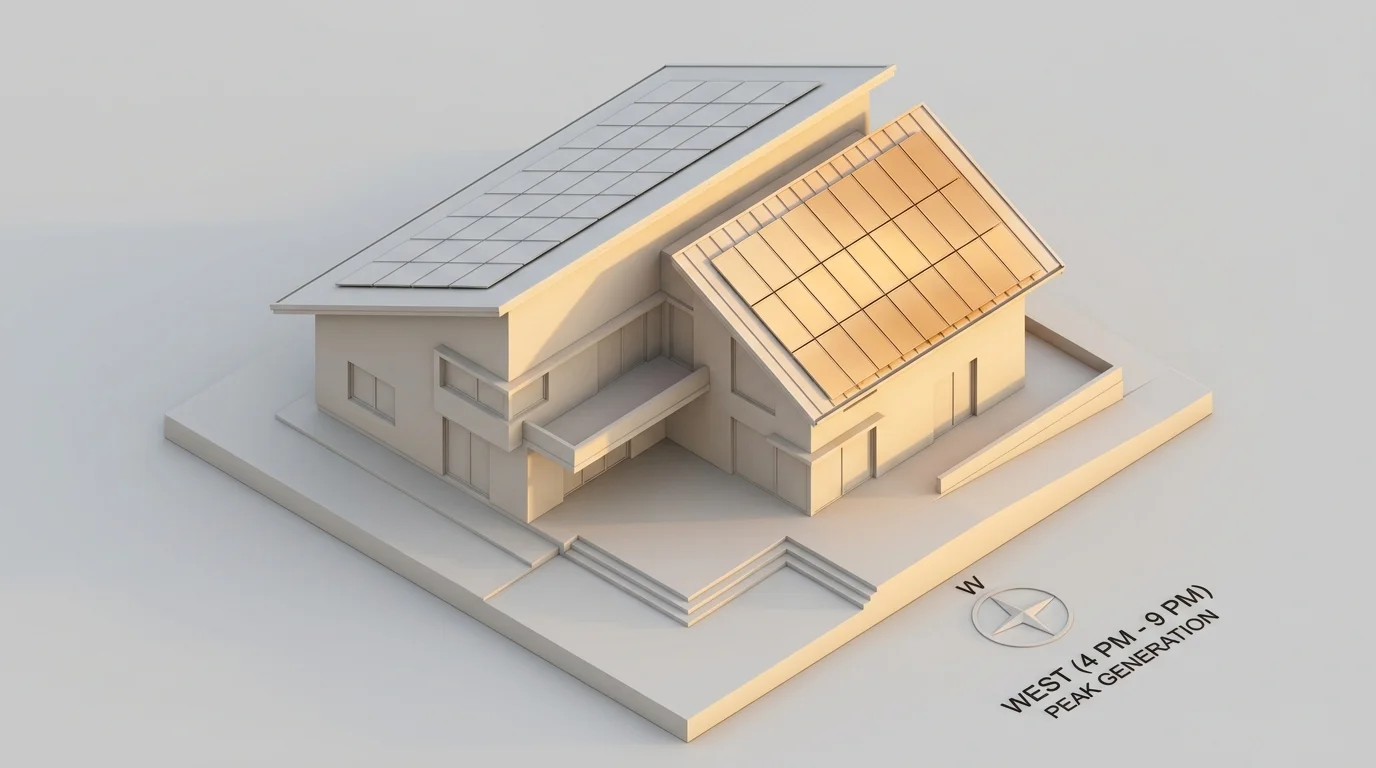
Positioning a portion of your rooftop solar array toward the west captures direct late-afternoon sunshine, supplying free clean power directly into the 4 PM to 9 PM peak billing window.
Strategic Panel Orientation: The West-Facing Advantage
For decades, solar designers followed one golden rule: always face solar panels true south. South-facing panels receive the strongest sunlight across the entire year, maximizing total annual kilowatt-hours.
However, time-of-use pricing changes the definition of good solar design. A kilowatt-hour produced at 5:30 PM under peak pricing is often worth three to four times more than a kilowatt-hour produced at 11:30 AM.
West-facing solar panels generate about 12 to 15 percent less total energy across a full year than south-facing panels. But because the sun sets in the west, west-facing panels produce their highest electrical output between 3:00 PM and 6:30 PM. This extra afternoon production directly offsets expensive on-peak utility rates.
Many modern solar installers recommend a split-orientation roof design:
- 60 Percent South-Facing Panels: Generates high total energy volume to power daytime household appliances and fully charge your home battery bank.
- 40 Percent West-Facing Panels: Extends direct solar generation into late afternoon and dinner hours, easing the load on your battery and reducing peak grid demand.
Five Smart Habits to Cut Peak Costs Without Extra Equipment
Even before buying new equipment, you can adjust daily household habits to avoid high time-of-use electricity charges:
Pre-Cool Your Living Space
Set your smart thermostat three degrees cooler between 1:00 PM and 3:30 PM while solar power is abundant. At 4:00 PM, raise the thermostat to your normal preference and let your home coast through peak hours.
Schedule EV Charging Overnight
Electric vehicles consume huge amounts of power. Use your vehicle app or home charging station to schedule charging during super off-peak midnight hours when electricity is cheapest.
Run Heavy Appliances Midday
Run dishwashers, washing machines, clothes dryers, and pool pumps between 10:00 AM and 2:00 PM when your solar panels are producing peak electricity.
Automate Water Heating Schedules
If you own a hybrid heat pump water heater, set its digital timer to run during the morning or early afternoon so your family has plenty of hot water before the evening peak arrives.
How to Review Your Utility Rate Options
Before signing a solar or battery contract, review your utility rate schedule carefully:
- Check for Mandatory Rate Shifts: Ask whether installing solar panels automatically shifts your account from a flat rate to a time-of-use tariff. In many states, this change is mandatory upon utility interconnection.
- Compare Available TOU Options: Many utilities offer several time-of-use plans, such as dedicated electric vehicle tariffs or whole-home electrification plans. Review the peak hours and off-peak spreads for each plan.
- Evaluate Solar Export Policies: Confirm whether your utility credits excess daytime exports at full retail prices or at reduced avoided-cost rates.
- Verify Installer Estimates: Ensure your solar installer uses the exact time-of-use tariff rates in their financial payback proposals rather than outdated flat-rate numbers.
Frequently Asked Questions
In many utility territories across the country, yes. Major utilities in California, Arizona, Hawaii, and parts of New York and Colorado require new solar customers to take service under time-of-use rate plans. Always check with your local utility provider before installing equipment to understand which rate schedules apply.
Annual savings depend on your battery capacity and the price difference between peak and off-peak utility rates. In areas with steep rate spreads of thirty cents or more per kilowatt-hour, a standard 10 to 13.5 kilowatt-hour home battery can save between $1,200 and $1,600 per year by discharging during peak hours.
Modern home solar batteries use lithium iron phosphate (LFP) chemistry engineered to withstand 6,000 to 10,000 full charge cycles. Performing one full charge and discharge cycle each day for time-of-use savings equals about 3,650 cycles over ten years, well within standard manufacturer warranty limits.
If your home consumes more energy than your battery can supply during the peak window, your system will automatically draw the remaining power needed from the electric grid. Your lights and appliances will continue running without interruption.
Yes. Modern smart battery storage systems allow you to enable grid charging during super off-peak hours, such as 2:00 AM to 5:00 AM. This feature is especially helpful during cloudy winter weeks when rooftop solar production is lower than usual.