Solar Battery vs Standby Generator: Cost, Lifespan, and ROI Comparison
Compare solar battery backup against standby generators. Discover real upfront costs, 10-year fuel expenses, tax credits, and long-term return on investment.
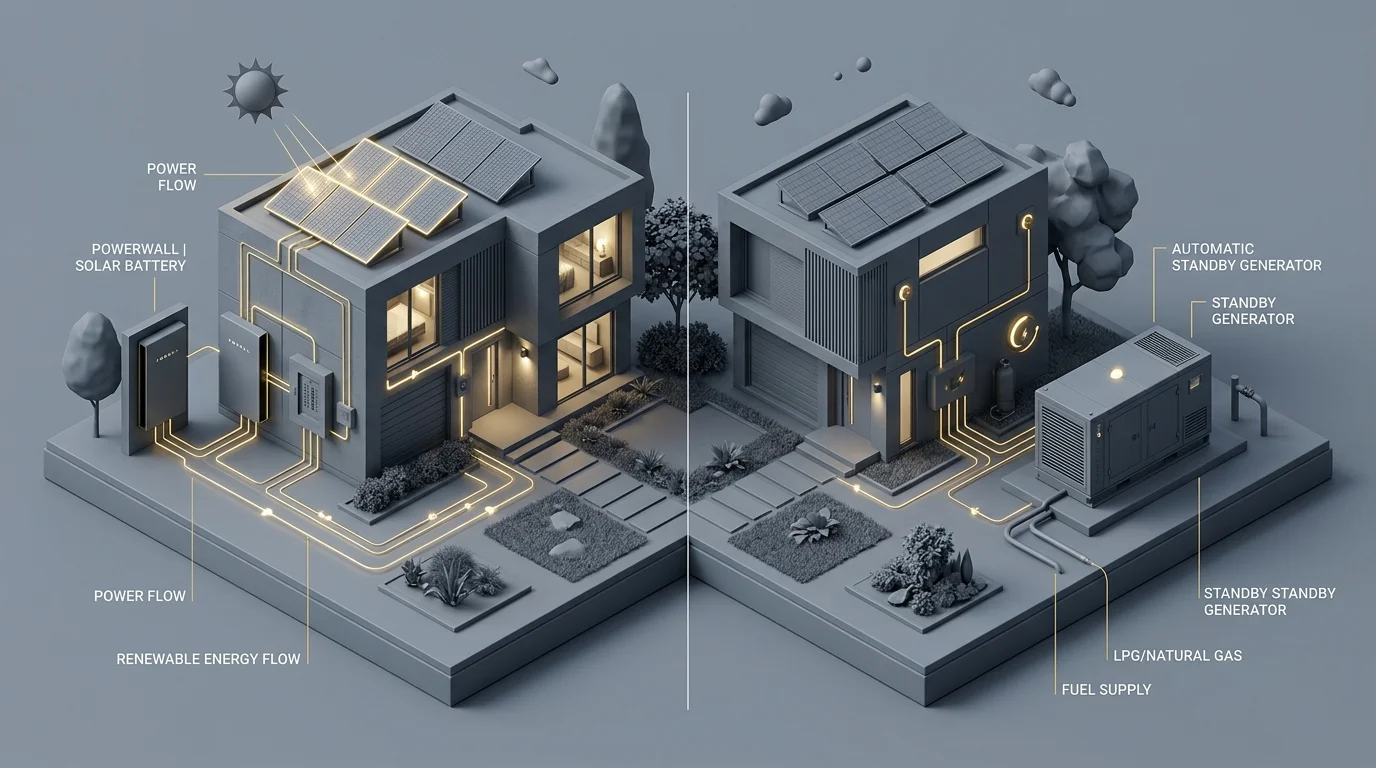
Power outages are happening more frequently across the country due to severe storms, aging utility infrastructure, and peak energy demand. When the grid goes dark, homeowners need a dependable way to keep lights, refrigerators, medical equipment, and climate systems running safely.
For decades, the standard answer to blackouts was a whole-home standby generator fueled by natural gas or propane. Today, home solar battery systems provide a modern, clean, and silent alternative.
While a standby generator often has a lower upfront sticker price, recurring fuel deliveries and regular mechanical upkeep add up quickly over time. In contrast, a solar battery pairs directly with clean rooftop solar panels. It recharges for free every sunny afternoon, runs silently without fumes, and lowers monthly electric bills even when the grid is working normally.
In this guide, we break down upfront installation costs, 10-year operating expenses, federal tax credit savings, and long-term return on investment to help you choose the best backup solution for your home.
Upfront Equipment and Installation Costs
When comparing the initial price of each system, it is important to review the entire installation quote rather than just the hardware box. Both options require dedicated electrical equipment, professional labor, and local building permits.
Standby Generator Costs
A whole-home standby generator is an engine-driven machine permanently installed outside the home on a poured concrete pad.
- Equipment: An air-cooled generator producing 14 to 24 kilowatts typically costs between $4,000 and $7,500. Larger liquid-cooled models designed for very large homes can cost $10,000 or more.
- Automatic Transfer Switch (ATS): A service-rated transfer switch that senses grid loss and starts the generator adds $800 to $1,500.
- Gas Plumbing: Connecting the unit to a municipal natural gas line or installing an on-site liquid propane tank adds $1,500 to $4,500 depending on trenching distance.
- Electrical Labor and Permits: Professional electrician labor, wiring, and municipal permits usually add $2,500 to $4,000.
In total, a typical whole-home standby generator installation costs between $9,000 and $17,000 before taxes. Traditional fossil fuel generators receive zero clean energy tax credits.
Solar Battery Storage Costs
A residential solar battery is a wall-mounted or floor-mounted energy storage unit built with modern lithium iron phosphate (LiFePO4) chemistry.
- Battery Hardware: A 10 to 15 kilowatt-hour battery module costs between $7,000 and $11,000.
- Smart Gateway or Critical Load Panel: A smart energy gateway that isolates the home from the grid within milliseconds costs $1,500 to $2,500.
- Electrical Installation and Conduit: Certified electrician labor and system commissioning typically range from $2,500 to $4,000.
The total upfront installation cost for a 13.5 kilowatt-hour home battery ranges between $11,000 and $17,500. However, residential battery storage qualifies for the 30% federal clean energy tax credit under Section 25D. This credit deducts 30% of total equipment and installation costs directly from your federal tax liability, bringing the net cost of a $14,000 battery installation down to approximately $9,800.
Solar Battery Storage
Silent operation, zero emissions, instant switchover, and daily electric bill savings through solar self-consumption.
Standby Generator
Runs continuously as long as fuel is supplied, but requires regular oil changes, routine servicing, and noisy engine operation.
How Power Flows During an Outage
During an unexpected utility failure, speed and reliability make a big difference in household comfort and safety.
When the electrical grid drops offline, a standby generator requires roughly 10 to 20 seconds to crank its internal combustion engine, stabilize its rotational speed, and transfer electrical loads. This short delay causes digital clocks to reset, computers to reboot, and unbuffered electronics to shut down.
In contrast, a modern lithium battery backup system detects a grid disruption and switches power sources in less than 20 milliseconds. This transition is faster than the blink of an eye. Lights do not flicker, internet routers remain connected, and sensitive electronic devices continue operating without interruption.
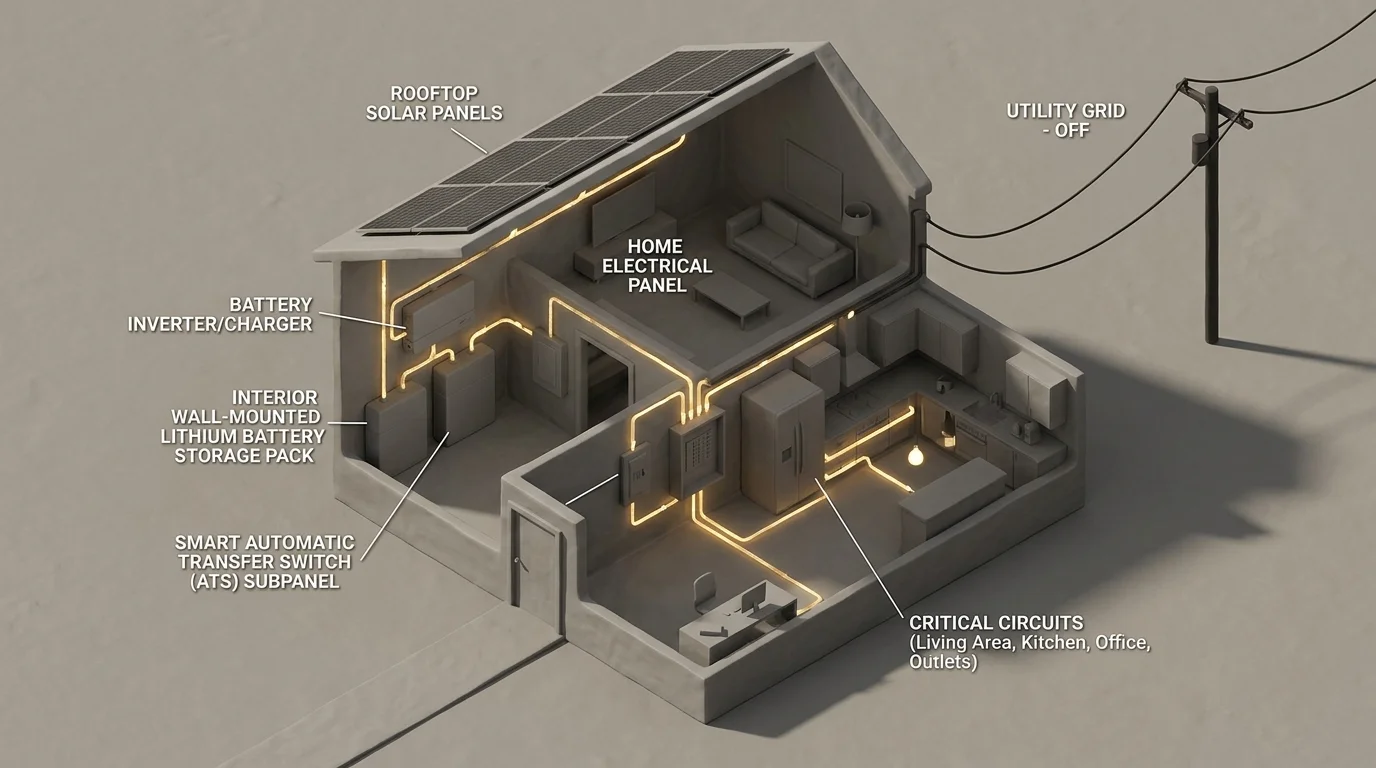
As shown in the technical routing diagram above, when the utility grid disconnects, the smart automatic transfer switch isolates the residence. Stored clean energy flows from the wall battery through the subpanel directly into critical home circuits, including refrigeration, indoor lighting, kitchen appliances, and home office workstations.
When the sun rises the following morning, rooftop solar panels generate direct current electricity that simultaneously powers the home and recharges the battery bank. This creates a self-sustaining microgrid that can run indefinitely without relying on fuel deliveries.
10-Year Lifecycle and Operating Costs
While a fossil fuel generator may look slightly cheaper on day one, the financial picture completely changes when you calculate 10 years of ongoing fuel consumption and mechanical maintenance.

Fuel Consumption During Blackouts
A standby generator uses significant amounts of fuel while running:
- Propane Usage: A standard 20 kilowatt generator running at half load burns about 2 to 3 gallons of liquid propane per hour. During a severe 4-day winter ice storm outage, the unit consumes 190 to 280 gallons of fuel. At $3.20 per gallon, that single storm costs $600 to $900 in fuel alone.
- Natural Gas Consumption: Running on utility natural gas avoids running out of fuel tanks, but continuous operation during multi-day outages can add hundreds of dollars to your monthly utility bill.
- Fuel Shortages: In major regional disasters like hurricanes or deep freezes, municipal gas pressure can drop, and local roads may be impassable for propane delivery trucks.
A solar battery paired with rooftop panels incurs exactly zero fuel expense. The sun recharges the battery daily at no extra charge.
Routine Maintenance and Engine Servicing
A standby generator contains pistons, valves, spark plugs, filters, and motor oil. To stay in working condition, it must execute an automated self-exercise cycle every week, burning fuel year-round.
- Oil Changes: Generator manufacturers require fresh oil and filter replacements after every 100 to 200 hours of continuous operation, as well as an annual service check.
- Annual Service Contracts: Professional technician visits to inspect belts, spark plugs, starter batteries, and fuel lines typically cost $350 to $600 per year. Over a 10-year lifespan, scheduled maintenance adds $3,500 to $6,000 to the total cost.
- Lifespan Limits: Air-cooled generator engines generally last between 1,500 and 3,000 total running hours before requiring major engine rebuilding or replacement.
A solar battery is a solid-state electronic device with zero moving parts, zero motor oil, and zero air filters. It operates in total silence at noise levels under 40 decibels, compared to 65 to 75 decibels for an engine generator. Routine maintenance over 10 years is essentially zero dollars. Most Tier-1 lithium iron phosphate batteries carry a 10-year manufacturer warranty that guarantees at least 70% retained storage capacity.
Daily Value: Outages vs Every Day of the Year
The single biggest difference between a solar battery and a generator is how often each system works for you.
A standby generator is an emergency-only insurance policy. For 99% of the year, it sits idle in your yard doing nothing while steadily depreciating. It produces zero dollars in daily financial savings.
A solar battery delivers financial returns 365 days a year:
- Time-of-Use Bill Savings: In regions with time-of-use electric rates, electricity costs much more during afternoon and evening peak hours. A solar battery charges with low-cost or free solar energy during the day, then powers your home during peak hours. This avoids high utility rates and can save $400 to $1,000 annually.
- Higher Solar Self-Consumption: Under modern net billing rules, utilities pay very low rates when you export surplus solar energy to the grid. A home battery stores your excess energy so you can use it yourself at night, maximizing the financial value of every solar watt.
- Virtual Power Plant (VPP) Income: Many regional power grids offer cash incentives for battery owners who agree to share a small portion of stored energy during extreme grid emergencies. Homeowners enrolled in VPP programs can earn $300 to $800 each year in passive utility bill credits.
Over 10 years, these daily financial benefits frequently return between $4,000 and $10,000, substantially offsetting the initial investment in the battery system.
How to Choose the Right Backup Solution
Use this four-step decision framework to determine whether a solar battery, a standby generator, or a combination of both is right for your property:
Assess Local Outage Patterns
If your neighborhood experiences frequent short blackouts lasting a few hours to two days, a solar battery handles every outage smoothly with zero noise or hassle. If you live in an area with repeated multi-week grid failures under heavy cloud cover, a hybrid approach may be considered.
Calculate 10-Year Fuel and Upkeep
Add up the purchase price, professional installation, fuel deliveries, and annual maintenance visits. Standby generators often end up costing thousands more over a decade than homeowners initially expect.
Check Solar Panel Compatibility
If you already have rooftop solar panels or plan to install them, a battery backup is the logical choice. It seamlessly integrates with your solar inverter and recharges every morning without utility grid power.
Claim Clean Energy Tax Incentives
Take full advantage of the 30% federal clean energy tax credit under Section 25D, along with local state storage rebates. These incentives make high-capacity battery systems cost-competitive with fossil fuel equipment.
Frequently Asked Questions
Yes. Modern high-output solar batteries can start and run central air conditioning systems. However, starting a large compressor requires a high surge of electricity. Most solar technicians recommend installing a soft-starter on your air conditioner or stacking two battery modules to handle both starting surges and continuous cooling loads.
A single 13.5 kilowatt-hour battery running critical circuits such as refrigerators, LED lighting, Wi-Fi, and phone chargers will generally last 18 to 24 hours on stored energy alone. When paired with rooftop solar panels, the system recharges during daylight hours, allowing homeowners to sustain critical power indefinitely during sunny and partly cloudy conditions.
Yes. Many premium smart electrical gateways, such as the FranklinWH aGate or Enphase System Controller, support generator integration. In this hybrid configuration, the solar battery handles daily power management and routine outages silently. If an outage lasts several consecutive cloudy days and battery reserves drop below 20%, the system can automatically crank a small generator to recharge the battery bank.
A standby generator produces substantial engine and exhaust noise, typically ranging between 65 and 75 decibels at a distance of 20 feet. This sound is roughly equivalent to a running lawnmower or heavy street traffic, which can violate neighborhood noise ordinances or disturb sleep. A solar battery operates in near silence, producing under 40 decibels of faint fan noise during high-rate charging.
High-quality lithium iron phosphate solar batteries are designed to last between 12 and 15 years with daily cycling, backed by standard 10-year warranties. Standby generators have an operational life of 1,500 to 3,000 engine hours. With proper annual servicing, a generator typically lasts 10 to 15 calendar years, though major engine components may require rebuilding as mechanical hours accumulate.