Net Metering vs. Net Billing: Differences and Solar ROI
Understand the crucial differences between net metering and net billing. Learn how export rates impact solar savings, battery payback, and your electric bill.

When you put solar panels on your roof, they often make more power during sunny afternoons than your house can use. What happens to that extra electricity determines how much money you save each month. For decades, electric companies offered a simple program called net metering. Today, many power companies are replacing it with a new system called net billing.
While these two terms sound almost identical, they work very differently. Net metering pays you full retail prices for your extra clean energy. Net billing pays you wholesale rates that are significantly lower. Understanding how these two policies work is the single most important step in calculating your true solar return on investment.
What Is Net Metering?
Traditional Net Energy Metering, often shortened to NEM, treats the electric grid like a giant battery bank.
Under a net metering program, your home uses a single bidirectional electric meter. When your solar panels produce more electricity than your home consumes, the meter measures the extra power flowing into the neighborhood grid. For every kilowatt-hour (kWh) of clean energy you send out, your utility gives you a full credit on your monthly statement.
Later that evening, when the sun goes down, your house draws power back from the grid. You use your banked energy credits on a direct 1-to-1 basis. If your retail utility rate is $0.25 per kilowatt-hour, your exported solar electricity is credited at that exact same $0.25 rate.
At the end of your billing cycle, you only pay for your net consumption. If your panels produced 800 kilowatt-hours and your home used 900 kilowatt-hours, you only receive a bill for the remaining 100 kilowatt-hours.
What Is Net Billing?
Net billing takes a completely different approach. Instead of banking kilowatt-hours, net billing treats electricity purchase and electricity sale as two independent transactions.
Under a net billing program, your power company measures power through two separate meter channels. Electricity that your home draws from the grid is billed at the regular retail rate, which often ranges from $0.25 to $0.35 per kilowatt-hour. However, when your solar panels push excess power back to the grid, the utility credits you at an avoided-cost rate.
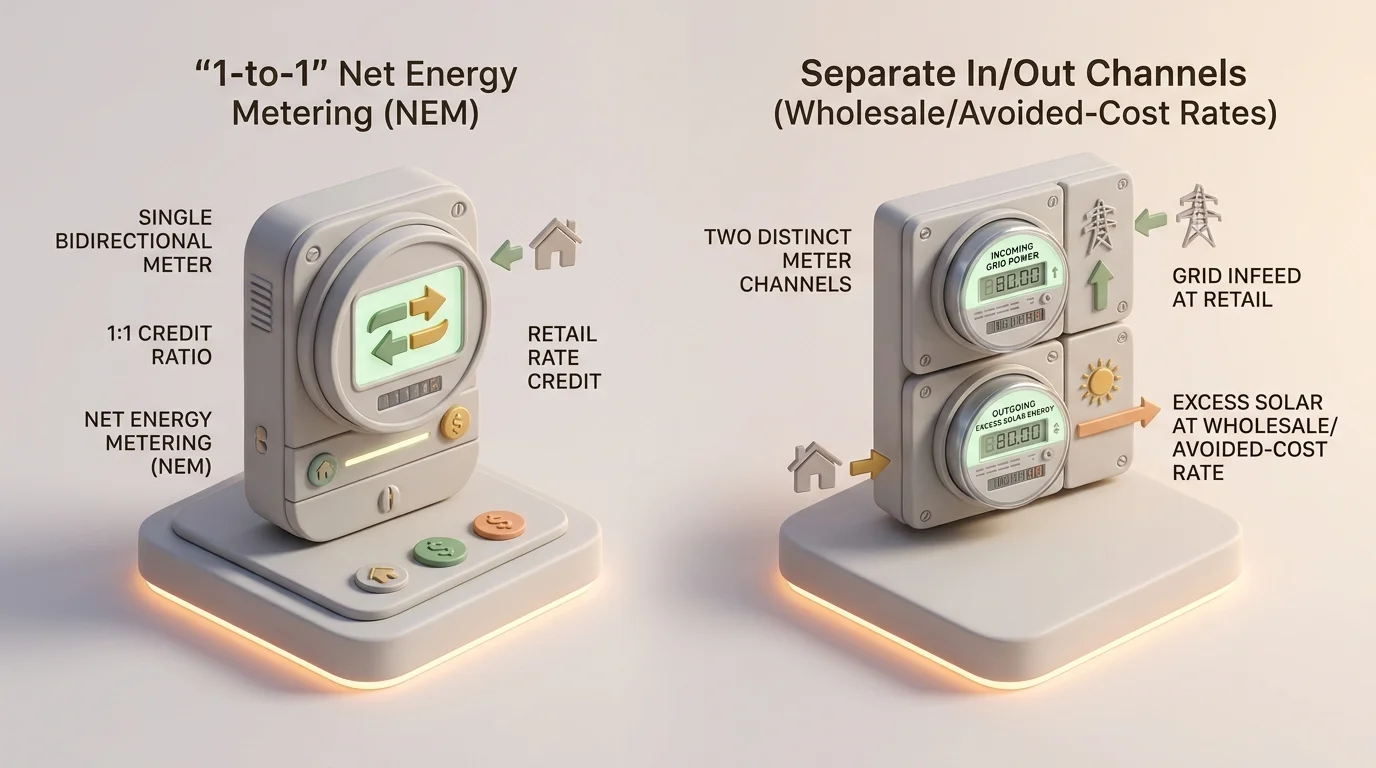
An avoided cost is simply what the power company estimates it would cost to produce that same electricity from a large power plant or purchase it from wholesale markets. In most utility territories, this export credit averages only $0.04 to $0.06 per kilowatt-hour.
Because your exported solar power is sold at wholesale prices while your imported grid power is bought at retail prices, sending electricity back to the grid during the afternoon earns much less money.
Side-by-Side Comparison
The core financial difference comes down to the credit value and how your meter records energy flows:
Net Metering (NEM)
Full retail credit for every exported kilowatt-hour. Stored credits roll over monthly to offset nighttime electric usage dollar for dollar.
Net Billing
Exported power earns wholesale avoided-cost rates ($0.04 to $0.06 per kWh). Grid imports remain at full retail rates ($0.25 to $0.35+ per kWh).
A Real-World Monthly Bill Example
To see why this policy change matters, let us look at a standard family home using modern turnkey residential solar. According to national industry market reports from SEIA and Wood Mackenzie, residential solar equipment currently averages approximately $3.36 per watt installed before federal incentives.
Imagine your rooftop solar system generates 1,000 kilowatt-hours during a sunny month:
- Your home consumes 400 kilowatt-hours immediately as the solar panels generate it. This direct self-consumption avoids grid power entirely.
- Your home exports the remaining 600 kilowatt-hours to the grid during peak afternoon sunlight.
- In the evening and overnight, your home draws 500 kilowatt-hours from the power grid.
Assume your utility charges a retail electricity rate of $0.30 per kilowatt-hour, and sets its net billing export rate at $0.05 per kilowatt-hour.
Under Net Metering
Your 600 exported kilowatt-hours cancel out your 500 imported kilowatt-hours completely. You end the month with an extra 100 kilowatt-hours of stored energy credits to carry into the next month. Your electric energy bill is $0.
Under Net Billing
Your 500 imported kilowatt-hours are billed at full retail price:
- Import Charges: 500 kWh × $0.30 = $150.00
Your 600 exported kilowatt-hours are credited at the avoided-cost rate:
- Export Credits: 600 kWh × $0.05 = $30.00
Your final electricity supply bill is:
- Net Electric Bill: $150.00 - $30.00 = $120.00
Even though your solar panels generated more total electricity than your home consumed, you still receive a bill for $120.00 under net billing.
How Net Billing Reshapes Solar ROI
Because net billing reduces the value of exported solar electricity by 70% to 80%, installing a standalone solar panel system without a home battery leads to a longer financial payback period.
Under classic net metering, a residential solar installation typically pays for itself within 6 to 8 years. Under net billing, an array without energy storage can take 12 to 16 years to break even because so much daytime solar power is exported at low wholesale values.
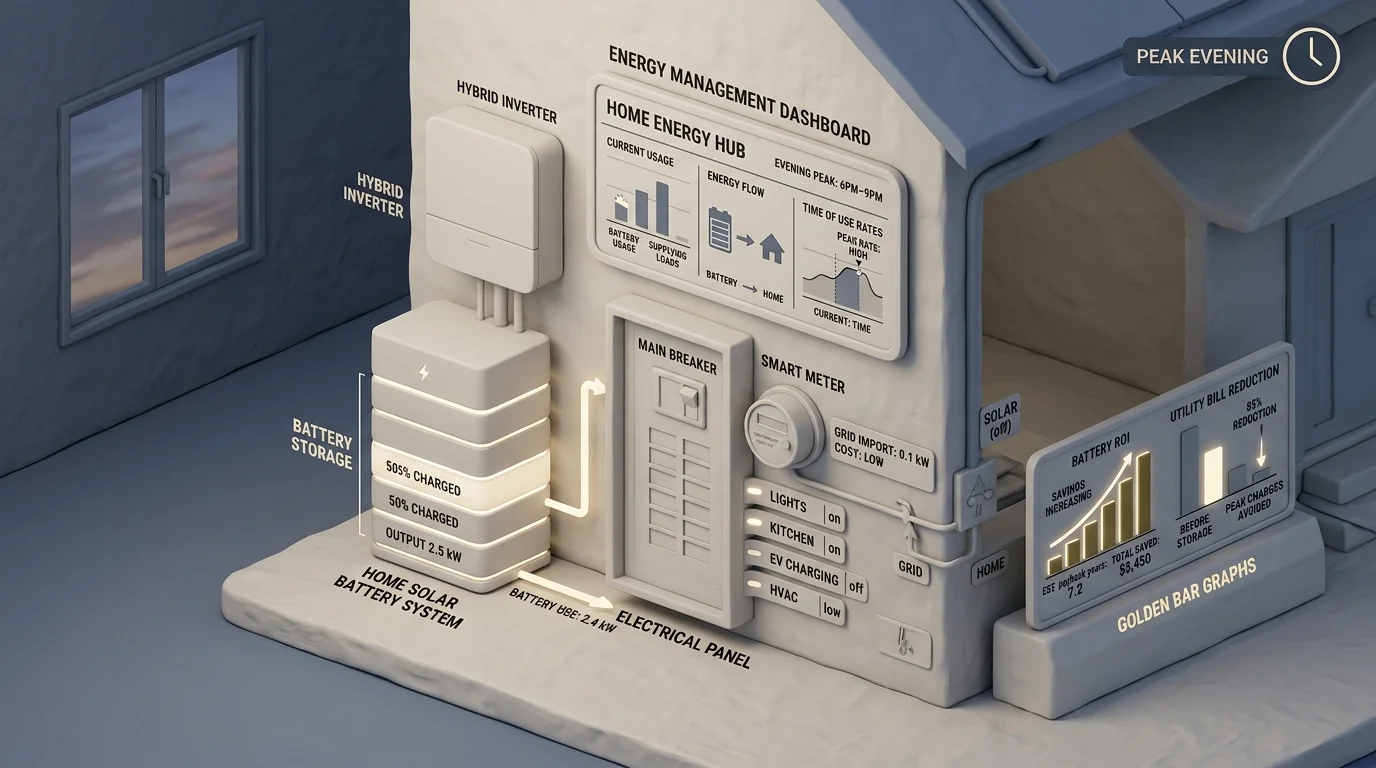
This economic shift explains why energy storage has become a central part of modern home energy design. When you add a lithium iron phosphate battery to your solar array, your home can store that extra 600 kilowatt-hours of afternoon electricity rather than exporting it for pennies.
During the evening peak hours, your home runs on cheap stored solar power instead of purchasing expensive grid electricity. In regions with net billing policies, roughly 70 percent of new solar homeowners now install battery storage to protect their long-term savings. With battery storage, home energy payback periods drop back down to 7 to 9 years.
4 Steps to Maximize Savings Under Net Billing
If your utility company operates under a net billing framework, follow these practical steps to secure the strongest return on investment:
Audit Your Time-of-Use Rates
Review your electric bill to identify when power costs the most. Many utilities charge peak rates between 4 PM and 9 PM on weekdays.
Pair Your System with Battery Storage
Store your surplus midday generation on-site. Using your own clean energy in the evening saves 20 to 30 cents per kilowatt-hour compared to exporting it.
Automate Daytime Appliance Loads
Program dishwashers, pool pumps, laundry, and electric vehicle chargers to run between 11 AM and 3 PM while your solar panels produce maximum power.
Size for Self-Consumption
Avoid overbuilding an oversized solar array if you do not have batteries. Size your panels to cover your actual household load rather than overproducing for grid export.
Frequently Asked Questions
Most regulatory commissions grant grandfathering protections to existing solar owners. If you installed your solar system under a previous net metering agreement, you typically keep your 1-to-1 retail credits for 15 to 20 years from your initial connection date. However, expanding your system size by more than 10 percent can trigger a transfer to the current net billing tariff.
A true-up statement is a yearly summary from your utility company that reconciles all your energy imports and exports over a twelve-month period. If you accumulated surplus credits across the year, the utility pays out the remaining balance at an avoided-cost wholesale rate during the true-up month.
Batteries are not legally required to connect solar panels to the electrical grid. However, without a home battery, you must export your surplus daytime solar at low avoided-cost rates and buy evening electricity at high retail rates. Adding battery storage keeps your power on-site and dramatically improves your return on investment.
State public utility commissions determine avoided-cost rates using complex computer models. These models calculate the fuel costs, generator wear, and transmission line upgrades that the utility avoids when distributed rooftop panels supply electricity locally. Some utilities update these values annually, while others adjust them on an hourly schedule.