Solar Panel Temperature Coefficient: How Heat Affects Solar Output
Learn what the solar panel temperature coefficient means, why summer heat lowers solar output, and how cell technology impacts hot-weather performance.
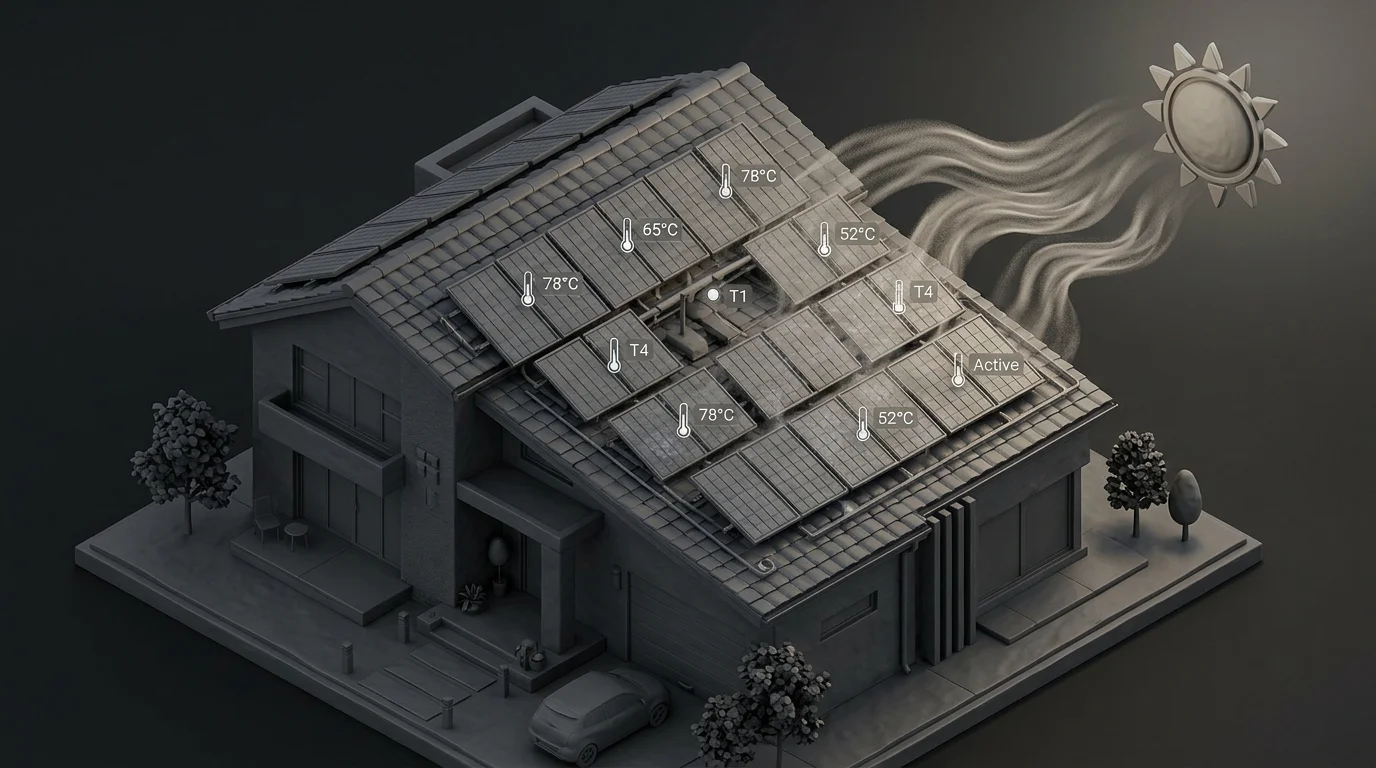
When homeowners invest in clean energy, they often assume that hot, blistering summer afternoons produce the highest electrical yield. It feels intuitive: more bright sun and hotter temperatures should mean more electricity. However, the reality of semiconductor physics is quite different. High heat actually reduces the amount of electricity your panels can produce.
To evaluate how your equipment responds to summer heat, look at the solar panel temperature coefficient listed on its official technical specification sheet. This single metric reveals how much power a solar module loses for every degree the cells warm up.
Understanding how heat affects solar panels helps you select the best modules for your local climate. It also prevents surprise drops in energy production when outdoor temperatures climb.
How Heat Affects Solar Cells at the Atomic Level
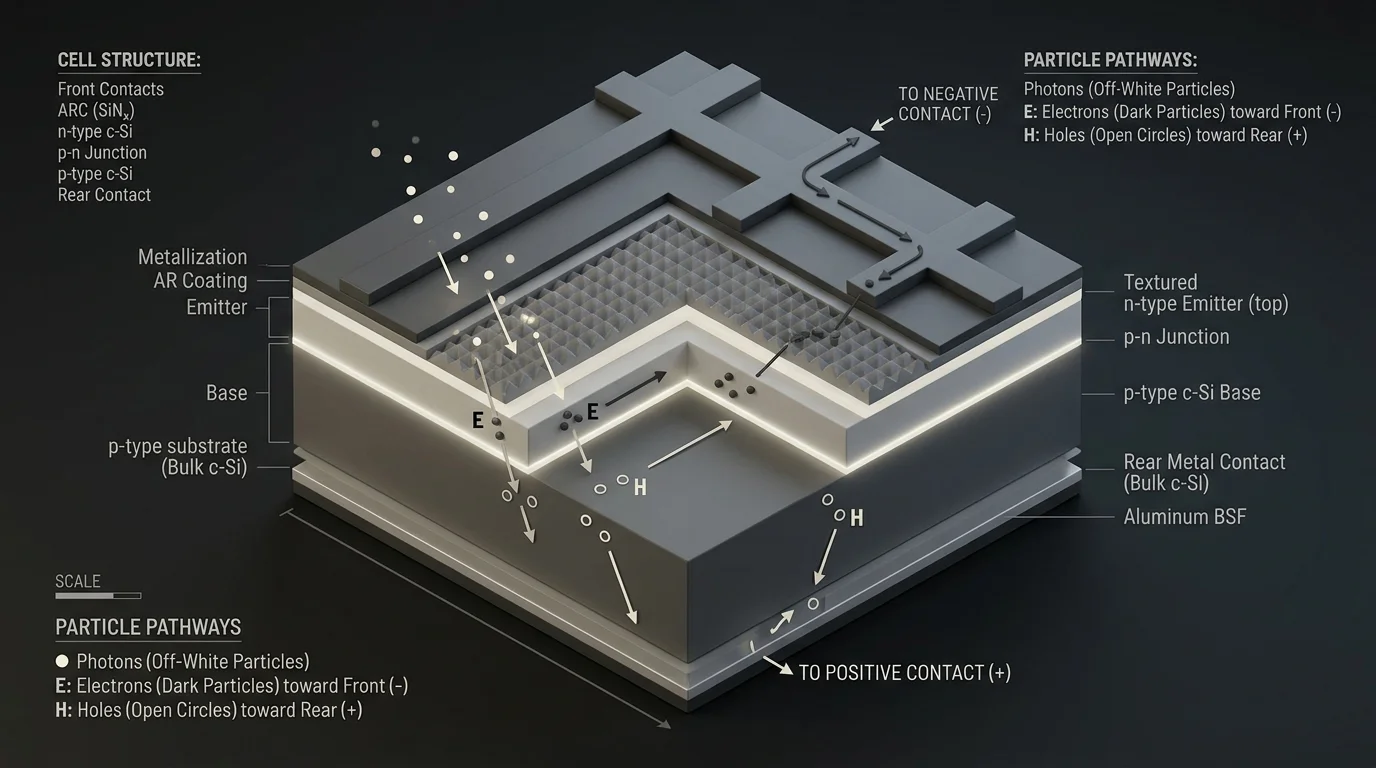
Inside each solar cell, sunlight frees electrons across a silicon junction. High temperatures energize electrons too early, which causes internal electrical resistance to climb and operating voltage to fall. Good cell design and proper thermal management keep electrons flowing smoothly toward your home.
What Is the Solar Panel Temperature Coefficient?
Every solar panel receives an official laboratory power rating under Standard Test Conditions (STC). In test facilities, engineers test modules at an exact cell temperature of 25 degrees Celsius (77 degrees Fahrenheit), under 1,000 watts of sunlight per square meter.
In the real world, solar panels rarely stay at 25 degrees Celsius. Dark silicon wafers absorb radiant heat all day long. When the midday sun beats down on a rooftop, the internal cell temperature quickly climbs 20 to 35 degrees Celsius above the surrounding outdoor air.
The temperature coefficient of Pmax (maximum power) tells you the exact percentage of power a panel loses for every 1 degree Celsius rise above that 25-degree baseline.
Because heat degrades power output, this coefficient is always expressed as a negative percentage:
- A standard residential panel might have a coefficient of -0.35% per degree Celsius.
- A premium heat-tolerant panel might have a coefficient of -0.26% per degree Celsius.
- If your panels heat up by 20 degrees above the test baseline, a -0.35% coefficient means you lose 7% of your rated midday wattage.
The Science: Why Heat Lowers Solar Panel Output
To understand why solar panels lose efficiency when hot, it helps to examine what happens inside the silicon wafer.
A solar cell generates electricity when light particles (photons) strike electrons in the silicon, knocking them loose. These loose electrons cross a built-in electric field (the p-n junction), creating an electrical current.
Power output equals electrical voltage multiplied by electrical current (Watts = Volts x Amps). When temperature changes, it affects both halves of this equation differently:
- Current increases slightly: Warmer silicon makes it slightly easier for light to knock electrons loose. As a result, the short-circuit current rises by a tiny fraction, usually around +0.04% per degree Celsius.
- Voltage drops significantly: As thermal energy increases inside the cell, electrons become hyperactive and bounce in random directions. This causes many electrons to recombine before escaping into the metal circuits. The internal voltage across the cell drops sharply, usually between -0.28% and -0.35% per degree Celsius.
Because the voltage drop is seven to eight times larger than the tiny current increase, the total power output declines. The hotter the silicon gets, the steeper the voltage drop becomes.
Comparing Temperature Coefficients Across Cell Technologies
Different manufacturing techniques and cell architectures handle heat with varying levels of resistance. When choosing equipment for hot or humid regions, checking the cell technology is essential.
Heterojunction (HJT)
HJT cells combine crystalline silicon with ultra-thin amorphous silicon layers. This hybrid design features a wider energy bandgap that prevents severe voltage drops in intense summer heat.
N-Type TOPCon
Tunnel Oxide Passivated Contact (TOPCon) cells use an ultra-thin oxide layer to reduce electron recombination. They perform noticeably better in warm weather than traditional panels.
Monocrystalline PERC
Passivated Emitter and Rear Cell (PERC) modules served as the industry workhorse for a decade. While reliable and affordable, they experience moderate power loss during summer heat waves.
Polycrystalline
Older multi-crystalline wafers have higher internal resistance and more crystal defects, making them particularly vulnerable to summer thermal losses.
Real-World Math: Sizing Solar Arrays for Hot Climates
To see how temperature loss works on an actual rooftop, consider a home on a typical 35-degree Celsius (95-degree Fahrenheit) summer day.
Because dark panels absorb sunlight, the internal cells will reach roughly 65 degrees Celsius (149 degrees Fahrenheit). That is 40 degrees above the standard 25-degree test condition.
Here is how two identical 400-watt panels with different cell technologies compare under those conditions:
Legacy PERC Panel (-0.35% per degree Celsius)
- Temperature rise: 65°C - 25°C = 40°C
- Total power loss: 40°C x 0.35% = 14.0%
- Wattage reduction: 400W x 0.14 = 56W
- Actual real-world output: 344 Watts
Advanced HJT Panel (-0.26% per degree Celsius)
- Temperature rise: 65°C - 25°C = 40°C
- Total power loss: 40°C x 0.26% = 10.4%
- Wattage reduction: 400W x 0.104 = 41.6W
- Actual real-world output: 358.4 Watts
Across a full 10-kilowatt rooftop system with 25 panels, that 14.4-watt difference per module adds up to 360 extra watts of continuous generation during peak hours. In sunny southern regions, this difference yields hundreds of additional kilowatt-hours every year.
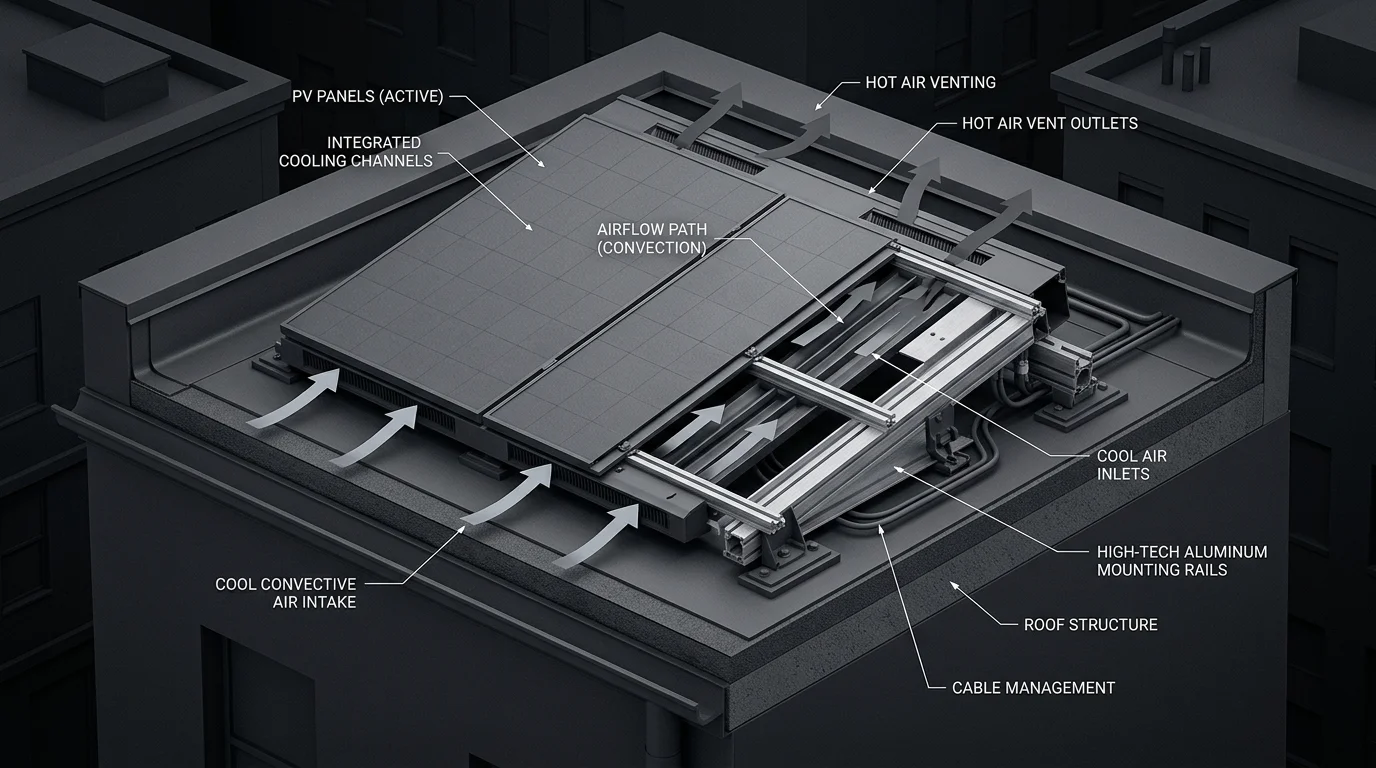
Convective Airflow Channels Beneath Rooftop Panels
Mounting panels with a 4 to 6 inch ventilation gap allows cool air to enter at the roof eave and hot air to exit at the ridge. Natural buoyancy creates a chimney effect that lowers cell operating temperatures by 10 to 15 degrees Celsius.
4 Installation Practices That Keep Solar Panels Cool
While you cannot control the weather, smart design and professional installation practices keep panels operating at lower temperatures.
Maintain Proper Roof Clearance
Install panels at least 4 to 6 inches above your roof tiles or shingles. This gap enables continuous passive airflow under the array, carrying away trapped heat through natural convection.
Pair With Reflective Roofing
Light-colored metal roofs or cool roof shingles absorb less radiant thermal energy than dark asphalt. A cooler roof surface prevents ambient heat from radiating back into the undersides of the modules.
Account for Inverter Voltage Windows
Because high temperatures reduce string voltage, system designers must verify that minimum hot-weather voltage remains well within the Maximum Power Point Tracking (MPPT) window of your inverter.
Select Low-Coefficient Modules
If you live in an area with prolonged summer temperatures above 32 degrees Celsius (90 degrees Fahrenheit), prioritize N-type TOPCon or HJT panels with temperature coefficients of -0.30% per degree Celsius or better.
Frequently Asked Questions
Yes. Solar panels continue generating clean power during severe heat waves. While their peak efficiency drops by 10% to 15% during the hottest midday hours, summer days provide many more daylight hours than winter. The longer duration of sunlight usually balances out the thermal efficiency losses in your total monthly utility bill.
Yes. Solar cells operate at peak electrical efficiency in cold temperatures. On a crisp, clear winter morning around 0 degrees Celsius (32 degrees Fahrenheit), panels can generate higher voltages than their official factory nameplate ratings. As long as snow does not block sunlight, cold sunny days offer optimal conditions for solar semiconductors.
Open the manufacturer datasheet PDF and scroll to the Temperature Characteristics table. Look for the row labeled Temperature Coefficient of Pmax, Temperature Coefficient of Pm, or Temperature Coefficient of Power. It is listed as a percentage change per degree Celsius, such as -0.29%/°C or -0.34%/°C.
You should avoid spraying cold tap water on hot solar panels. The sudden temperature shock from cold water hitting glass heated to 65 degrees Celsius can crack the tempered glass. Additionally, tap water contains minerals that evaporate and leave stubborn hard water scale, which permanently blocks incoming sunlight.