How Much Power Does a Solar Panel Produce? Daily and Yearly Output Guide
Calculate how much electricity a solar panel generates daily, monthly, and yearly. Compare panel wattages, regional sun hours, and real-world system efficiency.
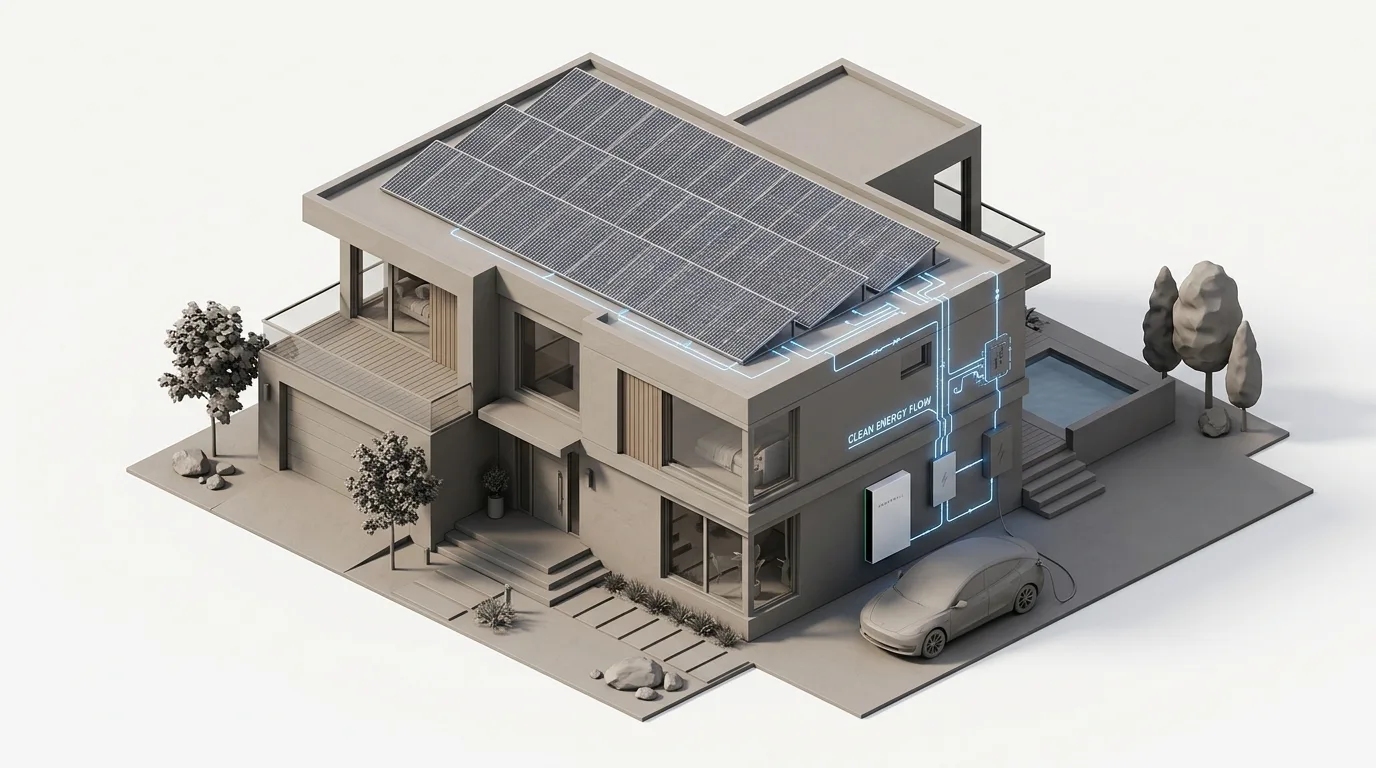
When homeowners and business owners explore solar energy, the very first question they ask is simple: how much electricity does a solar panel actually make?
The short answer is that a standard modern residential panel rated at 400 watts produces between 1.4 and 1.8 kilowatt-hours (kWh) of electricity on a typical clear day. Over an entire year, that single panel creates between 510 and 650 kWh of clean power.
However, solar panels do not run like light switches. They do not turn on at full power and stay constant until dusk. Their real electricity output changes continuously based on sunlight intensity, seasonal sun angles, ambient temperature, and equipment losses.
Understanding how to calculate this energy output helps you size your system correctly, match your utility bills, and ensure your clean energy investment delivers maximum value.
Watts vs. Kilowatt-Hours: Understanding the Units
To calculate your power production accurately, you must understand the distinction between two fundamental electrical terms: watts and kilowatt-hours.
- Watts (W): A unit of power at an exact instant in time. When a panel carries a 400-watt nameplate rating, that number represents its maximum output under perfect factory test lighting.
- Kilowatt-Hours (kWh): A unit of electrical energy delivered over time. One kilowatt-hour equals 1,000 watts used or produced for one full hour. Your local electric utility bills you based on the total kilowatt-hours your home consumes each month.
Think of watts like the speed of a car on a speedometer, while kilowatt-hours represent the total distance traveled on your trip odometer. A 400-watt panel running at peak output for three solid hours produces 1,200 watt-hours, which equals 1.2 kilowatt-hours of usable electricity.
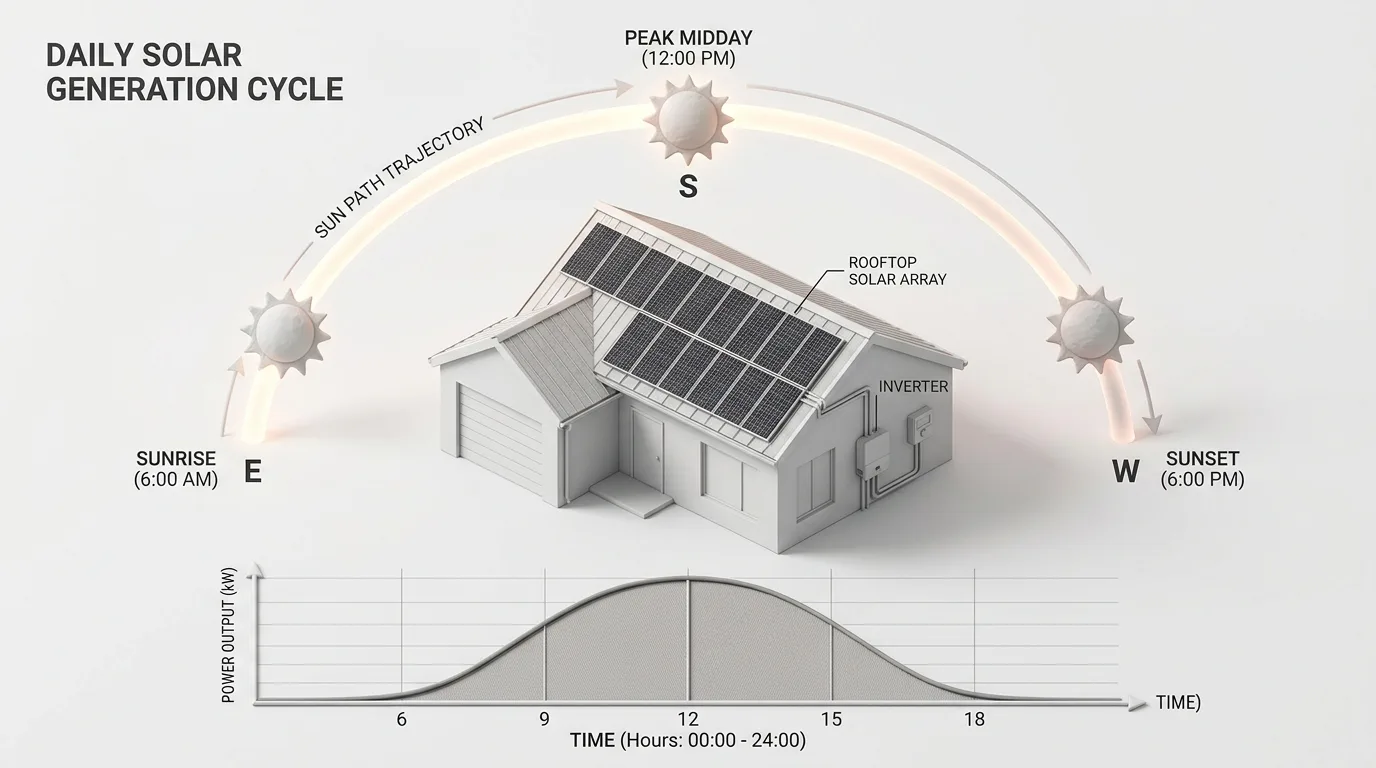
The Daily Solar Production Formula
You can determine the daily electricity yield of any solar panel using a proven mathematical formula used by professional solar designers:
Daily Output (kWh) = (Panel Wattage * Peak Sun Hours * Derate Factor) / 1,000
Let us examine each variable in this equation:
- Panel Wattage (W): The factory nameplate capacity of the module under Standard Test Conditions (STC). Modern residential panels typically range from 380W to 450W, while commercial modules reach 550W or more.
- Peak Sun Hours (PSH): The equivalent number of hours per day when solar radiation averages 1,000 watts per square meter. Most areas in the continental United States receive between 3.5 and 6.0 peak sun hours per day.
- Derate Factor (0.80 to 0.85): A realistic multiplier that accounts for field inefficiencies such as panel heat, inverter DC-to-AC conversion, wiring resistance, and rooftop dust.
- Divided by 1,000: Converts total watt-hours into standard kilowatt-hours.
Real-World Example
Imagine you install a popular 400-watt monocrystalline panel in a location that averages 4.5 peak sun hours per day:
- Gross potential energy = 400 watts * 4.5 hours = 1,800 watt-hours
- Apply an 82 percent system delivery factor = 1,800 * 0.82 = 1,476 watt-hours
- Divide by 1,000 = 1.48 kWh per day
- Over 365 days, this single panel produces approximately 540 kWh per year.
Comparing Power Output by Panel Wattage
Solar panels are manufactured in various sizes and cell configurations. Larger commercial panels generate more power, but their physical dimensions are bigger and heavier. Residential rooftops typically use 66-cell or 108-half-cell formats that balance high efficiency with manageable weight.
The following comparison highlights expected production across common module tiers based on an average 4.5 peak sun hours per day:
300W Budget Panel
- Annual Generation: ~405 kWh per panel
- Cell Technology: Older polycrystalline or early PERC
- Best Application: Small cabins, RV roofs, and budget DIY sheds
- Efficiency Range: 17% to 19%
400W Standard Residential
- Annual Generation: ~540 kWh per panel
- Cell Technology: N-Type TOPCon or high-efficiency PERC
- Best Application: Standard suburban residential rooftops
- Efficiency Range: 21% to 22.5%
450W High-Efficiency
- Annual Generation: ~606 kWh per panel
- Cell Technology: Heterojunction (HJT) or advanced TOPCon
- Best Application: Limited roof spaces requiring maximum power density
- Efficiency Range: 22.5% to 23.5%
550W Commercial Module
- Annual Generation: ~741 kWh per panel
- Cell Technology: Large-format bifacial utility cells
- Best Application: Commercial warehouses, solar carports, and open fields
- Efficiency Range: 21.5% to 22.8%
Real-World Losses: Why Output Drops Below Nameplate Rating
Why does a 400-watt panel rarely output a continuous 400 watts on a sunny afternoon?
Panel ratings are established in laboratory testing chambers under Standard Test Conditions (STC): exactly 1,000 W/m² of light, a 25°C (77°F) cell temperature, and an air mass ratio of 1.5. In the real world, several ambient variables reduce overall system performance.
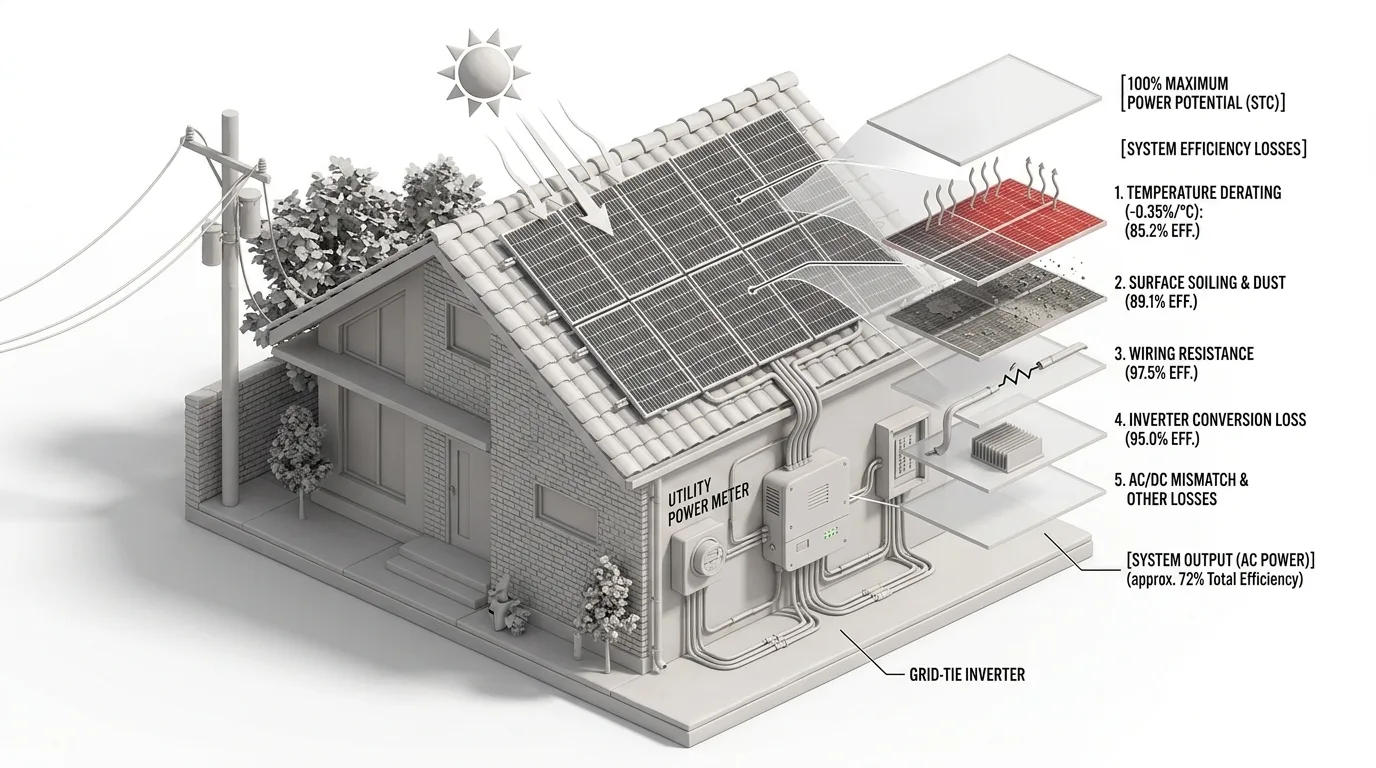
Here is a breakdown of the primary efficiency losses that determine your overall system derate factor:
1. Temperature Derating (5% to 15% Loss)
Solar cells are semiconductors, and like computer chips, they lose efficiency as they get hot. When dark panels sit under direct summer sunshine, cell temperatures often climb to 65°C (149°F) or higher. Most modern panels carry a temperature coefficient of -0.30% to -0.38% per degree Celsius above 25°C. On a hot summer afternoon, this heat effect reduces operating wattage by 12% to 15%.
2. Inverter Conversion (2% to 5% Loss)
Solar panels generate Direct Current (DC) electricity, while household appliances and the utility grid rely on Alternating Current (AC) electricity. High-efficiency string inverters and microinverters convert DC to AC power with 96% to 98% efficiency, resulting in a small conversion loss.
3. Surface Soiling and Dust (2% to 5% Loss)
Pollen, airborne dust, tree sap, and bird droppings accumulate on panel glass. In regions with periodic rainfall, panels self-clean effectively. In dry arid climates, surface soiling can reduce generation by 5% until washed.
4. Wiring and Resistance (1% to 3% Loss)
Current traveling through copper DC conductor cables and AC branch circuits encounters electrical resistance, creating a small voltage drop before electricity reaches your main service panel.
5. Angle and Shading (0% to 10%+ Loss)
Panels generate maximum power when light hits them perpendicular to their glass surface. Suboptimal roof tilt angles, tree shadows, chimneys, and winter snow cover all reduce the total photon capture across the day.
Key Rule of Thumb: When sizing an array, always assume an overall system efficiency between 80% and 85%. Modeling your output with this buffer ensures you never fall short of your household energy targets.
Four Steps to Calculate How Many Panels You Need
To calculate your total panel count based on individual panel output, follow this straightforward four-step process:
Check Your Monthly Electricity Usage
Review your electric bills from the past twelve months. Find your average monthly consumption in kilowatt-hours. The typical American single-family household uses approximately 900 kWh per month, which equals 30 kWh per day.
Identify Your Local Peak Sun Hours
Look up your regional solar irradiance. A home in Arizona or Nevada enjoys 6.0 peak sun hours daily, while a home in Ohio or Pennsylvania averages around 4.3 peak sun hours daily.
Calculate Daily Production per Panel
Multiply your chosen panel wattage by your local sun hours and your 0.82 derate factor. In a 4.5 peak sun hour zone, one 400W panel delivers about 1.48 kWh daily.
Divide Total Daily Need by Panel Output
Divide your target daily consumption by the daily output of a single panel. For 30 kWh daily need: 30 kWh / 1.48 kWh per panel = 20.3 panels. Rounding up suggests a 21-panel array of 8.4 kW total capacity.
How System Output Translates to Financial Savings
Knowing how many kilowatt-hours your panels make directly connects to your utility savings.
When your system produces 10,000 kWh per year and your local utility charges $0.20 per kilowatt-hour, your rooftop array generates $2,000 worth of clean electricity annually. Current turnkey residential installations cost between $2.50 and $3.00 per watt before incentives. For an 8 kW system (twenty 400W panels), the gross project price averages $20,000 to $24,000.
After applying the federal 30 percent clean energy investment tax credit, the net system cost drops to roughly $14,000 to $16,800. In sunny states with favorable net metering or net billing rules, the system pays for itself within six to eight years, providing free, predictable electricity for the remainder of its 25-to-30-year operational life.
A standard 400-watt residential panel produces between 1.4 and 1.8 kilowatt-hours (kWh) of power per day in typical sunny climates with 4 to 5 peak sun hours. Output is highest on clear spring and summer days and lower during overcast winter months.
Yes. Solar panels do not need direct unbroken sunshine to operate. They capture diffuse ambient daylight through clouds. On moderately overcast days, panels typically generate 25% to 40% of their rated capacity. On dark stormy days, output drops to 10% to 20%.
Factory nameplate ratings are tested under ideal laboratory temperatures of 25°C (77°F). In natural outdoor sunshine, dark solar panels heat up, and silicon efficiency drops as temperatures rise. Additional normal losses from inverter conversion, wiring resistance, and light dust mean real-world peak output is usually 80% to 85% of rated capacity.
A 400-watt panel generates between 500 and 650 kilowatt-hours per year depending on geographical location. In the desert Southwest (Arizona, New Mexico), a single panel can generate over 700 kWh annually, while in northern states (Washington, New York), it yields roughly 480 to 520 kWh annually.
A modern Energy Star refrigerator uses between 1.0 and 1.5 kWh of electricity per day. One 400-watt panel produces enough daily energy to match that consumption. However, because refrigerators run around the clock and panels only generate power during daylight, you need a battery storage system to store daytime solar power for overnight cooling.