How Many Solar Batteries Do I Need? Complete Home Storage Sizing Guide
Calculate the exact number of solar batteries your home needs for outage backup, peak-rate savings, or off-grid living with practical formulas and runtime charts.
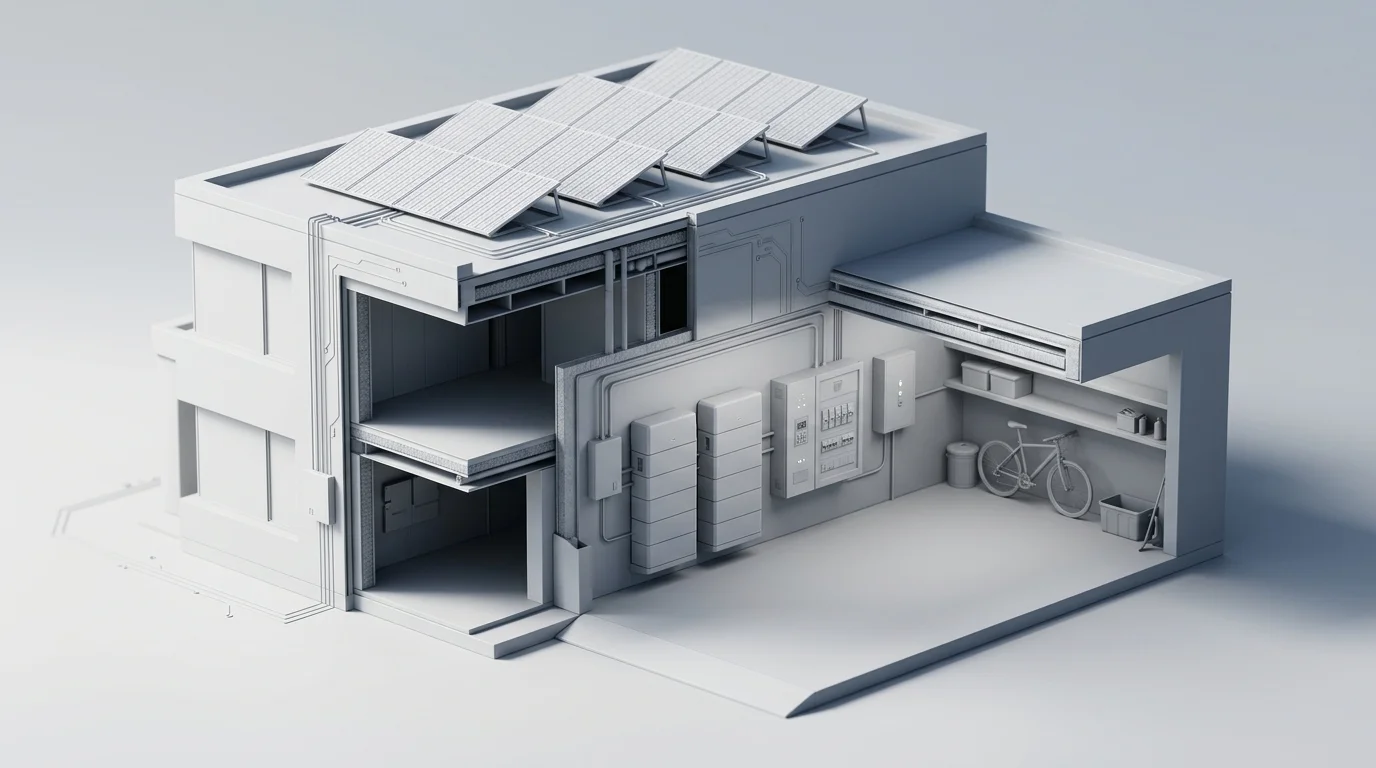
Adding energy storage to your solar panel system gives you peace of mind during grid blackouts and cuts your electric bills. When homeowners start planning a battery installation, the most common question is straightforward: how many solar batteries do I need?
The short answer is that most homes need between one and three modern lithium batteries. A single battery (roughly 10 to 13.5 kilowatt-hours of usable storage) easily keeps your lights, Wi-Fi router, and refrigerator running during an emergency. Two batteries allow you to run heavier appliances and avoid expensive peak electricity rates in the evening. Three or more batteries give you whole-home backup power that can run central air conditioners, heat pumps, and well pumps without worry.
Understanding how battery capacity, power ratings, and your daily energy habits interact helps you choose the exact setup for your needs and budget.
Two Core Battery Metrics: Capacity vs Power
Before calculating numbers, it is essential to understand the difference between battery capacity and battery power output. Homeowners often mix these two terms up, but they measure completely different jobs.
- Usable Capacity (Kilowatt-Hours / kWh): This measures how much total energy the battery can store. Think of capacity as the size of your water tank. A 13.5 kWh battery can supply 1 kilowatt of continuous power for 13.5 hours, or 2 kilowatts for 6.75 hours.
- Continuous Power Output (Kilowatts / kW): This measures how much electricity the battery can deliver all at once. Think of power output as the width of the faucet. If your central air conditioner requires 4 kW to run, a battery with only a 3 kW continuous rating cannot start or run the compressor on its own, regardless of how much total capacity it holds.
Modern lithium iron phosphate (LiFePO4) solar batteries offer a Depth of Discharge (DoD) of 90% to 100%. This means you can use almost all of the energy stored inside without damaging the battery cells, unlike older lead-acid batteries that could only use 50% of their rated capacity.
The Battery Sizing Calculation Formula
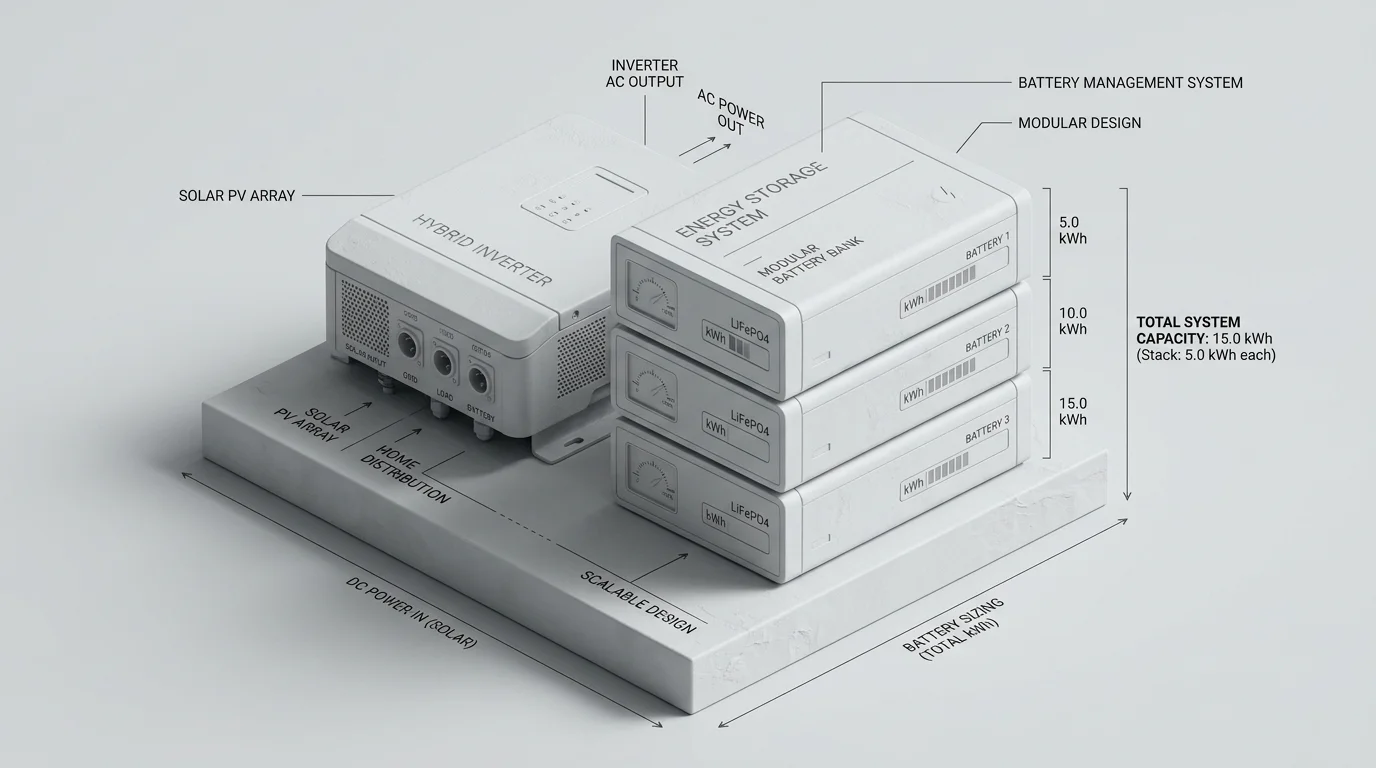
You can determine your ideal battery bank size using a simple four-part calculation. This formula helps you match your daily consumption to your personal backup goals:
Daily kWh Needed = Sum of (Appliance Watts * Hours of Use per Day) / 1,000
Total Battery Bank Capacity (kWh) = Daily kWh Needed / (Depth of Discharge * Round-Trip Efficiency)
Number of Batteries = Total Battery Bank Capacity / Usable kWh Per Battery Unit
In practical installations, modern home batteries operate at roughly 90% round-trip efficiency and 95% usable depth of discharge. Multiplying 0.95 by 0.90 yields an effective system factor of approximately 0.855. This factor accounts for energy converted to heat during charging and discharging.
Four Steps to Calculate Your Solar Battery Needs
Follow these four steps to find the exact number of battery modules required for your property:
1. Review Your Electric Bill
Look at your monthly power statement to find your average daily kilowatt-hour usage. The average American home uses about 29 kWh per day, which works out to roughly 1.2 kWh per hour across a normal 24-hour cycle.
2. Choose Your Backup Goal
Decide whether you want emergency critical load protection (5 to 10 kWh daily), time-of-use peak bill savings (10 to 20 kWh daily), or complete whole-home off-grid security (25 to 40+ kWh daily).
3. Calculate Critical Appliance Wattages
List the essential equipment you must keep running during a storm: your refrigerator (1.5 kWh/day), LED lights and Wi-Fi (0.8 kWh/day), laptop and phone chargers (0.5 kWh/day), and water filtration or pumps.
4. Divide by Usable Battery Size
Take your target daily backup kilowatt-hours and divide by the usable capacity of your chosen battery brand (typically 5 kWh, 10 kWh, or 13.5 kWh per unit) to get your final battery count.
Comparing the Three Sizing Tiers
Most residential solar installations fall into one of three distinct battery configurations based on budget and electrical demands:
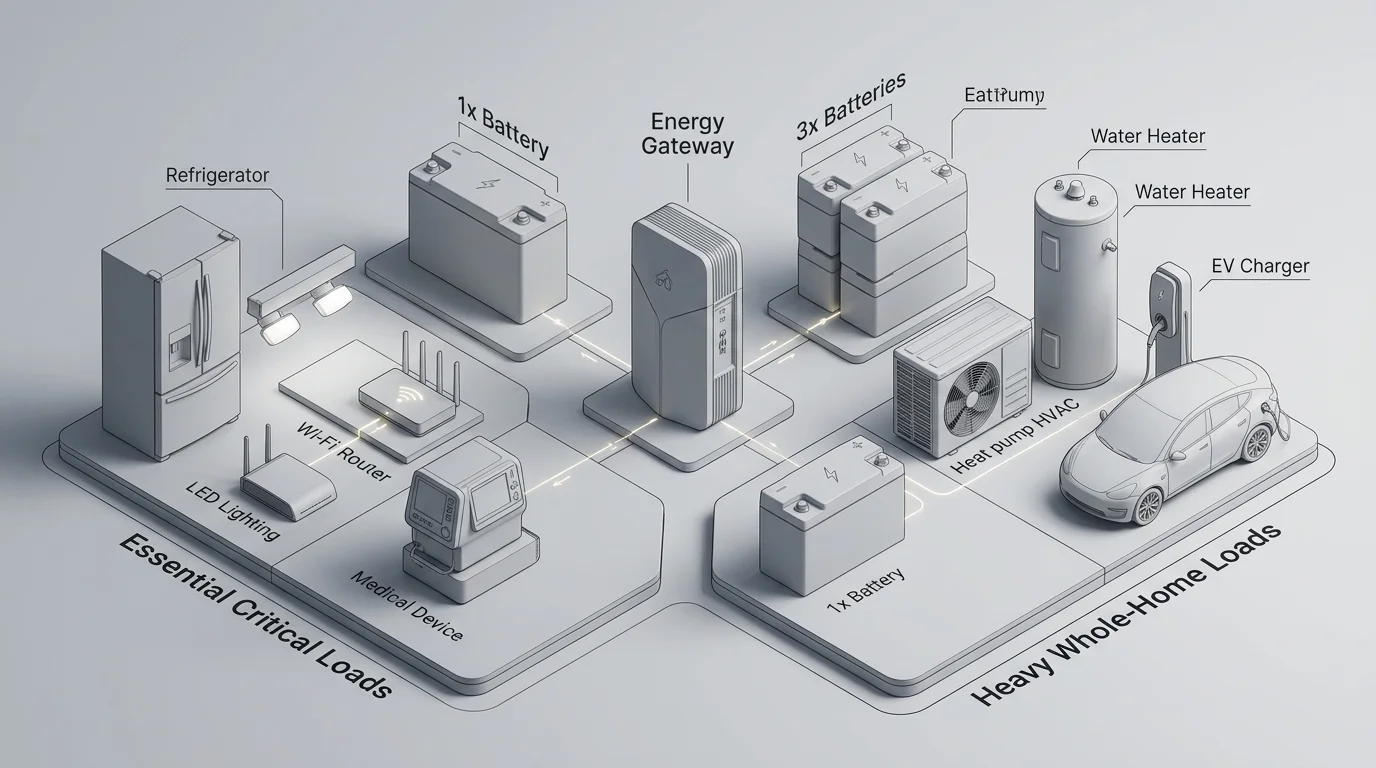
Tier 1: Critical Loads
Powers essential household circuits through a dedicated backup subpanel. Keeps your refrigerator, internet gateway, home office electronics, LED lighting, and medical devices powered for 18 to 24 hours during an outage.
Tier 2: Daily Self-Consumption
Provides the best financial return under modern net metering policies. Stores excess midday solar generation to power your home during expensive evening peak utility hours. Keeps essentials running plus microwave, television, and gas furnace blowers.
Tier 3: Whole-Home Backup
Eliminates the need to pick and choose circuits. Powers high-draw electrical equipment including central heat pumps, central air conditioning, well pumps, electric water heaters, and electric vehicle charging sessions through multi-day storms.
Appliance Runtime Estimates by Battery Bank Size
How long will your equipment actually run when the power grid goes down? The table below outlines realistic runtimes for standard household appliances across common battery system sizes:
| Household Appliance | Average Power Draw | 10 kWh Battery (1 Unit) | 20 kWh Battery (2 Units) | 30 kWh Battery (3 Units) |
|---|---|---|---|---|
| Full-Sized Refrigerator | 150 Watts (running cycle) | 48 to 60 Hours | 96 to 120 Hours | 140+ Hours |
| Wi-Fi Router & Modem | 15 Watts | 300+ Hours | 600+ Hours | 900+ Hours |
| Home LED Lighting (6 fixtures) | 60 Watts | 120 Hours | 240 Hours | 360 Hours |
| CPAP Medical Machine | 40 Watts | 150 Hours | 300 Hours | 450 Hours |
| Microwave Oven | 1,200 Watts | 6 Hours total cooking | 12 Hours total cooking | 18 Hours total cooking |
| Central Air Conditioning (3-Ton) | 3,500 Watts | 2 to 2.5 Hours | 4.5 to 5.5 Hours | 7 to 9 Hours |
| Ductless Mini-Split Heat Pump | 1,000 Watts | 8 to 9 Hours | 16 to 18 Hours | 24 to 28 Hours |
| Electric Vehicle Level 2 Charger | 7,200 Watts | 1 Hour (adds ~25 miles) | 2.5 Hours (adds ~60 miles) | 3.8 Hours (adds ~90 miles) |
When your solar panels produce power during daylight hours, your batteries recharge continuously. With sunny conditions, a 10 kWh battery paired with a 6 kW solar panel array can keep essential loads running indefinitely.
Financial Incentives and Tax Credits
Investing in home energy storage has become significantly more affordable thanks to government incentives. Under Section 25D of the Internal Revenue Code, the Residential Clean Energy Credit provides a 30% federal tax credit on the full equipment and installation cost of battery storage systems with a capacity of 3 kilowatt-hours or greater.
Notably, you qualify for this 30% credit even if you install a battery storage unit without adding new solar panels, or if you add storage to an existing solar setup installed years ago. Many local electric utilities also offer lucrative demand response programs and battery rebates that pay homeowners annual bonuses for allowing small discharges during high-stress summer afternoons.
Frequently Asked Questions
A single 10 kWh to 13.5 kWh battery cannot run an entire home with central air conditioning, an electric oven, and an electric clothes dryer all at once. Heavy appliances demand high surge currents that exceed the 5 kW to 7 kW continuous power output of one battery. To back up whole-house loads without managing circuits, you typically need at least two or three batteries paired with a smart electrical management panel.
Yes, most modern lithium battery systems are modular. You can start with a single battery to keep upfront costs low and add a second or third battery module as your budget permits or if you purchase an electric vehicle. Make sure your initial hybrid inverter and balance-of-system equipment support expansion before starting installation.
Modern lithium iron phosphate (LiFePO4) solar batteries are rated for 4,000 to 10,000 complete charge cycles. In normal residential daily cycling, this translates to between 10 and 15 years of useful operating life. Most reputable manufacturers provide a 10-year warranty that guarantees the battery will maintain at least 70% of its original capacity.
Yes, solar panels still generate electricity under diffuse daylight during cloudy weather, typically producing 10% to 25% of their rated capacity. While recharging takes longer on rainy days, your system will continue replenishing battery storage whenever daylight is present.