Solar Energy for Wastewater Treatment Plants: Guide to Costs & Savings
Discover how municipal wastewater treatment plants use solar arrays, floating solar on lagoons, and battery microgrids to slash power bills and prevent outages.
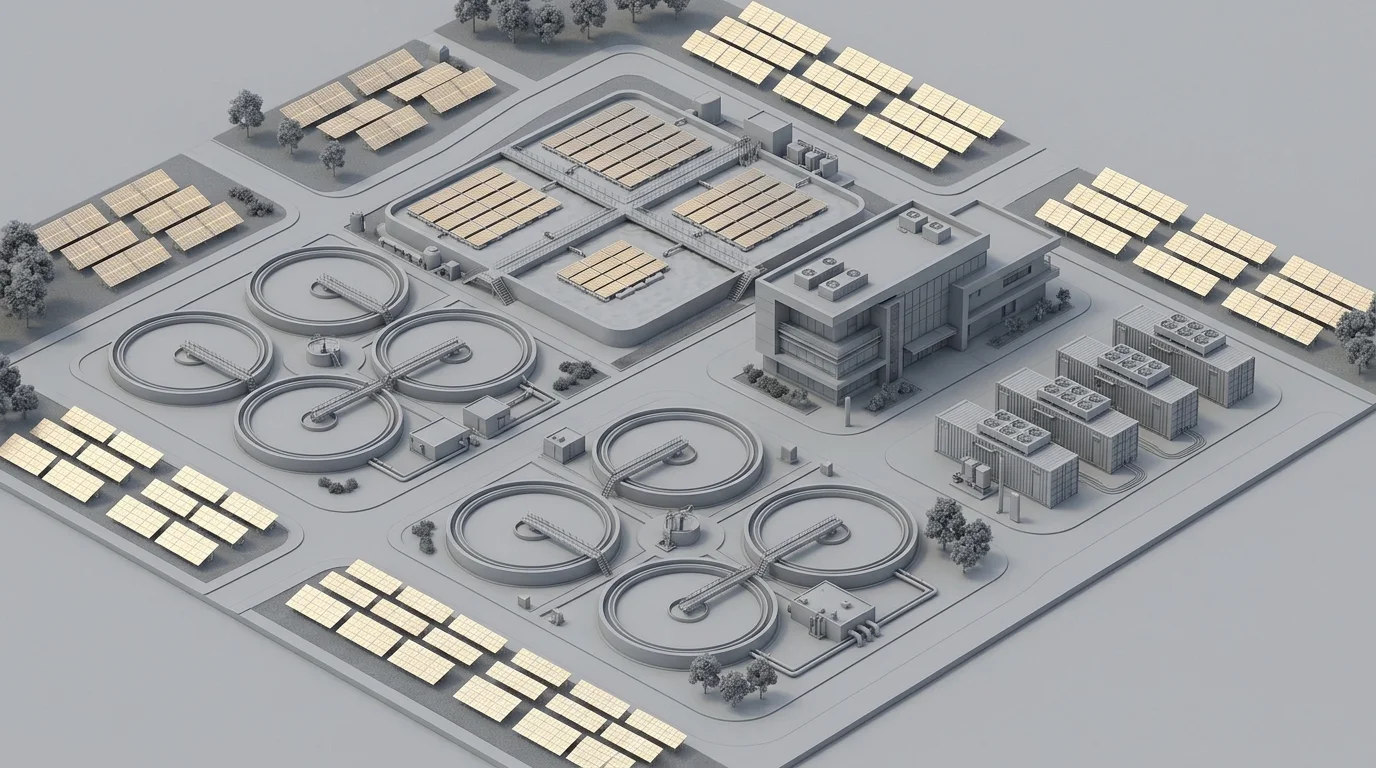
Wastewater treatment plants are among the largest electricity consumers in local government. Municipal water and wastewater treatment facilities consume roughly 2% of all electricity generated in the United States. For many cities and towns, running sewage treatment equipment, massive aeration blowers, and high-pressure water pumps accounts for 25% to 40% of the entire municipal electric bill.
To control rising utility rates and protect public health, city planners and utility managers are deploying solar energy for wastewater treatment plants. By installing ground-mounted solar fields, floating solar panels over treatment lagoons, and battery microgrids, water utilities can lock in predictable energy rates and prevent hazardous untreated sewage overflows during electric grid blackouts.
In this guide, we review how wastewater facilities use solar power, explain floating solar technology on aeration basins, compare municipal financing models, and explore emergency microgrid design.
Why Wastewater Facilities Require Enormous Electrical Power
Treating millions of gallons of residential and industrial sewage every single day is a non-stop biological and mechanical process. Unlike standard municipal office buildings that close down at night, wastewater plants must operate 24 hours a day, 365 days a year.
Power consumption across a typical water resource recovery facility is divided across three main operational phases:
- Aeration Basins (25% to 60% of plant energy): Aerobic bacteria need constant oxygen to digest organic waste. Giant electric blowers and mechanical surface aerators pump compressed air into deep aeration basins around the clock.
- Raw Sewage and Effluent Pumping (10% to 15% of plant energy): Large electric submersible pumps lift heavy wastewater into primary clarifiers and push treated effluent through discharge pipelines.
- Sludge Dewatering and Processing (25% to 33% of plant energy): Centrifuges, belt filter presses, and thermal dryers require continuous high-voltage power to separate water from solid biosolids.
Because water utility energy demand is steady during daylight hours, on-site solar generation creates an ideal balance, directly replacing expensive grid electricity with clean solar kilowatt-hours as fast as they are generated.
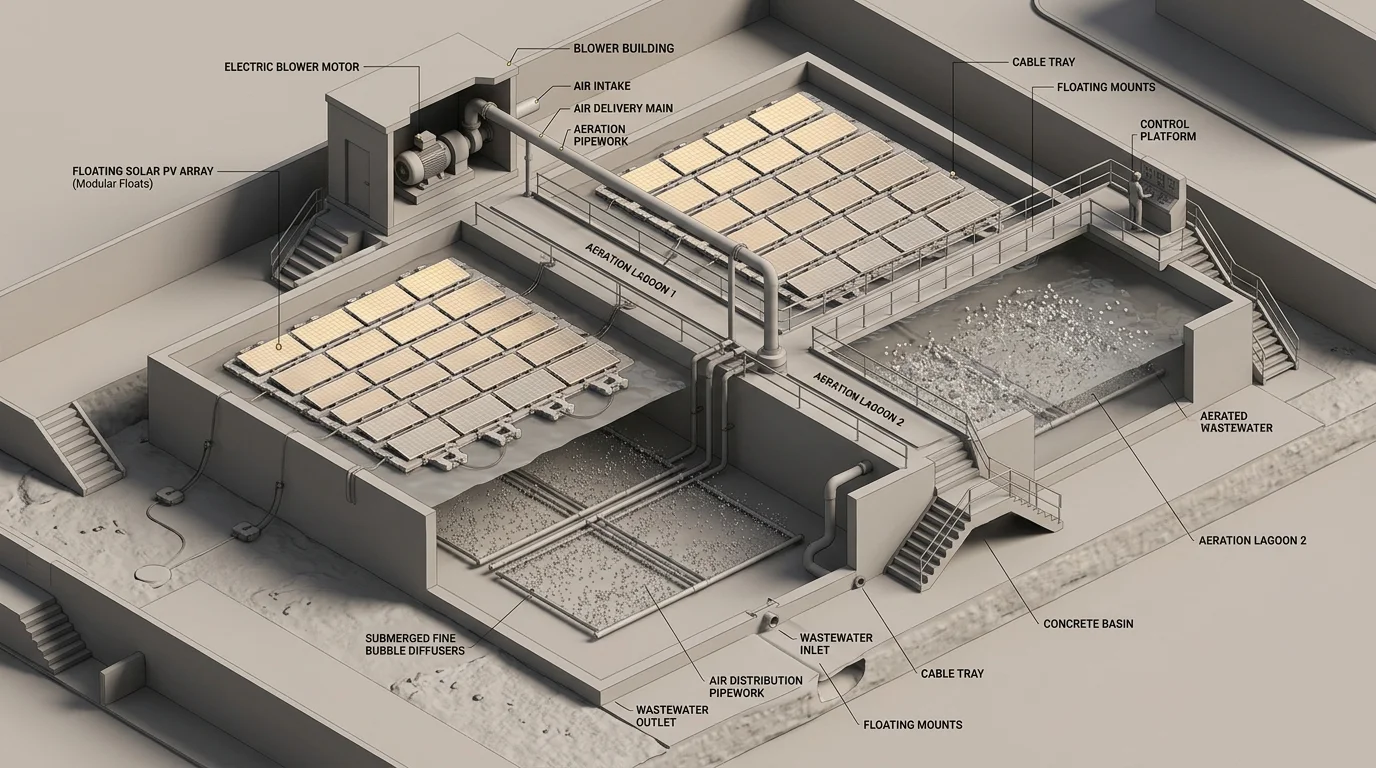
The Advantages of Floating Solar on Equalization Basins
Wastewater facilities often have limited open rooftop space on buildings, but they manage vast acres of open water surfaces in the form of equalization basins, retention ponds, and chlorine contact lagoons.
Deploying floating solar arrays (also known as floatovoltaics) on treatment ponds delivers multiple engineering and environmental benefits:
- Zero Land Acquisition Cost: Floating panels turn non-productive pond surfaces into revenue-generating clean energy assets without taking up valuable dry land.
- Natural Water Cooling Boosts Panel Efficiency: High ambient summer temperatures reduce solar panel output. The cooling effect from underlying lagoon water keeps solar cells 5 to 10 degrees cooler, boosting annual electrical yield by 5% to 12% compared to standard ground-mounted arrays.
- Evaporation Reduction: Covering pond surfaces with floating solar modules shades the water, cutting surface water evaporation by up to 70% in arid and drought-prone regions.
- Algae Growth Suppression: By blocking direct sunlight from reaching nutrient-rich wastewater lagoons, floating solar arrays stop harmful algae blooms that clog intake filters and degrade water quality.
How Solar Microgrids Protect Water Systems During Grid Blackouts
When extreme storms, hurricanes, or heatwaves knock out the regional power grid, wastewater treatment plants cannot afford to go offline. A loss of electrical power can cause catastrophic raw sewage backups into city streets, basements, and local rivers within hours.
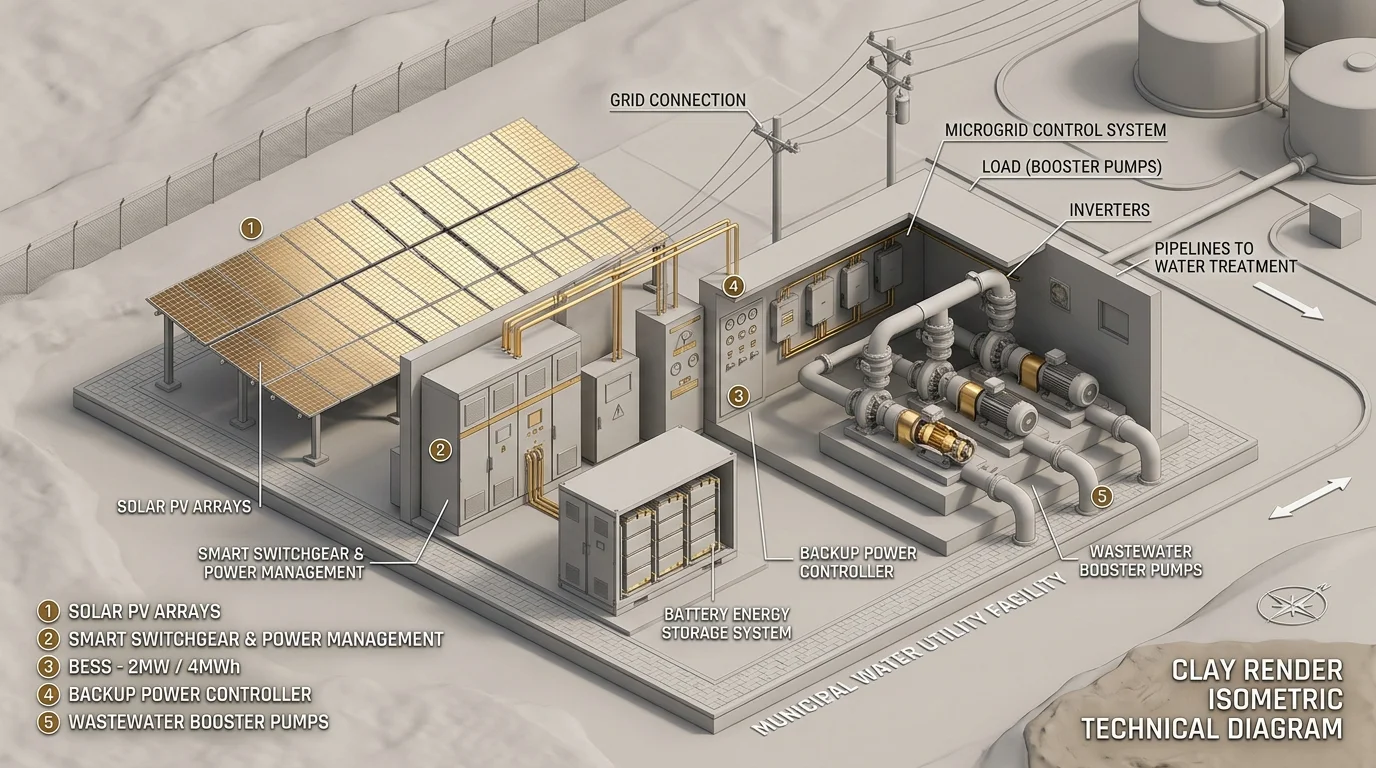
Combining on-site solar arrays with battery energy storage systems (BESS) creates a resilient municipal microgrid:
Continuous Midday Solar Capture
Ground-mounted solar panels, rooftop arrays, and floating lagoon modules generate clean direct current (DC) electricity to power active blowers and pumps.
Smart Battery Energy Storage
Excess daytime solar energy charges large lithium iron phosphate (LFP) battery containers, preparing stored reserves for evening aeration cycles.
Peak Demand Charge Reduction
Intelligent power controllers discharge battery power during sudden pump startups, shaving costly utility demand spikes and lowering peak tariff rates.
Seamless Islanding Backup
During unexpected grid failures, automatic microgrid switchgear instantly islands the plant, running essential biological treatment without dirty diesel fuel delays.
Comparing Municipal Wastewater Solar Financing Models
Public wastewater authorities and regional sewer districts have multiple flexible financing options to build on-site solar and battery systems:
Power Purchase Agreement (PPA)
A private clean energy developer finances, engineers, installs, and maintains the solar system on water utility land or lagoons. The municipality buys the generated electricity at a fixed, low rate per kilowatt-hour, providing day-one utility cost savings without taking on municipal debt.
Direct Ownership via Elective Pay
The municipality finances the project through municipal revenue bonds or Clean Water State Revolving Funds. Under federal Elective Pay rules, tax-exempt municipal water authorities receive a direct cash payment covering 30% to 50% of total project costs.
Energy Savings Performance Contract
An Energy Service Company (ESCO) bundles solar installation with high-efficiency aeration blowers, variable frequency drives (VFDs), and smart SCADA controls, guaranteeing that energy savings will pay for the equipment costs.
Key Steps to Deploy Solar at a Water Treatment Facility
Municipal engineers and water utility boards can follow this five-step implementation roadmap:
- Conduct a Plant Energy Baseline Audit: Analyze 24-month electrical load profiles, submeter aeration blower circuits, and evaluate pump startup surge characteristics.
- Perform Site and Lagoon Structural Assessments: Verify soil bearing capacity for ground mounts, inspect building roof structural integrity, and survey lagoon bathymetry and anchoring points for floating solar floats.
- Model Solar and Storage Economics: Calculate optimal solar panel sizing and battery capacity (kWh) to maximize peak demand shaving and qualify for local net billing or clean energy tariffs.
- Issue a Competitive Municipal RFP: Request comprehensive turnkey proposals from experienced commercial and industrial solar engineering, procurement, and construction (EPC) firms.
- Coordinate Utility Interconnection and SCADA Integration: Interconnect the solar microgrid with local utility switchgear and integrate solar monitoring into the plant central SCADA control room.
Frequently Asked Questions
Yes. Wastewater treatment facilities produce hydrogen sulfide (H2S), ammonia, and moisture. Commercial solar arrays installed at water plants utilize marine-grade anodized aluminum mounting frames, 316 stainless steel fasteners, NEMA 4X sealed inverter enclosures, and anti-corrosive conformal coatings on electrical circuit boards to ensure 25 to 30 year operating lifespans.
Floating solar racking systems are secured using flexible anchoring lines and self-tensioning elastic moorings attached to concrete deadweight anchors on the lagoon bottom or heavy bank anchors along the shoreline. These systems automatically adjust as water levels rise and fall during storm surge or basin draining.
A medium-sized municipal wastewater facility treating 10 million gallons per day (MGD) typically requires 1.5 to 3 megawatts (MW) of solar capacity to offset 40% to 70% of its daytime energy use. This saves taxpayers hundreds of thousands of dollars in utility electric bills annually.
No. Modular floating solar arrays are designed with integrated maintenance walkways that allow technicians to inspect water aeration equipment safely. For periodic lagoon dredging, floating modular sections can be uncoupled and temporarily repositioned to one side of the basin without disassembling the electrical wiring.