Solar Power for Warehouses: Commercial Rooftop Systems and Fleet Integration
Explore how commercial solar power and battery storage transform warehouses and logistics hubs into resilient, cost-saving clean energy powerhouses.
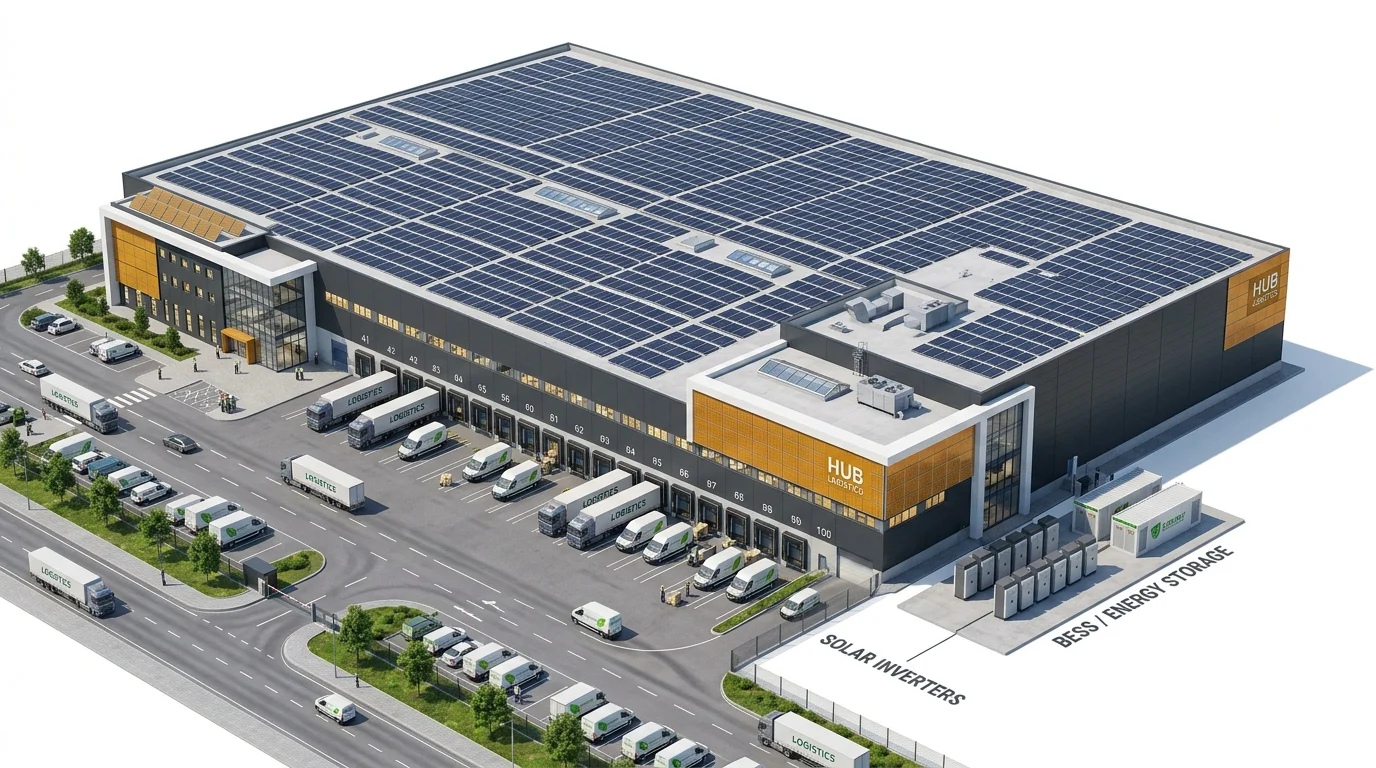
Modern logistics centers and distribution warehouses are among the highest energy users in the commercial property sector. A standard one million square foot fulfillment center consumes between 10 and 18 megawatt-hours (MWh) of electricity every day to run high-bay lighting, automated conveyor belts, and climate control systems.
At the same time, warehouses possess one of the greatest untapped clean energy assets: massive, unobstructed flat roofs. Spanning hundreds of thousands of square feet, these roof surfaces provide the perfect foundation for multi-megawatt solar photovoltaic (PV) arrays.
When combined with on-site battery storage and electric vehicle (EV) charging depots, warehouse solar systems turn large operating expenses into long-term financial assets. Here is a complete guide to how warehouse solar works, layout options, fleet charging integration, and commercial return on investment.
Why Warehouses Are Ideal for Commercial Solar
Warehouses offer unique structural and operational benefits that make them ideal hosts for commercial solar installations:
- Massive Unshaded Roof Space: Most logistics hubs feature wide open roofs ranging from 100,000 to over 1,000,000 square feet. A 500,000 square foot roof can easily support a 4 to 5 megawatt (MW) solar system without ground footprint constraints.
- Daytime Energy Alignment: Warehouse activity peaks during daylight hours when workers, robotic sorting conveyors, and air handlers run continuously. This means the building consumes solar power directly as it is generated, maximizing self-consumption and avoiding utility peak demand charges.
- Low Structural Complexity: Modern commercial roofs with single-ply TPO or EPDM membranes allow for ballasted mounting systems. Installers place panels on specialized trays held down by concrete blocks, eliminating roof penetrations and preserving membrane warranties.
- Fleet Electrification Ready: Logistics companies are rapidly replacing diesel delivery vans with battery-electric models. On-site solar provides predictable, low-cost electricity right at the depot where vehicles park overnight.
Layout Options: Rooftop, Carport, and Ground Arrays
Depending on site boundaries and available acreage, logistics operators deploy solar across three main physical configurations:
Rooftop Ballasted PV
Uses existing roof area without consuming any ground space or parking stalls. Non-penetrating ballasted mounts protect commercial roofing warranties and keep installation costs low.
Solar Carport Canopies
Covers vehicle parking stalls and delivery van staging lanes with overhead solar canopies. Directs clean power straight to EV charging pedestals while providing weather protection for vehicles.
Adjacent Ground-Mount
Installed on surplus land parcels or retention basin buffer zones next to the warehouse. Allows optimal panel tilt angles and single-axis tracking for maximum annual energy yield.
How Solar Powers the Modern Distribution Center
An industrial warehouse solar setup links rooftop solar panels, a central Battery Energy Storage System (BESS), smart electrical switchgear, automated warehouse machinery, and delivery vehicle charging docks into a unified microgrid.
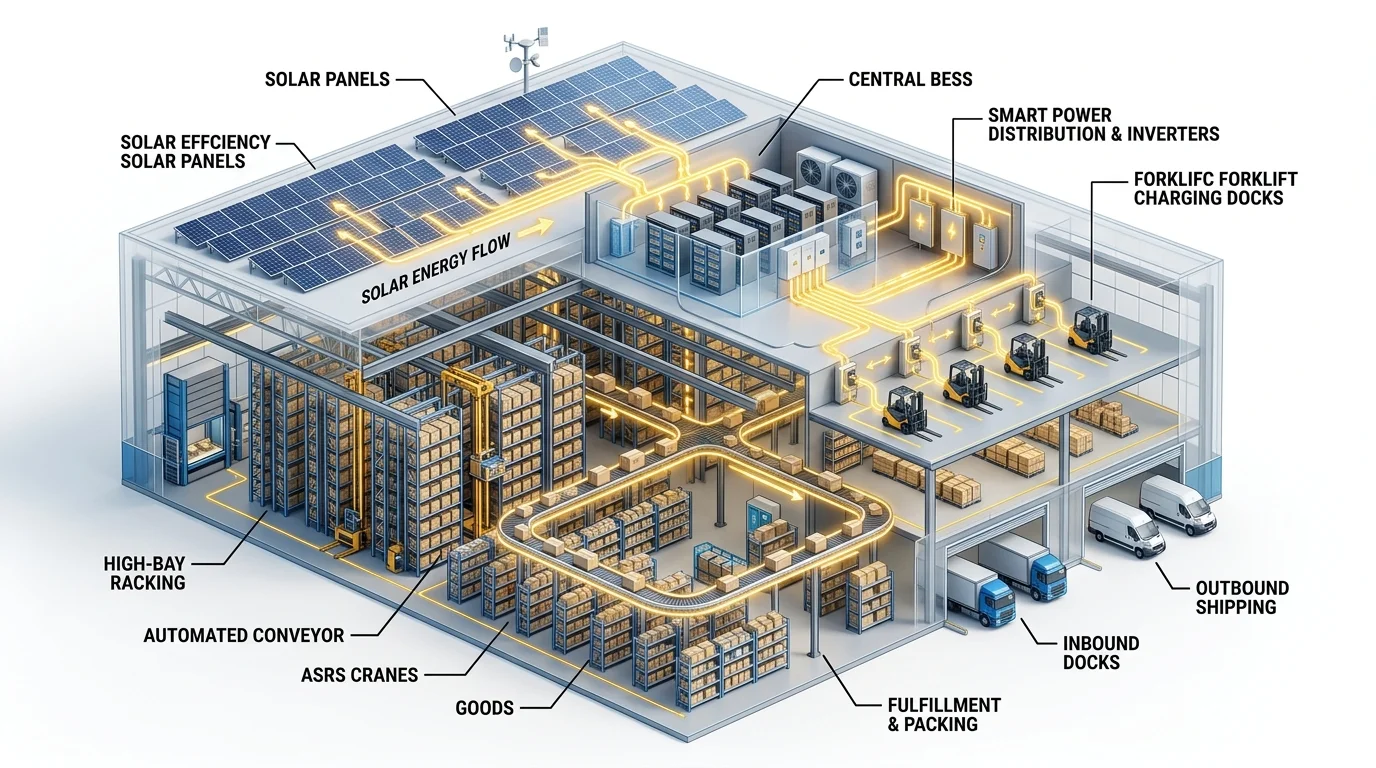
During peak sunlight hours, rooftop solar panels generate high-voltage Direct Current (DC) power. Commercial central inverters convert this energy into standard 480V three-phase Alternating Current (AC).
Smart energy management systems automatically direct this power to three priority channels:
- Immediate Facility Loads: Powering automated storage and retrieval systems (ASRS), sorting conveyors, ventilation fans, and high-bay LED lighting.
- Battery Storage Charging: Storing surplus daytime energy in on-site lithium iron phosphate (LFP) battery cabinets to power facility loads during evening peak rate windows or sudden utility blackouts.
- Material Handling Equipment: Running dedicated rapid charging stations for electric forklifts, automated guided vehicles (AGVs), and order pickers between work shifts.
Integrating Electric Delivery Fleet Charging
The rapid shift toward commercial electric delivery fleets creates substantial new electricity demand for warehouse hubs. Adding 100 electric delivery vans increases a depot daily energy consumption by 1.2 to 1.8 MWh.
If drawn entirely from the local electric grid during high-demand hours, this charging load triggers expensive utility demand charges and requires costly substation upgrades.
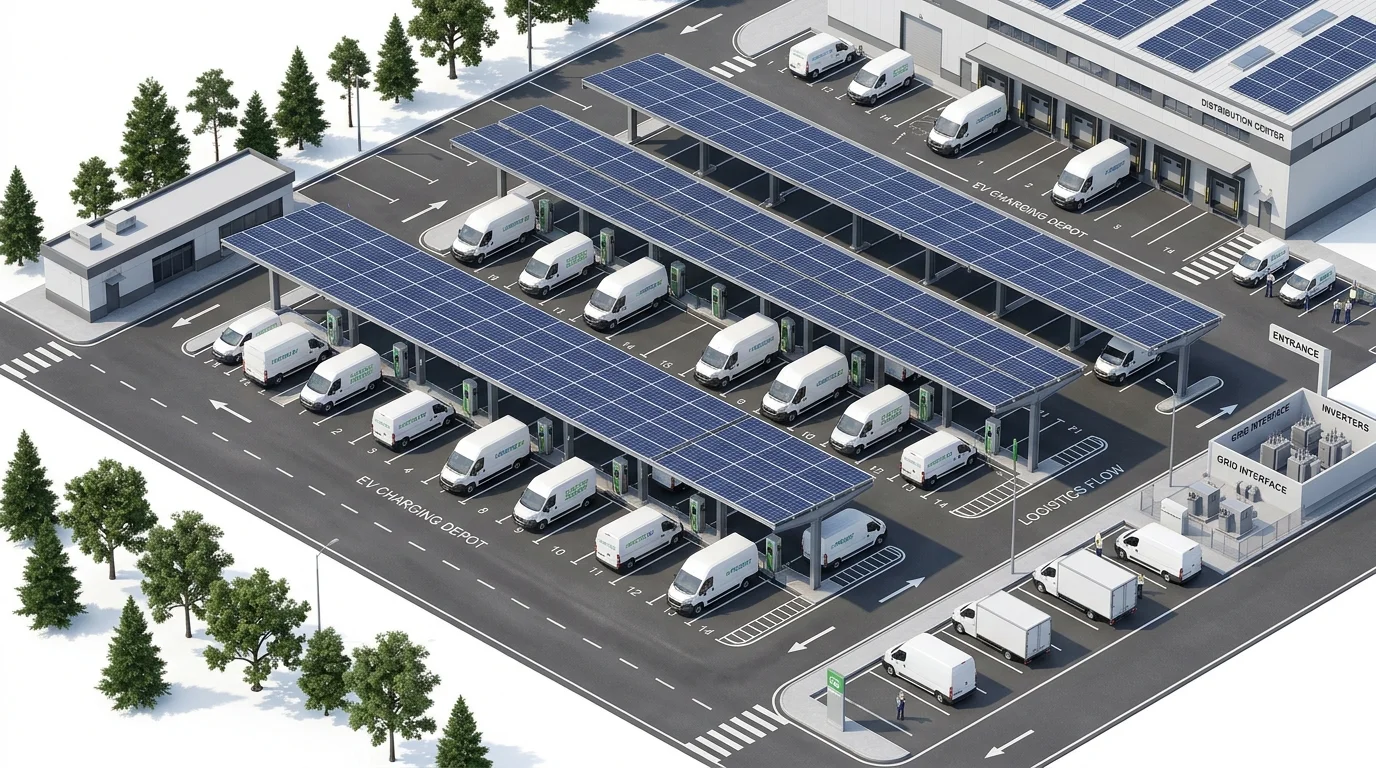
Pairing solar carports and rooftop PV with smart fleet charging software solves this bottleneck:
- Solar Canopies over Vehicle Staging: Solar canopies mounted over van parking bays produce clean power directly above charging stalls.
- Managed Smart Charging: Fleet software schedules high-power charging during solar peak generation or during off-peak overnight hours, smoothing out energy spikes.
- Peak Shaving with Battery Storage: On-site commercial battery systems discharge power when multiple vans plug in simultaneously, preventing utility peak demand penalties.
- Operational Continuity: In the event of an electric grid blackout, the solar microgrid keeps delivery vans charged and ready for daily delivery routes.
5-Stage Implementation Roadmap for Warehouse Solar
Deploying commercial solar on a logistics property requires coordinated engineering, utility interconnection, and construction scheduling:
Structural & Electrical Site Feasibility
Structural engineers evaluate roof dead-load capacity, membrane age, and wind load ratings. Electrical engineers review the main 480V service panel capacity and examine utility interconnection rules.
System Design & Financial Modeling
Designers produce 3D layout models optimizing panel density around rooftop HVAC units and skylights. Financial analysts model energy savings, tax incentives, and utility rate tariffs.
Permitting & Utility Interconnection
The project team submits engineering drawings for local building and fire permits, while filing interconnection applications with the regional electric utility.
Ballasted Installation & Electrical Tie-In
Certified commercial solar contractors install ballasted roof racking, run DC cabling through dedicated conduits, mount inverters, and connect battery storage units on ground pads.
Commissioning & Real-Time Monitoring
Engineers conduct safety tests, obtain final permission to operate (PTO) from the utility, and connect cloud-based energy monitoring software for 24/7 performance tracking.
Financial Payback, Tax Credits, and Commercial ROI
Commercial solar for warehouses delivers strong investment returns backed by federal and regional tax incentives:
- Section 48E Investment Tax Credit (ITC): Commercial projects qualify for a 30% baseline federal tax credit. Facilities located in designated energy communities or utilizing domestic steel and components can claim up to 40% to 50% in total tax credits.
- MACRS Accelerated Depreciation: Businesses can deduct the cost of solar equipment over a 5-year Modified Accelerated Cost Recovery System (MACRS) schedule, often writing off substantial capital costs in the first year.
- Electricity Cost Reductions: On-site solar replaces grid electricity purchased at commercial retail rates, lowering monthly utility bills by 40% to 70%.
- Typical Payback Period: With stacked federal tax credits and accelerated depreciation, commercial warehouse solar projects generally achieve full capital payback within 4 to 7 years. Over their 25-year warrantied lifespan, these systems generate millions of dollars in clean energy savings.
Frequently Asked Questions
No. Commercial solar installers use non-penetrating ballasted racking systems for flat roofs. The racking rests on protective slip sheets directly over the roof membrane, held securely in place by concrete blocks. Major roofing manufacturers approve these ballasted designs to keep full roof warranties intact.
A typical ballasted commercial solar system adds between 3 and 5 pounds per square foot of dead load to the roof. Most modern distribution centers and warehouses built with steel truss framing are engineered to support this load comfortably. A structural engineering review verifies the exact load capacity prior to installation.
Yes. Rooftop solar and solar carport canopies generate low-cost clean electricity on site. When paired with smart energy management software and commercial battery storage, the system can charge delivery vans, yard tractors, and electric forklifts without triggering expensive utility demand charges.
Building owners can structure solar investments through rooftop leases, green lease provisions, or Power Purchase Agreements (PPAs). The landlord can sell solar power to the tenant at a discount compared to the local utility rate, creating a predictable new revenue stream while lowering tenant operating expenses.
Total project timelines typically range from 6 to 12 months. Most of this time is spent on engineering design, local municipal permitting, and utility interconnection approval. The actual physical on-roof construction usually takes only 4 to 8 weeks for a standard multi-megawatt installation.