Solar Powered Airports: Glare Studies, Microgrids, and Aviation Decarbonization
Discover how commercial airports harness solar energy. Learn about FAA ocular glare safety regulations, airfield microgrids, and the future of electrified aviation.

Commercial airports are among the largest single electricity consumers in modern metropolitan areas. A medium to large hub airport consumes between 50 and 200 megawatt-hours of electricity every day. Power runs passenger terminal heating and cooling, flight information displays, high-intensity runway lighting, baggage conveyor networks, and security screening systems.
At the same time, airports hold a unique advantage: vast expanses of open, flat land. Wide safety buffer zones line active runways, while multi-acre maintenance hangars and long parking lots offer ideal surfaces for solar energy generation.
By deploying large-scale solar arrays paired with battery energy storage systems, airport authorities are cutting millions of dollars in annual utility costs. Onsite clean power also shields vital aviation communications and runway operations from regional grid blackouts.
Here is a complete look at how solar-powered airports work, how aviation authorities manage pilot glare risks, the engineering behind airfield microgrids, and the future of electrified flight.
Comparing Airport Solar Deployment Models
Airports use different zones across their property to generate clean electricity. Each area comes with specific safety rules, structural designs, and installation costs.
Airside Ground-Mount Arrays
Installed on flat grass buffer zones between runways and taxiways. Delivers massive megawatt volume but requires strict height limits, frangible mountings, and FAA ocular glare certifications.
Terminal & Hangar Rooftops
Placed on expansive, unobstructed roofs of passenger concourses, cargo facilities, and maintenance hangars. Directly feeds terminal HVAC and baggage handling loads without long electrical trenching.
Solar Parking Canopies
Shades passenger and rental cars while generating clean power. Integrates high-speed electric vehicle charging stations for travelers and ground service fleets.
Managing Glint and Glare: FAA Safety Standards
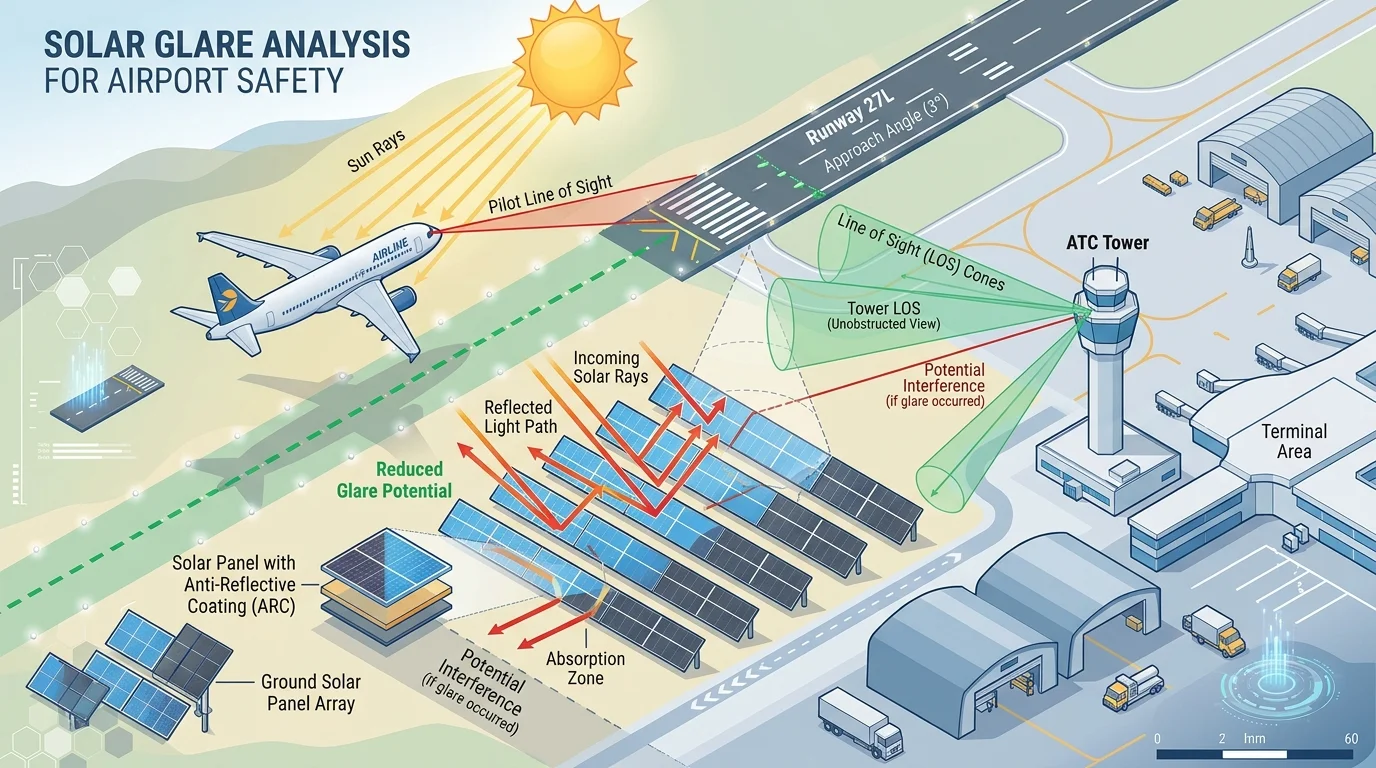
The primary safety question for airport solar installations is glint and glare. Pilots descending toward a runway on final approach and air traffic controllers seated in tall control towers need clear, unobstructed vision at all times.
To protect flight safety, aviation regulators, including the Federal Aviation Administration (FAA), require rigorous optical glare modeling before approving any solar construction on or near airport property.
Understanding Glint vs. Glare
Aviation engineers divide light reflections into two distinct types:
- Glint: A brief, momentary flash of bright light, similar to a reflection off a moving windshield.
- Glare: A continuous, steady reflection that lasts several seconds or minutes as the sun moves across the sky.
The Solar Glare Hazard Analysis Tool (SGHAT)
Before an airport or neighboring landowner installs solar panels within several miles of a runway, engineers run 3D computer simulations using tools like ForgeSolar GlareGauge (developed based on Sandia National Laboratories SGHAT algorithms).
The software maps three critical ocular hazard levels:
- Green Glare (Low Potential for After-Image): A mild reflection that causes no visual impairment. Permitted along flight approach paths.
- Yellow Glare (Potential for Temporary After-Image): Bright enough to create a temporary blind spot or visual spot. Strictly prohibited within the two-nautical-mile final approach corridor and inside air traffic control tower visual sightlines.
- Red Glare (Retinal Burn Risk): An extreme, hazardous light intensity that can cause physical eye damage. Prohibited under all conditions across the entire airport grounds.
How Modern Solar Panels Prevent Glare
Modern solar panels are engineered to absorb as much sunlight as possible, not reflect it. High-efficiency photovoltaic modules reflect only 2 to 4 percent of incoming light. In comparison, calm water reflects over 5 to 10 percent, and typical commercial glass windows reflect 15 to 20 percent.
To pass strict airport safety reviews, developers apply three primary engineering solutions:
- Anti-Reflective Coatings (ARC): Micro-thin layers of silicon dioxide or titanium oxide trap photons within the glass.
- Textured Front Glass: Light-diffusing pyramids etched into the glass scatter incoming rays in random directions rather than bouncing a concentrated beam.
- Fixed Tilt and Azimuth Adjustments: Racking orientation is precisely angled so that peak seasonal reflections aim away from runway approach cones and control tower windows.
Airfield Microgrids: Keeping Airports Running During Blackouts
Power loss at an airport is a major public safety hazard. A sudden grid outage can disable runway approach lights, knock out baggage screening, and ground hundreds of flights.
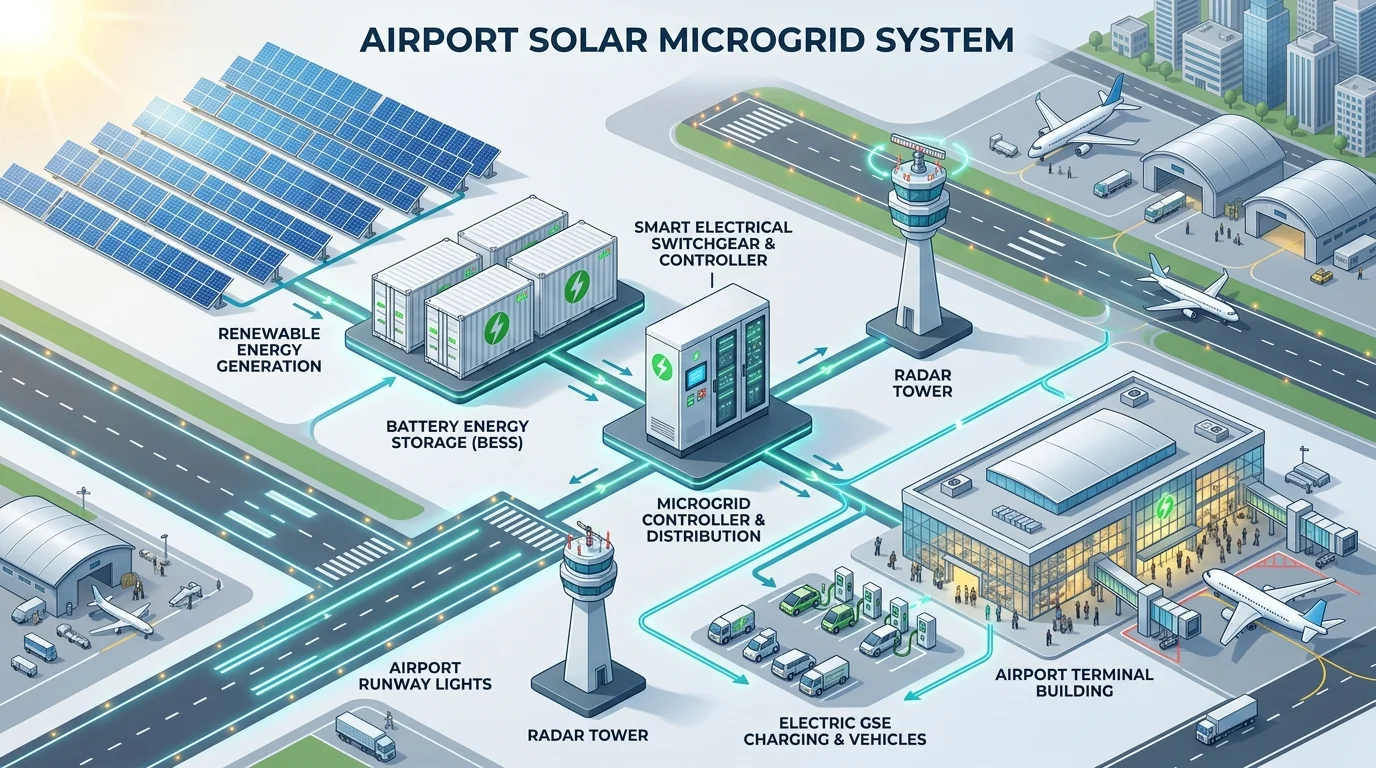
To guarantee continuous operation, modern solar airports integrate photovoltaic arrays with industrial Battery Energy Storage Systems (BESS) and backup generators to form a self-healing microgrid.
Normal Utility Operation
The airport solar farm generates clean electricity during the day. Power first supplies terminal buildings and airfield equipment. Excess generation charges the onsite battery bank or feeds back to the public utility grid for revenue credits.
Instant Grid Outage Detection
If severe weather, a storm, or equipment failure cuts off external utility power, smart microgrid controllers detect the voltage drop in less than 16 milliseconds.
Seamless Islanding Mode
Automated fast-acting switchgear disconnects the airport from the wider regional grid. This prevents dangerous electrical back-feeding into downed utility lines and isolates the airport power network.
Prioritizing Critical Flight Loads
The central energy management system directs stored battery power and active solar generation to essential systems: Air Traffic Control radar, CAT III runway approach lighting, ILS guidance systems, and security screening.
Real-World Solar Airports Leading the Transition
Airports across the globe have proven that solar power delivers both environmental sustainability and financial resilience.
Cochin International Airport (Kerala, India)
In August 2015, Cochin International Airport (CIAL) made global aviation history by becoming the world’s first fully solar-powered airport.
- Installed Capacity: Over 50 Megawatts-peak (MWp) across terminal roofs, carports, and 94 acres of airfield land.
- Daily Generation: Approximately 250,000 kilowatt-hours of clean electricity per day.
- Economic Impact: Completely eliminated the airport’s second-largest operational expense (electricity bills), saving millions of dollars every year.
- Agrivoltaic Synergy: CIAL grows organic vegetables underneath elevated solar arrays, harvesting hundreds of tons of fresh produce each year between flights.
Chattanooga Metropolitan Airport (Tennessee, USA)
Chattanooga Metropolitan Airport (CHA) became the first airport in the United States to achieve 100 percent clean energy self-sufficiency on an annual basis.
- Installed Capacity: 2.64 MW solar farm built on a 12-acre inactive airfield buffer zone.
- Storage Integration: Integrated with an on-site utility-grade battery storage system.
- Resilience Advantage: The system provides complete off-grid islanding capabilities, allowing the airport to maintain critical flight operations even during severe regional grid blackouts.
Indianapolis International Airport (Indiana, USA)
Indianapolis International Airport (IND) hosts one of the largest airport solar installations in North America, known as the IND Solar Farm.
- Installed Capacity: 17.5 MW spread across 75 acres of land near the main terminal entrance.
- Energy Output: Generates over 31 million kilowatt-hours annually, enough electricity to power more than 3,000 average homes.
- Land Optimization: Turns unused runway approach safety buffers into a high-yield revenue stream for the airport authority through long-term utility power purchase agreements.
Powering the Next Era: Electric Aviation and GSE Fleets
The transition to solar-powered airports goes beyond terminal lighting and heating. Clean electricity generated on airfield property is now directly fueling the decarbonization of airport ground operations and next-generation aircraft.
Electrifying Ground Support Equipment (eGSE)
Traditional diesel-powered airport support vehicles produce significant ground-level exhaust. Airports are replacing these legacy machines with zero-emission electric alternatives powered directly by onsite solar:
- Electric Pushback Tugs: High-torque battery tugs that move commercial airliners from boarding gates to taxiways.
- Electric Baggage Tractors and Belt Loaders: Quiet, emissions-free transport for passenger luggage across the apron.
- Ground Power Units (eGPUs): Supplies conditioned electric power to parked airplanes, allowing pilots to turn off noisy auxiliary jet fuel engines (APUs) at the gate.
Preparing for Electric Regional Aircraft and eVTOLs
As electric vertical takeoff and landing (eVTOL) air taxis and hybrid-electric commuter planes enter commercial testing, airport electrical demand will surge.
Megawatt-scale charging pads require immense instantaneous power. Onsite airport solar farms paired with high-capacity battery storage supply the high electrical burst currents required for fast aircraft turnaround times without overloading municipal utility substations.
Frequently Asked Questions
No. Extensive testing by aviation authorities and the FAA shows that standard solar panel arrays do not interfere with airport surveillance radar, instrument landing systems (ILS), or VHF aircraft radio communications. Racking systems are kept low to the ground and positioned outside radar line-of-sight cones to eliminate signal refraction or shadow effects.
Airports use specialized automated robotic cleaners and water-truck wash systems equipped with soft rotating brushes. Cleaning is scheduled during low-traffic night hours to avoid Foreign Object Debris (FOD) hazards on active taxiways and runways.
Aviation regulations make the airport sponsor and developer responsible for resolving any post-construction glare issues. Mitigation steps include adjusting the module tilt angle, adding anti-reflective matte films, or planting non-hazardous vegetative sightline buffers. Performing a certified pre-construction glare study prevents this risk.
Solar panels installed at northern airports utilize dark anti-reflective glass that absorbs ambient heat quickly, accelerating natural snow melting. Arrays are mounted with sufficient ground clearance so shedding snow slides off without burying the lower edge of the modules.
Yes. Small and regional airports frequently utilize Power Purchase Agreements (PPAs) and government infrastructure grants (such as FAA Airport Improvement Program funds and clean energy tax credits). Under a PPA, a third-party developer finances, builds, and maintains the solar system at zero upfront cost to the airport, selling electricity back at a fixed, discounted rate.