Solar Energy vs Nuclear Energy: Cost, Safety, Land Use, and Grid Reliability Comparison
Compare solar energy vs nuclear energy. Discover how levelized costs, build times, capacity factors, safety profiles, and carbon footprints shape our clean power future.
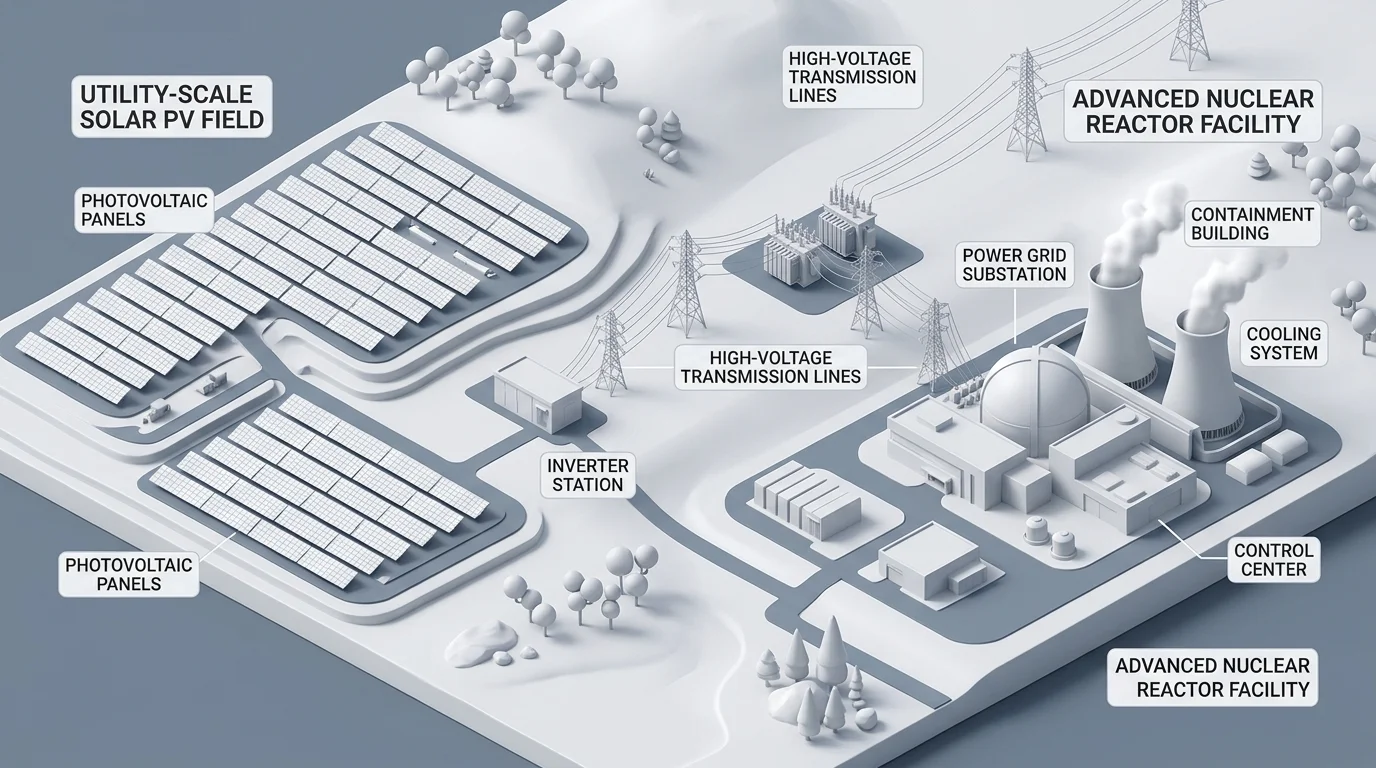
The global transition toward carbon-free electricity has sparked an important debate among policymakers, energy engineers, and consumers: should our clean energy future rely primarily on solar power or nuclear energy? Both technologies generate massive quantities of electricity without burning fossil fuels or releasing greenhouse gases during day-to-day operation, yet they function under completely different economic, operational, and physical principles.
Solar power is modular, rapid to deploy, and currently ranks as the cheapest source of new electricity in history. Nuclear power provides continuous, round-the-clock baseload generation with unmatched power density on a compact land footprint. Understanding how these two zero-emission powerhouses compare across cost, construction speed, safety, and reliability is essential for evaluating national grid strategies and community energy planning.
In this comprehensive guide, we compare solar and nuclear energy across every critical dimension, using the latest empirical data from energy researchers, grid operators, and independent economic benchmarks.
Core Differences in Power Generation
Solar photovoltaic (PV) systems generate electricity by converting photons of sunlight directly into direct current (DC) electricity using semiconductor silicon wafers. Because solar panels depend directly on sunlight, power production peaks during midday hours and stops at night.
Nuclear power plants generate electricity through nuclear fission, where uranium-235 atoms split inside a reactor core to produce intense thermal heat. This heat boils water into pressurized steam, which spins massive steam turbine generators to produce alternating current (AC) electricity continuously.
These distinct mechanics create fundamental differences in grid integration. Solar operates as a variable, distributed power source that scales from individual home rooftops to utility fields. Nuclear operates as a centralized, high-output baseload power plant designed to run continuously at maximum capacity.
Economic Cost Breakdown: LCOE and Capital Investment
When evaluating energy costs, economists rely on the Levelized Cost of Electricity (LCOE). LCOE measures the total lifetime cost of building, financing, operating, fueling, and decommissioning a power plant divided by the total megawatt-hours (MWh) of electricity it generates over its working life.
According to independent benchmark analyses from Lazard and the International Energy Agency (IEA), utility-scale solar photovoltaic energy produces power at an unsubsidized cost of $28 to $45 per MWh. Even when adding 4-hour utility battery storage systems to firm daytime output, solar plus storage ranges between $70 and $115 per MWh.
In contrast, newly constructed conventional nuclear power plants range between $140 and $220 per MWh. Nuclear power carries steep capital expenditures, extensive safety containment engineering, complex licensing processes, and long financing periods where interest accumulates for years before the facility sells its first kilowatt-hour.
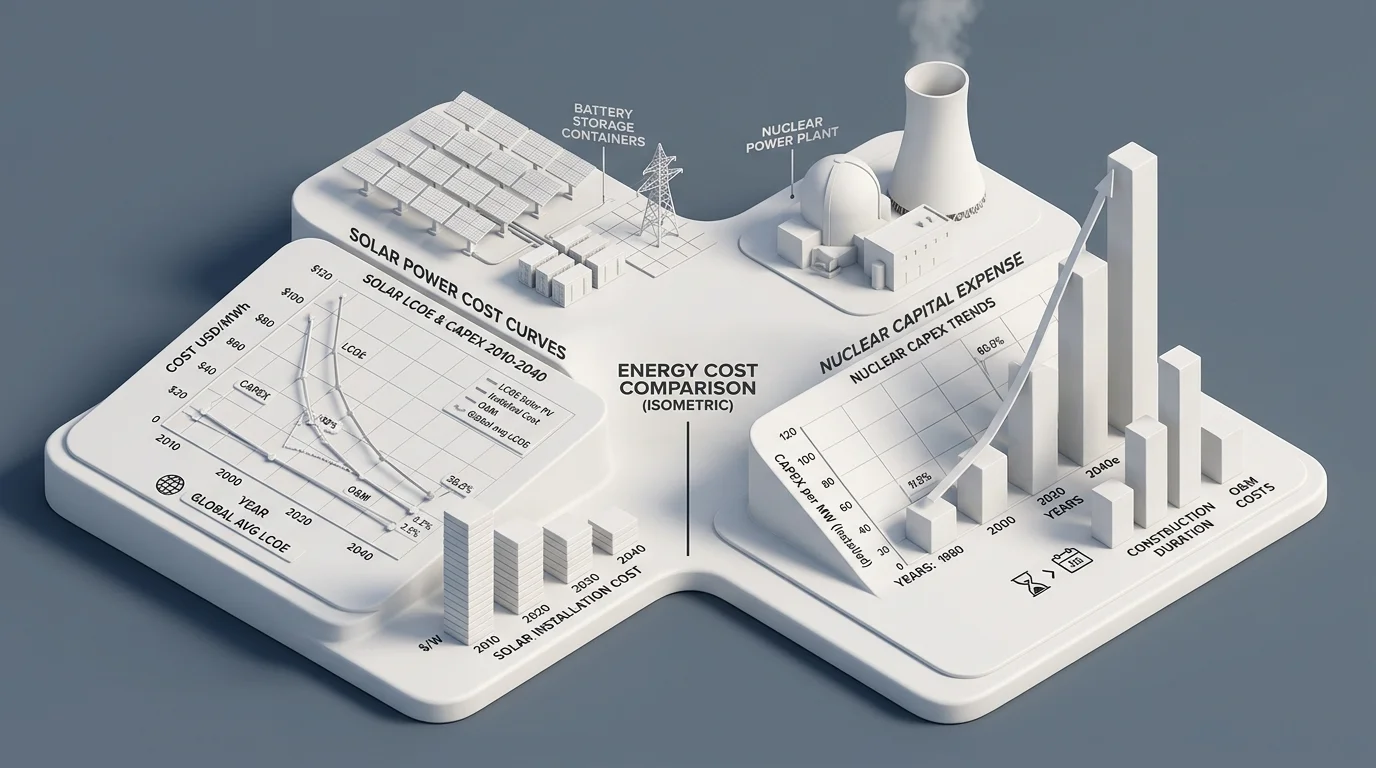
Why Solar Costs Plummeted While Nuclear Remained High:
- Manufacturing Learning Curves: Solar panels follow Swanson’s Law, meaning module prices drop by roughly 20 percent every time global manufacturing capacity doubles.
- Standardized Factory Assembly: Solar panels are mass-produced on automated assembly lines in uniform shapes, whereas nuclear reactors are large custom civil construction projects built on-site.
- Financial Risk and Insurance: Nuclear projects require deep financial guarantees and government risk backstops due to multi-billion dollar construction overruns, while solar projects can be financed in modular phases.
Side-by-Side Performance and Lifecycle Comparison
To see how these clean power sources measure up, let us examine their key operational specifications side by side:
Utility-Scale Solar Energy
- Lowest levelized cost of energy across all global generation technologies
- Fast construction timeline of 12 to 24 months from groundbreak to grid connection
- Highly modular deployment from residential rooftops to multi-gigawatt desert installations
- Zero water consumption during electricity generation
- Requires battery storage or grid balancing to manage nighttime and cloudy demand
Advanced Nuclear Energy
- Industry leading capacity factor operating continuously 24 hours a day
- Ultra compact land footprint requiring only 1 to 2 acres per megawatt of capacity
- Long facility operational lifespan lasting 60 to 80 years with refurbishment
- High upfront capital expense exceeding $8,000 to $12,000 per installed kilowatt
- Lengthy construction periods lasting 8 to 14 years with strict regulatory hurdles
Construction Timelines and Deployment Speed
Speed is a decisive factor in global decarbonization. Every year spent waiting for new clean power generation to come online is a year where legacy fossil fuel power plants continue burning natural gas and coal.
Solar farms can be planned, permitted, constructed, and synchronized to the grid within 12 to 24 months. Rooftop residential solar installations can be completed in as little as one to three days once municipal permits are approved.
In comparison, commercial nuclear reactors frequently encounter construction timelines lasting 8 to 14 years. For example, the Vogtle Units 3 and 4 expansion in Georgia took over 14 years to complete, with final costs surpassing $35 billion. While emerging Small Modular Reactors (SMRs) aim to reduce factory build times to 4 to 6 years, commercial factory pipelines are still in early licensing stages.
Land Use, Power Density, and Environmental Footprint
Land footprint is an area where nuclear power holds a notable physical advantage:
- Nuclear Power Density: A typical 1,000-megawatt nuclear reactor requires approximately 200 to 400 acres of land, generating around 8 billion kilowatt-hours of power annually.
- Solar Power Density: Generating the equivalent annual energy output with solar PV requires roughly 4,000 to 7,000 acres, because solar panels must be spaced out and only produce power during daylight hours.
However, solar energy offers unique land flexibility that mitigates this difference:
- Dual-Use Surfaces: Solar can be installed on existing artificial surfaces that require zero extra land, including home rooftops, commercial warehouses, parking lot carports, and irrigation canals.
- Agrivoltaics: Solar arrays can be elevated above crop fields, pasture lands, and pollinator habitats, allowing agricultural production and clean power generation to co-exist on the same plot.
- Brownfield Redevelopment: Solar farms can be situated on capped landfills, former coal mines, and industrial brownfield sites where other construction is restricted.
Lifecycle Emissions, Water Use, and Safety Records
Both solar and nuclear energy boast stellar environmental and safety track records when compared to fossil fuels:
1. Lifecycle Carbon Intensity
Neither technology emits carbon during electricity generation. Over their full lifecycle (including mining, raw materials extraction, manufacturing, construction, and end-of-life recycling), solar PV lifecycle emissions average 25 to 45 grams of CO2 equivalent per kilowatt-hour, while nuclear averages 12 to 28 grams per kilowatt-hour. Both are vastly cleaner than natural gas (450 g/kWh) and coal (820 to 1,000 g/kWh).
2. Water Requirements
Traditional nuclear power plants require enormous amounts of cooling water, consuming between 400 and 700 gallons of water per MWh of electricity generated. During severe summer droughts and heatwaves, nuclear plants occasionally must throttle output if river temperatures rise too high. Solar photovoltaic panels require virtually zero water during operation, needing only occasional washing to remove surface dust.
3. Safety and Waste Management
Nuclear energy produces high-level radioactive spent fuel that must be safely stored in reinforced dry casks and long-term deep geological repositories. While nuclear power has one of the lowest historical mortality rates per terawatt-hour produced, public perception and severe incident prevention require stringent containment systems.
Solar panels produce zero operational waste during their 25 to 30 year lifespan. At end of life, solar panels are processed in specialized circular recycling facilities that recover up to 95 percent of silver, silicon, copper, and glass for manufacturing new panels.
How Solar and Nuclear Work Together on the Modern Grid
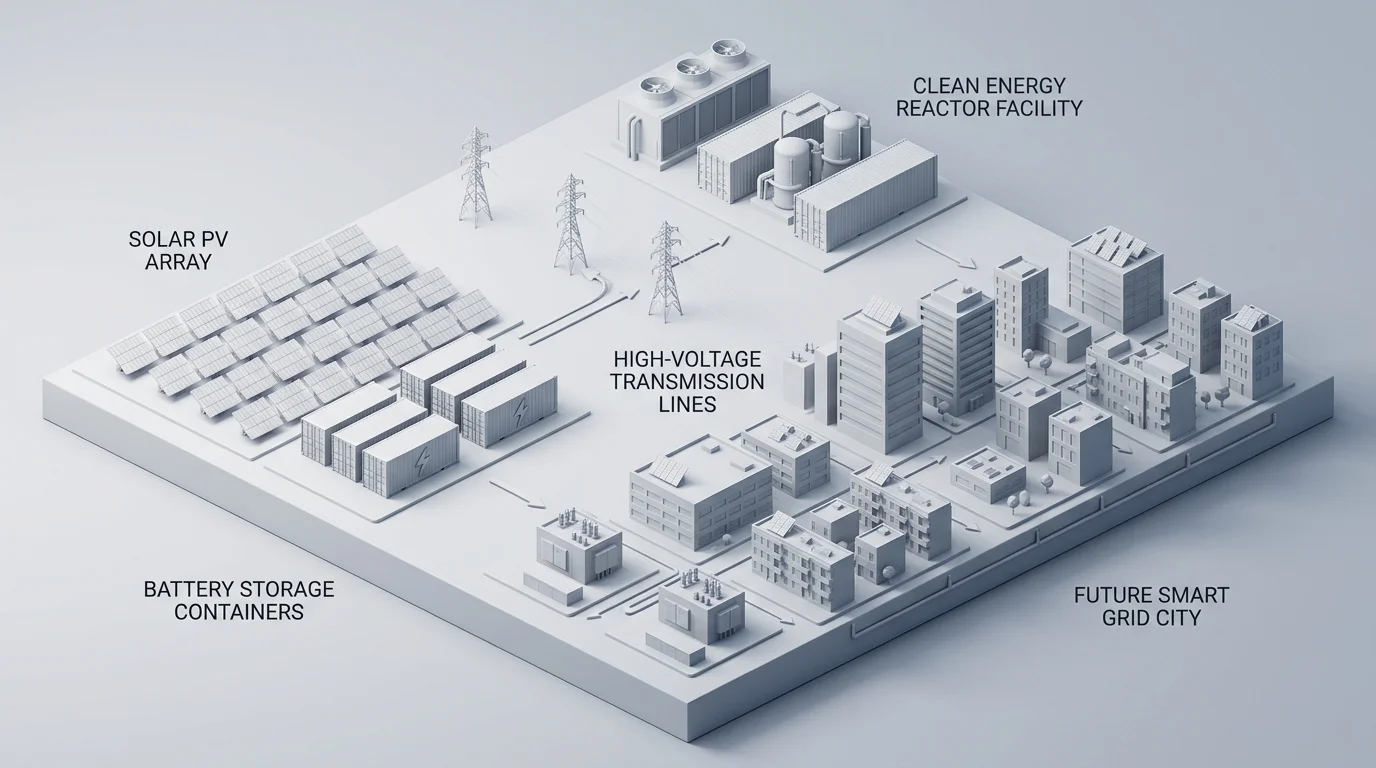
Rather than viewing solar and nuclear as mutually exclusive rivals, energy economists and grid operators increasingly look at how both clean sources complement each other in a modernized grid architecture.
Midday Solar Surges
Low-cost solar PV generates massive volume during daylight peak hours, powering air conditioning demand and charging grid-scale battery storage banks.
Rapid Battery Dispatch
Utility battery storage reserves dispatch stored solar power during the evening peak demand window (4 PM to 9 PM) to smooth grid frequency.
Continuous Nuclear Baseload
Nuclear reactors provide steady, unshakable foundation power through overnight hours, winter cold snaps, and weeks of heavy storm clouds.
Industrial Heat & Hydrogen
Nuclear thermal energy and daytime surplus solar power are harnessed together for green hydrogen production and heavy industrial decarbonization.
Frequently Asked Questions
Solar power is significantly cheaper to build. Utility-scale solar costs between $0.85 and $1.15 per watt installed, with a levelized cost of $28 to $45 per MWh. In comparison, newly constructed nuclear power costs between $8.00 and $12.00 per watt installed, with a levelized cost of $140 to $220 per MWh.
Solar energy combined with battery storage, wind power, and smart grid interconnects can supply the vast majority of electrical demand. However, maintaining high-density nuclear baseload power reduces the total volume of long-duration battery storage needed during prolonged winter weather and cloudy periods.
A large utility solar farm takes 1 to 2 years from initial construction to commercial operation. In contrast, conventional commercial nuclear reactors typically take 8 to 14 years due to complex safety certifications, containment engineering, and heavy civil construction.
Both are zero-emission during operation. Over their full manufacturing and construction lifecycles, nuclear generates approximately 12 to 28 grams of CO2 equivalent per kWh, while solar PV generates 25 to 45 grams of CO2 equivalent per kWh. Both are more than 95 percent cleaner than coal or natural gas.
Nuclear spent fuel is sealed inside concrete and steel dry casks and stored in secure facilities awaiting deep geological repositories. Retired solar panels are recycled in specialized facilities that recover valuable aluminum frames, copper wiring, silver contacts, and silicon wafers to produce new panels.
Final Verdict: Choosing the Right Clean Power Mix
Both solar energy and nuclear power represent crucial pillars in the worldwide phase-out of fossil fuels.
For rapid, cost-effective capacity additions over the next decade, solar photovoltaic power is unbeatable. Its modular scalability, falling battery storage prices, and swift installation timelines allow homeowners, businesses, and electric utilities to deploy clean power immediately.
At the same time, existing nuclear facilities and next-generation small modular reactors provide valuable, weather-independent baseload power for space-constrained regions and heavy industrial processes. Combining widespread distributed solar with reliable baseload generation ensures a resilient, affordable, and 100 percent carbon-free energy future.