Hydro-Solar Hybrid Power Plants: Pairing Floating Panels with Dams
Discover how hydro-solar hybrid systems float solar panels on dam reservoirs to save water, boost efficiency, and deliver reliable 24/7 clean power.
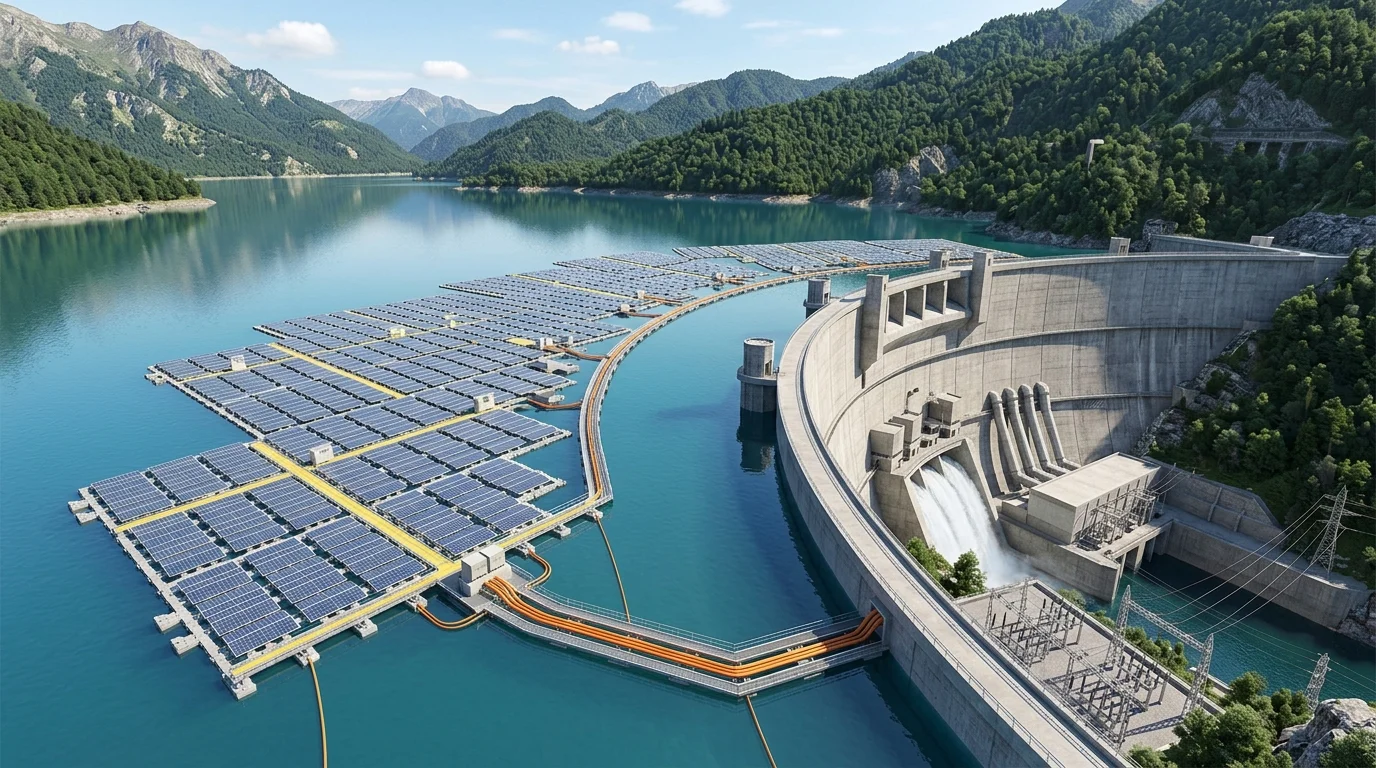
Solar panels and hydroelectric dams are two of the cleanest ways to generate electricity. Both have powered homes and businesses for decades. Yet both face distinct challenges in the real world. Solar power fades when the sun sets, and building huge solar arrays on dry land can take up valuable farmland or open wilderness. At the same time, hydroelectric dams often face water shortages and severe seasonal droughts.
Engineers have discovered a smart way to solve both problems at once. By floating thousands of solar panels on the water surface behind a hydroelectric dam, they created a hydro-solar hybrid power plant. This clean energy partnership uses the dam as a giant natural battery, protects precious freshwater from evaporating, and delivers steady electricity around the clock.
The Natural Partnership of Sun and Water
A hydroelectric dam already owns the most expensive parts of a clean energy project. It has large concrete structures, high-voltage transformers, transmission lines that connect directly to major cities, and skilled staff on site every day.
Building a traditional solar farm requires buying hundreds of acres of flat land, clearing trees, and constructing miles of new power lines. A hydro-solar hybrid skips these hurdles entirely. Floating panels sit directly on artificial lake water that was flooded decades ago.
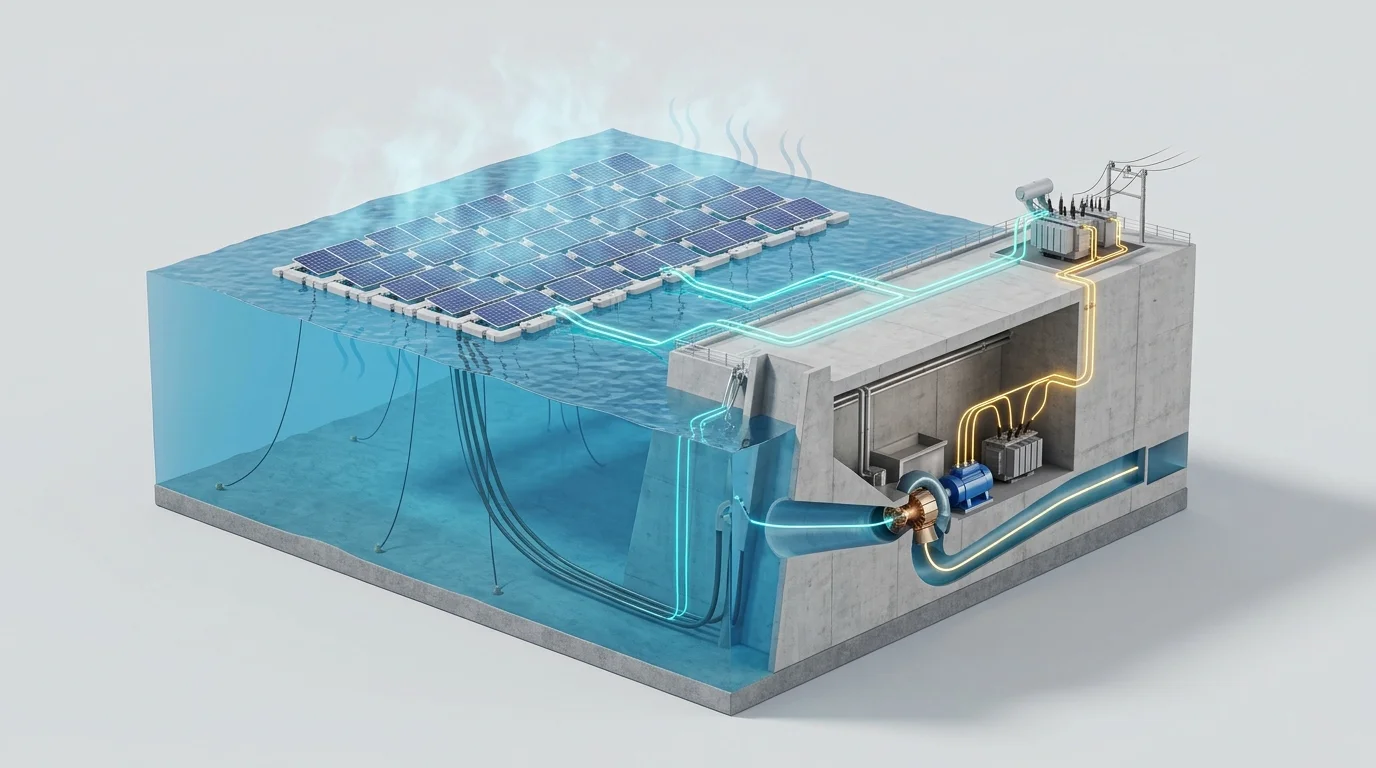
Heavy-duty underwater cables run from the floating arrays straight into the dam electrical switchyard. Because the transmission lines already exist, clean power reaches the electrical grid immediately. This setup can reduce the initial capital cost of a new solar project by up to twenty percent.
Why Floating Solar and Hydropower Make the Perfect Team
When floating solar arrays share water with a hydroelectric dam, both systems perform better than they would on their own.
- Water Evaporation Savings: In hot regions, baking sun rays cause reservoirs to lose billions of gallons of freshwater to the sky. Floating panels shade the water below. This shadow barrier cuts reservoir evaporation by twenty to thirty percent, preserving water for human drinking, crop irrigation, and hydroelectric generation.
- Natural Water Cooling: Silicon solar cells lose efficiency when they overheat on hot summer days. The cool lake water underneath cools the floating modules through natural convection. This cooling effect increases total solar energy production by ten to fifteen percent compared to dry ground arrays.
- Zero Land Conflicts: Land scarcity is a major barrier for clean energy projects. By deploying arrays across man-made lakes, developers avoid competing with farmers, livestock pastures, or native forest ecosystems.
- Healthier Water Quality: Direct sunlight striking calm lake water can trigger dangerous algae blooms. Shading parts of the reservoir blocks excess light, keeping the water cooler and limiting algae growth without harmful chemicals.
Hydro-Solar Hybrid vs. Ground Solar vs. Stand-Alone Hydro
To see why energy planners favor hybrid projects, let us compare how they stack up against single-source installations:
Hydro-Solar Hybrid
- Uses existing high-voltage dam transmission lines with zero land needed
- Acts as a 24/7 battery by storing water behind the dam during daylight
- Reduces reservoir water evaporation by up to thirty percent
- Natural water cooling boosts solar panel output in summer heat
Ground-Mount Solar
- Requires clearing forests or taking over agricultural fields
- Suffers efficiency drops during hot midday summer temperatures
- Requires building costly new high-voltage transmission corridors
- Generates power only during clear daylight hours
Stand-Alone Hydro
- Power generation drops during dry summer heatwaves and droughts
- Loses vast quantities of reservoir water to unshaded evaporation
- Cannot increase total output without building taller, costlier dams
- Depends heavily on annual rain and mountain snowpack patterns
The Day and Night Power Balance: A Virtual Water Battery
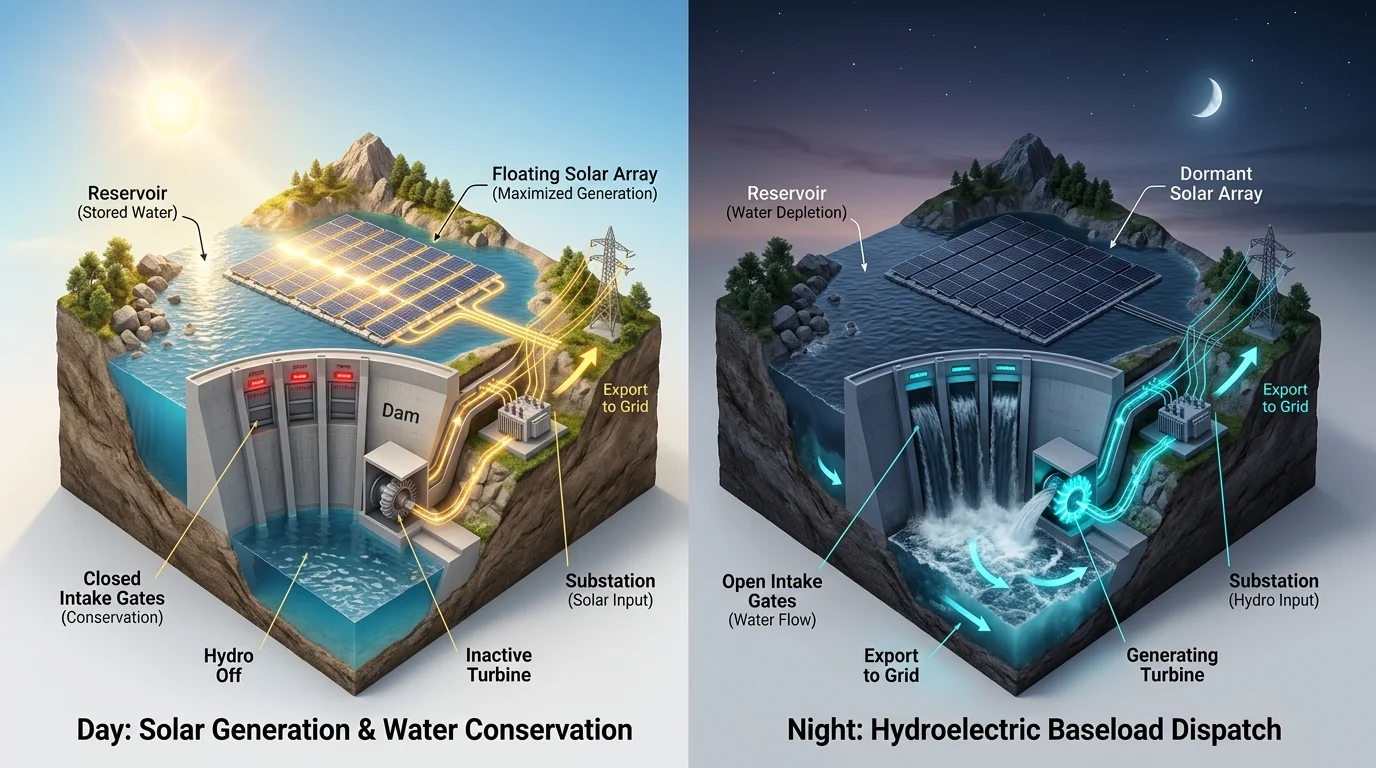
The biggest benefit of a hydro-solar hybrid system is its ability to smooth out power supply without buying giant chemical battery banks. The dam reservoir acts as a virtual water battery:
Daytime Solar Priority
When bright sunlight fills the sky, the floating solar array generates high volumes of electricity. Dam operators dial back the water turbines, closing gates and storing river water inside the reservoir.
Evening Hydro Dispatch
As the sun dips below the horizon, families turn on lights, cook dinner, and plug in electronics. With solar output tapering off, dam operators open the gates. Stored water rushes through spinning turbines to meet peak evening demand.
Seasonal Balance
During hot, rainless summer months, strong sunshine produces reliable solar electricity while water remains safely stored. During rainy seasons or winter runoff, hydroelectric generators operate at full capacity even beneath cloudy skies.
Global Flagship Projects Leading the Transition
Countries around the world are proving the value of hydro-solar hybrids at massive industrial scales:
- Kela Hydro-Solar Power Plant (China): Located in Sichuan Province, Kela is the largest hydro-solar hybrid project on Earth. Sitting at an altitude of 4,600 meters on the Yalong River, it features one gigawatt of solar capacity connected directly to the Lianghekou Hydropower Station.
- Sirindhorn Dam Hybrid Array (Thailand): The Electricity Generating Authority of Thailand built a forty-five megawatt floating solar system on the Sirindhorn reservoir. The array saves roughly 460,000 cubic meters of water from evaporating each year and serves as a model for fifteen more reservoir projects.
- Cirata Floating Solar Plant (Indonesia): Spanning 250 hectares on the Cirata hydroelectric reservoir in West Java, this 192-megawatt facility features 340,000 double-glass panels. It supplies electricity to more than fifty thousand homes while sharing the dam grid connection.
- Alqueva Reservoir Array (Portugal): Operating on the largest artificial lake in Western Europe, the Alqueva project pairs floating panels with pumped storage hydropower and lithium backup, providing a clean model for Southern European utilities.
Engineering Solutions for Moving Waters
Installing electrical equipment on a lake requires specialized engineering to withstand the elements:
- Water Level Changes: Unlike natural lakes, hydroelectric reservoirs rise and fall by ten to thirty meters throughout the year as water is released. Engineers use flexible mooring lines, weighted anchor blocks, and self-tensioning winches to keep floating platforms stable without snapping cables.
- Wind and Wave Resilience: Floating arrays use modular floats made of high-density polyethylene. These durable plastic pontoons flex with surface waves, while panels are angled at ten to twelve degrees to minimize wind drag during severe storms.
- Marine-Grade Electrical Systems: All junction boxes, inverter connections, and submerged wiring use IP68 waterproof ratings. Panels feature double-sided glass to stop moisture from penetrating internal circuits over twenty-five years of service.
Frequently Asked Questions
Studies show that moderate coverage, generally keeping arrays over less than twenty percent of the water surface, does not harm fish or plant life. In fact, partial shading keeps water cooler and prevents toxic blue-green algae blooms. The underside of floating pontoons often creates artificial reefs that provide shelter for small fish.
Reservoirs experience significant water level changes throughout the year. Engineers secure arrays using flexible anchoring lines attached to concrete lakebed anchors or shore winches. These elastic tethering systems expand and contract automatically as water levels rise and fall.
Standard silicon solar panels lose about 0.4 percent of their power output for every degree Celsius they heat up past room temperature. On hot summer days, ground-mounted panels can reach sixty degrees Celsius. Reservoir water provides constant evaporative cooling from below, keeping panels ten to fifteen degrees cooler and boosting total electricity yield.
Yes. Marine engineers design floating solar structures to withstand high winds and rough waves. The modular pontoons flex across the water surface like a floating mat, absorbing wave motion rather than resisting it. Low panel tilt angles also prevent gusts from lifting the platforms.